
Ground Calcium Carbonate (GCC) is one of the most widely used inorganic powder fillers in industry, with extensive applications in papermaking, plastics, rubber, coatings, and construction materials. As downstream industries demand higher precision in particle size, shape, and purity, choosing the right production process has become a core concern for investors and engineers. Currently, global Ground Calcium Carbonate production is primarily divided into the Dry Process and the Wet Process. These two methods differ fundamentally in their flowcharts, and the resulting products target different application sectors. This article provides an in-depth analysis of the characteristics, pros and cons, and core equipment for both technologies.
I. Dry Production Process: High Efficiency and Low Cost for Large-Scale Processing
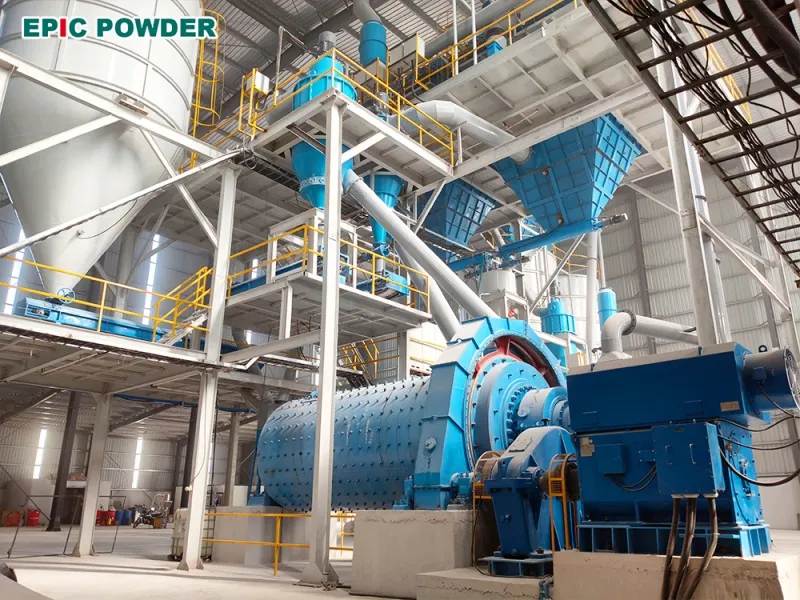
The dry process refers to the crushing and pulverizing of ore in a dry state. This is the mainstream method for Ground Calcium Carbonate production, especially for industrial-grade powders with D97 ≥ 5μm.
Process Characteristics
- Simple Workflow: No dehydration or drying is required; the finished product is packaged directly as powder.
- Lower Energy Cost: Compared to the wet process, the dry process saves significant thermal energy.
- Environmental Friendliness: It generates no industrial wastewater, and dust is strictly controlled through high-efficiency pulse dust collectors.
Core Equipment
The heart of the dry process lies in the closed-circuit circulation of “grinding” and “classifying.”
- Primary Crushing: Usually involves Jaw Crushers or Hammer Crushers to reduce large marble, calcite, or limestone blocks to 10–50 mm.
- Ultrafine Grinding Mill:
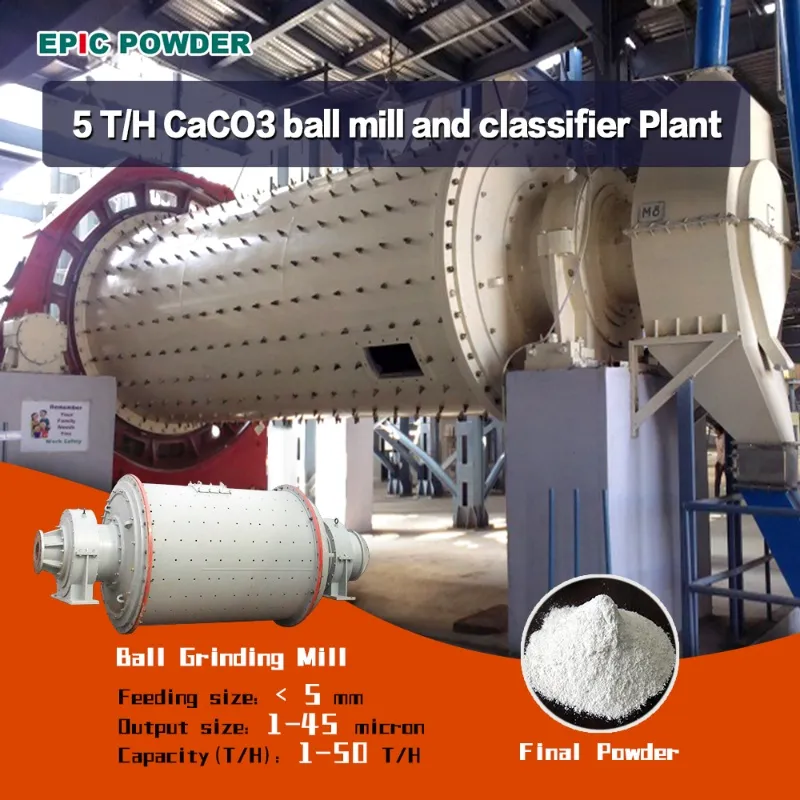
- Ball Mill: The most mature equipment for large-scale production, often paired with alumina or silica liners and grinding media to maintain whiteness.
- Vertical Roller Mill (VRM): Integrates crushing, drying, grinding, and classifying/conveying. It features high efficiency and massive single-machine capacity.
- Ring Roller Mill / Medium Speed Mill: A cost-effective choice for medium-fineness powder processing.
- Air Classifier Mill (MJW Series): Utilizes high-speed rotor impact with an integrated classifier wheel, ideal for products in the D97: 10–45μm range.
- Classification System: The Air Classifier is the soul of the dry process. Using centrifugal force and airflow, it separates qualified fine powder while returning coarse particles to the mill for regrinding.
II. Wet Production Process: Precision for Extreme Fineness
The wet process involves mixing GCC raw powder or marble chips into a slurry of a certain concentration and grinding it in a liquid medium. This process is primarily used for ultra-fine coating-grade or nano-grade powders where D98≤ 2μm.
Process Characteristics
- Extreme Fineness: Easily achieves nano-scale or sub-micron levels that are difficult for the dry process to reach.
- Uniform Particle Shape: Wet-ground particles tend to be spherical or polyhedral, providing better leveling properties in coatings.
- High Added Value: Products are mostly used in high-end coated paper, premium paints, and inks.
Core Equipment
Wet production is a sophisticated physical-chemical process.
- Pre-conditioning System: Includes dosing tanks and stirring tanks to mix ore powder with water and dispersants.
- Grinding Host:
- Stirred Mill (Attritor): Uses a stirring shaft to drive grinding media (such as zirconia or ceramic beads) at high speeds, creating high shear force.
- Horizontal Bead Mill: Achieves micro-refinement through violent collisions of grinding media in a closed vessel.
- Post-treatment System:
- Filter Press: Dehydrates the slurry into filter cakes.
- Flash Dryer / Spray Dryer: Dries the filter cake into dry powder, or the product is sold directly as a Slurry.
III. Dry vs. Wet: How to Choose?
Before deciding on a process route, enterprises should evaluate based on Target Market, Investment Budget, and Resource Conditions:
Fineness Requirements (The Key Indicator)
- If your target is 325 mesh to 2500 mesh (D97 ≥ 5μm), the Dry Process is the economical choice.
- If your target is above 6000 mesh (D97 ≤ 2μm) or requires extreme gloss and opacity, the Wet Process is virtually the only option.
Product Application
- Dry Products: Primarily used in plastic masterbatches, pipes, rubber filling, coating primers, etc.
- Wet Products: Primarily used in high-end paper coatings, water-based paints, and modification of polymer composites.
Economy and Environment
- Investment: Dry lines require relatively smaller investment and have shorter construction periods.
- Operating Cost: Dry processes have lower electricity consumption and no gas cost for drying. Wet processes have high power consumption and significant costs for dispersants and drying.
- Water Resources: Wet production requires a stable water supply and a wastewater treatment system.
IV. Industry Trend: The Combined Dry-Wet Process
To increase market flexibility, many large-scale enterprises now adopt a “Dry First, Wet Second” approach:
- Produce a coarse powder (D97: 20–30μm) using a Dry Ball Mill Classifying Line as raw material.
- Feed a portion of this coarse powder into a Wet Grinding System for deep processing into ultra-fine slurry.This allows the factory to supply both high-volume base markets and high-end precision markets simultaneously.
V. FAQ (Frequently Asked Questions)
Q: Are dry GCC and wet GCC fully interchangeable in downstream applications like plastics or coatings?
Answer: No.
- Particle Shape: Dry GCC is irregular and angular, which increases rigidity in plastics but may lower tensile strength. Wet GCC is more rounded with a narrow distribution, providing higher gloss and better flow.
- Oil Absorption: Wet GCC usually has lower oil absorption because of the uniform distribution and dispersants used. This allows for lower resin usage in coating formulas, reducing costs.
Conclusion
Choosing the Ground Calcium Carbonate production process is a strategic balance. The dry process is the battlefield of “Scale and Cost,” while the wet process is the competition for “Precision and Functionality.” Companies should scientifically configure Epic Powder‘s ball mill lines or wet grinding equipment based on their resource advantages and target customer needs to maximize production benefits.

“Thanks for reading. I hope my article helps. Please leave a comment down below. You may also contact Zelda online customer representative for any further inquiries.”
— Posted by Emily Chen