
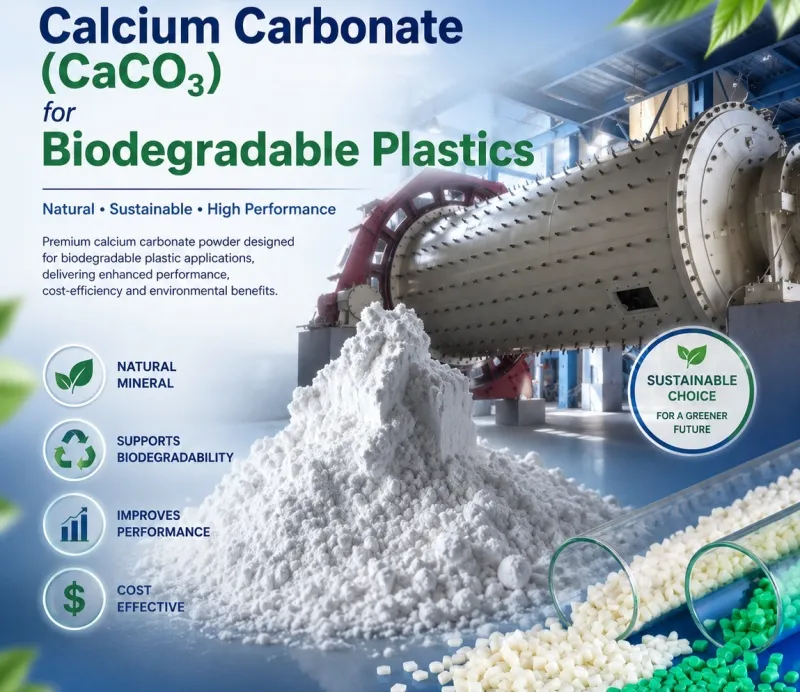
Calcium Carbonate Filler for Plastics (including both ground calcium carbonate and precipitated calcium carbonate) is currently the most widely used and highest-volume inorganic filler in the plastics industry. It is not merely a “supporting-role” filler, but rather a “performance modifier” that fine-tunes the properties of modified plastics. The key functions of calcium carbonate in plastics span four major dimensions: cost reduction and efficiency improvement, processing flowability, mechanical and physical properties, and appearance enhancement. The realization of these functions largely depends on the processing technology of upstream grinding equipment.
Four Core Functions of Calcium Carbonate Filler for Plastics
Cost Reduction and Efficiency Improvement (The Most Important Economic Function)
Direct substitution for cost reduction:
The price of calcium carbonate is significantly lower than that of synthetic resins such as PE, PP, PVC, and PS. By incorporating large amounts of Calcium Carbonate Filler for Plastics into plastic products, it can directly replace resin raw materials, greatly reducing overall formulation costs.
Optimized volumetric cost:
Calcium carbonate has a relatively high density. Although it may increase product weight under the same volume, scientific formulation in large-scale production of films, pipes, and injection-molded parts can maximize resin reduction and achieve extreme cost control using Calcium Carbonate Filler for Plastics.
Improved Processing Flowability and Forming Performance
Adjusting Melt Flowability:
Adding an appropriate amount of ultrafine calcium carbonate can improve the rheological properties of plastic melts and reduce melt viscosity. This reduces table torque in extruders and injection molding machines. This not only saves electricity but also increases extrusion/injection speed, significantly improving production efficiency.
Anti-Shrinkage and Improved Shaping:
Inorganic powders effectively suppress crystallization shrinkage, warping, and deformation after molding, significantly improving dimensional stability. This is especially important for injection housings, large-diameter pipes, and building panels when using Calcium Carbonate Filler for Plastics.
Smoother Demolding and Shorter Cycle Time:
As an inorganic rigid particle, calcium carbonate acts as a micro-lubricant within the mold cavity. This reduces product sticking to the mold and lowers the defect rate. Furthermore, due to its different thermal conductivity compared to plastics, it accelerates plastic cooling and shaping, shortening the production cycle and increasing capacity.
Improved Physical and Mechanical Properties
Increased Rigidity and Hardness:
Pure plastics are often too soft. After calcium carbonate is added, the flexural modulus, tensile modulus, and surface hardness of the plastic increase significantly. This makes it ideal for load-bearing products such as packing straps, plastic building formwork, and appliance casings.
Enhanced Heat Resistance:
Calcium carbonate itself has excellent thermal stability. Adding it significantly increases the no-load heat distortion temperature (HDT) of plastics. This makes the products less prone to softening and deformation at high temperatures.
Abrasion Resistance, Scratch Resistance, and Longer Lifespan:
When the powder is uniformly dispersed in the plastic, the surface abrasion resistance and scratch resistance of the product are enhanced. It also reduces the coefficient of thermal expansion of the plastic. This reduces precision errors in precision plastic parts caused by temperature changes and improves compressive creep resistance.
Optimized Appearance and Surface Properties
Low-Cost Matte/Gloss Finish:
An alternative to expensive chemical matte agents, achieved by controlling the particle size distribution of calcium carbonate. A high-end matte visual effect can be achieved at low cost on packaging films and appliance casings.
Adjusting Whiteness and Opacity:
Using high-whiteness heavy or light calcium carbonate significantly improves the overall whiteness and opacity of plastic products. It also greatly reduces the amount of expensive titanium dioxide (TiO2) required.
Improved Printability and Adhesion:
Pure plastic surfaces are inert and smooth, making them difficult to print on. The introduction of calcium carbonate increases the microscopic roughness of the plastic surface, resulting in stronger adhesion of printing inks, self-adhesive labels, and adhesives.
Eliminating Surface Defects:
It effectively reduces sink marks, flow marks, and bubbles on injection-molded surfaces, improving overall smoothness and texture when using Calcium Carbonate Filler for Plastics.
The Core Link: How Does Grinding Equipment Determine the Performance of Calcium Carbonate in Plastics?
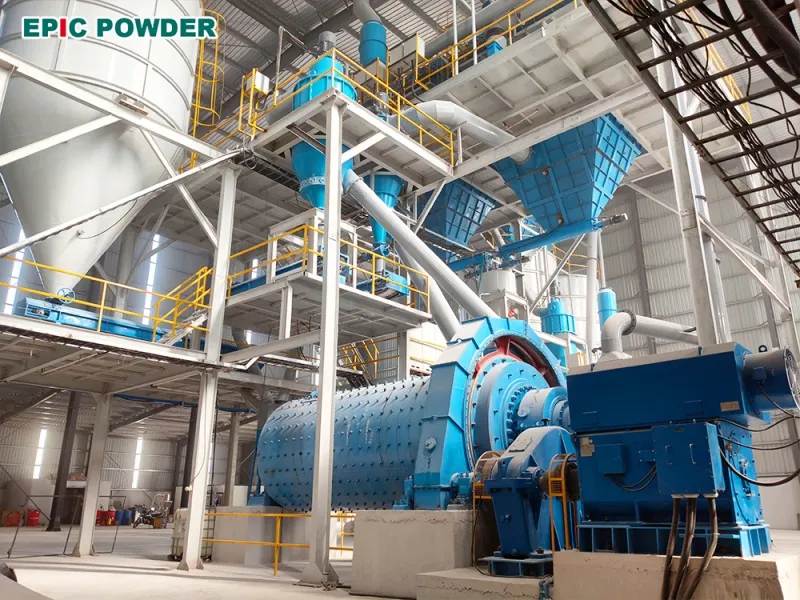
Whether calcium carbonate acts as a “reinforcing modifier” or a “performance-damaging impurity” in plastics hinges on its particle size (fineness), particle size distribution (gradation), and crystal morphology. This places extremely high demands on industrial grinding equipment.
Currently, calcium carbonate for the plastics industry is mainly produced using the following mainstream grinding equipment and systems:
- Ring roller mill / Ring roller micro-mill (suitable for: low- to mid-range plastic fillers)
In the plastics industry, the commonly used calcium carbonate particle size range is typically D50 = 0.5–10 μm. Different applications place different requirements on the equipment:
Injection molding and engineering plastics: Emphasis is placed on uniform particle size and low agglomeration (D50 1–3 μm)
PVC pipes and profiles: Emphasis is placed on high filling power and stable flowability (D50 2–5 μm)
Films and packaging materials: Emphasis is placed on dispersibility and transparency control (D50 < 2 μm) Achieving these specifications largely depends on the type of grinding equipment and the combination of processes. Currently, the mainstream equipment in the industry includes:
- Raymond Mill: Suitable for medium to fine powders (80–600 mesh), low investment but limited fineness, mostly used in basic heavy calcium carbonate powder production.
- Vertical Mill: Suitable for large-scale continuous production, low energy consumption, suitable for medium to fine powder systems.
- Ball Mill + Classifier System: Suitable for high whiteness and high fineness heavy calcium carbonate, with more controllable particle size distribution.
- Impact Mill/Ring Roller Mill: Suitable for mid-to-high-end plastic fillers, with significant improvement in particle shape.
- Jet Mill: Used for high-end ultrafine calcium carbonate, capable of producing micron or even submicron-sized powders, with high purity and low pollution.
- Stirred Mill: Suitable for high-value-added ultrafine fillers, with the narrowest particle size distribution. In high-end plastic applications, such as highly filled PVC, modified PP/PE, and biodegradable plastic systems, more and more companies are adopting integrated ball mill + classification + modification systems or dry ultrafine grinding systems to ensure stable particle size distribution and batch consistency.
Integration of Grinding + Surface Modification
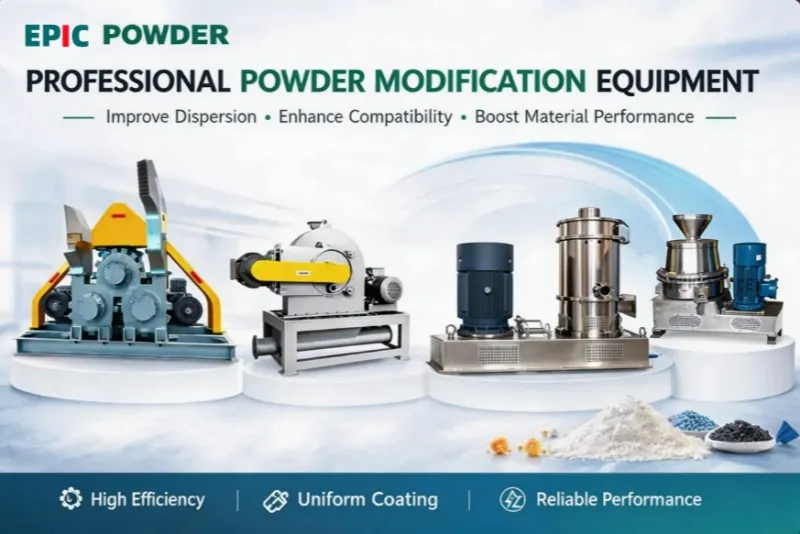
As the plastics industry moves towards higher filler content, higher performance, and lower costs, calcium carbonate processing has evolved from simple crushing to an integrated system combining grinding, classification, and surface modification.
For example, production lines using ball mill classification systems combined with continuous modifying machines. This allows for particle size control and surface hydrophobic modification within the same process chain. This results in better compatibility and dispersibility of calcium carbonate in PP, PE, PVC, and other systems.
Under this trend, grinding equipment is no longer merely a “powder-making tool,” but a core process unit that determines the effectiveness of plastic modification. Its technological level directly impacts the upper limit of the final material properties.
Conclusion
In the context of the calcium carbonate plastic modification industry, the development trend is toward higher fineness, higher performance, and more integrated processes. Grinding equipment has become a key factor that determines the upper limit of material performance.
As a technology company deeply engaged in the field of ultrafine powder processing, Epic Powder has long been dedicated to providing integrated solutions. These include ball mill classification systems, jet milling, classification systems, and surface modification systems. These solutions are designed for Calcium Carbonate Filler for Plastics applications.
These solutions support the application of ground calcium carbonate in plastics, PVC pipes, engineering plastics, and high-end packaging materials. They rely on stable and reliable processing equipment. Through precise particle size control and efficient classification technology, Epic Powder helps customers achieve lower energy consumption, higher filler loading, and improved product performance. This work continuously promotes the value upgrade and technological progress of inorganic fillers in the plastics industry. It is especially important for Calcium Carbonate Filler for Plastics applications.

“Thanks for reading. I hope my article helps. Please leave a comment down below. You may also contact Zelda online customer representative for any further inquiries.”
— Posted by Emily Chen