
Calcium carbonate, as the most abundant and lowest-cost inorganic powder filler, naturally exhibits strong hydrophilicity on its surface. However, it has poor compatibility with organic polymer matrices such as plastics, rubber, and coatings. Under high loading conditions, it tends to suffer from particle agglomeration, weak interfacial bonding, and reduced mechanical properties of final products. These issues have long been the core bottlenecks limiting the high-end application of calcium carbonate. Surface modification technology, through physical or chemical methods such as coating and surface functionalization, can purposefully alter the surface physicochemical properties of calcium carbonate powders. It is a key technological approach to solve compatibility issues, improve product added value, and promote calcium carbonate from a general-purpose filler to a functional material.
With the continuous improvement of performance requirements in downstream manufacturing industries, surface modification has become the most technically challenging and highest value-added link in the calcium carbonate deep processing industry chain.
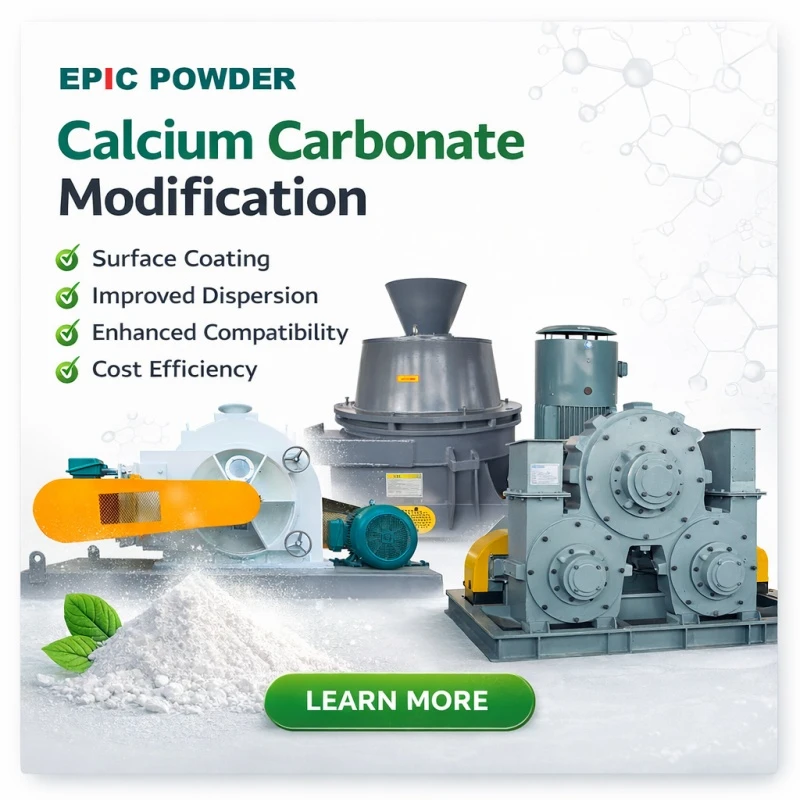
Core Mechanism and Functional Value of Calcium Carbonate Surface Modification
The essence of calcium carbonate surface modification is the adsorption, chemical bonding, or coating of modifier molecules on the particle surface, which reduces surface energy, adjusts hydrophilic/hydrophobic balance, and introduces specific functional groups for targeted performance optimization.
1. Improved Dispersion and Agglomeration Control
Calcium carbonate particle size decreases lead to higher surface energy and stronger Van der Waals forces, making aggregation more likely. Nano calcium carbonate is particularly prone to secondary agglomeration, preventing full utilization of nanoscale effects.
Surface modification forms steric hindrance and electrostatic repulsion between particles, effectively preventing agglomeration and significantly improving dispersion uniformity in both polymer matrices and solvents. This allows the full utilization of size-dependent effect
2. Improved Compatibility and Interfacial Strength
Unmodified calcium carbonate is hydrophilic and oleophobic, resulting in poor wetting with organic resins and weak interfacial bonding. Under external stress, it becomes a defect point in materials.
After modification, the surface becomes more hydrophobic and oleophilic, greatly improving compatibility with polymer matrices. Modifier molecules can form chemical bonds or physical entanglements with both inorganic particles and organic matrices, effectively transferring stress.
Thus, calcium carbonate shifts from an “inert filler” to an “active reinforcing filler,” maintaining mechanical performance even at high filler loadings.
3. Functionalization and Expanded Application Scope
By selecting different modifiers and coating processes, calcium carbonate can be endowed with functions such as flame retardancy, antibacterial properties, matting, conductivity, and thermal insulation.
This breaks its traditional single filler role and enables expansion into high-end applications, significantly increasing product value.
Main Calcium Carbonate Surface Modification Process Routes and Application Scenarios
Currently, calcium carbonate surface modification technologies can be divided into three main categories: dry modification, wet modification, and in-situ modification. These differ significantly in process principles, equipment investment, product positioning, and application scenarios.
Dry Modification Process
Dry modification is the most widely used industrial route, especially for large-scale processing of ground calcium carbonate (GCC).
In this process, dried calcium carbonate powder is fed into a high-speed mixer. Under high-speed stirring and controlled temperature, the modifier is sprayed and dispersed onto particle surfaces, where it is adsorbed or chemically reacts to form a coating layer. The final product is obtained after cooling and discharge.
Dry modification features simple process flow, low equipment investment, high efficiency, and relatively low energy consumption, making it suitable for large-scale continuous production. It is the mainstream method for producing general-purpose activated GCC.
However, dispersion uniformity of the modifier is more difficult to control, and coating thickness consistency is limited. It is mainly used for mid- to low-end modified products.
Wet Modification Process
Wet modification is carried out in a liquid-phase system and is commonly used in the production of precipitated calcium carbonate (PCC) and nano calcium carbonate.
In this process, the modifier is added directly into the slurry after carbonation. Under controlled temperature and stirring, the modifier adsorbs and deposits uniformly on particle surfaces. The product is then obtained through dewatering, drying, and grinding.
Wet modification provides more uniform dispersion and a denser coating layer, resulting in significantly better activity and dispersibility compared with dry modification. It is the core process for high-end nano calcium carbonate and functional calcium carbonate.
However, it involves longer processing routes, requires dewatering and drying equipment, has higher energy consumption, and generates wastewater treatment challenges.In-situ Modification Process
In-situ modification is an advanced integrated technology in which modifiers are introduced during nucleation and crystal growth of calcium carbonate.
The modifier participates in crystal growth, regulating morphology from the nucleation stage while simultaneously achieving surface modification. Products prepared via this method have controllable crystal structures, uniform coating, and excellent dispersion.
However, this process requires precise control, advanced equipment, and high technical expertise. It is mainly used for high-value specialty calcium carbonate in small-scale production and has not yet achieved large-scale industrial adoption.
Common Types of Modifiers and Downstream Application Logic
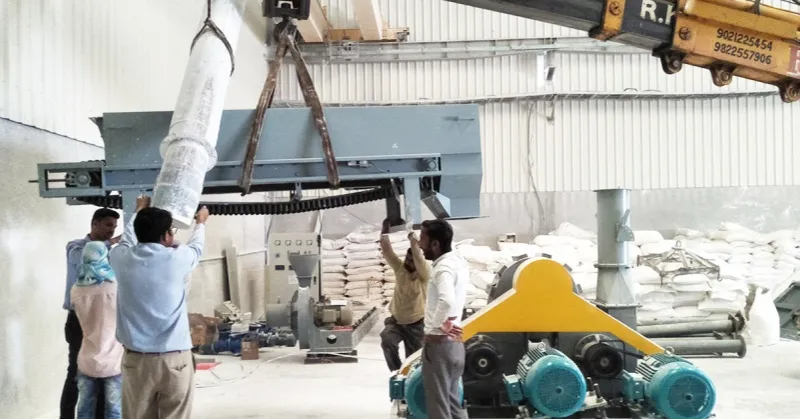
Modifiers are the most critical factor determining modification performance. Different types have different mechanisms and application systems.
1. Fatty Acid and Metal Soap Modifiers
Stearic acid and its salts are the lowest-cost and most widely used anionic modifiers.
Their carboxyl groups chemically adsorb or react with calcium carbonate surfaces, while hydrophobic alkyl chains extend outward, imparting hydrophobicity.
They are widely used in PVC pipes, profiles, shoe soles, and other mid- to low-end plastic products.
However, they have relatively weak bonding strength and limited high-temperature resistance, making them unsuitable for high-end engineering plastics.
2. Coupling Agents
Coupling agents are the mainstream modifiers for high-performance calcium carbonate, including titanate, aluminate, and silane coupling agents.
They contain both inorganic-affinity and organic-affinity functional groups, forming a molecular bridge between phases and significantly enhancing interfacial bonding.
- Aluminum ester coupling agents: widely used in plastics due to balanced cost and performance
- Titanate coupling agents: better reinforcement, used in rubber and engineering plastics
- Silane coupling agents: widely used in coatings and adhesives
Although performance is superior, cost and process control requirements are higher.
3. Polymer Coating Modification
Polymer coating involves grafting or coating a polymer layer onto particle surfaces, significantly improving compatibility with polymer matrices.
The coating layer enables molecular entanglement with resin systems, enhancing interfacial strength, weather resistance, and chemical stability.
It is widely used in high-end engineering plastics, automotive plastics, and premium coatings, but has higher cost and process complexity.
4. Composite Modification Systems
Composite modification combines multiple modifiers such as fatty acid salts, coupling agents, and dispersants to achieve synergistic effects.
It balances performance and cost and is becoming a major industry trend for segmented applications.
Downstream Applications and Development Trends of Modified Calcium Carbonate
Different industries require different performance characteristics, leading to differentiated modification strategies.
Plastics Industry
The plastics industry is the largest application field.
- General plastics: stearic acid-modified GCC for cost reduction
- PVC pipes and automotive plastics: aluminate/titanate coupling agents for strength and processability
- Engineering and biodegradable plastics: polymer-grafted calcium carbonate for stability at high loading
Rubber Industry
Rubber applications require reinforcement performance.
Nano and fine calcium carbonate modified with coupling agents is used to improve tensile strength, tear resistance, and wear resistance. It also helps achieve color lightening while maintaining performance.
Coatings and Adhesives
These industries prioritize dispersion, stability, and rheological properties.
Silane coupling agents or composite-modified ultra-fine calcium carbonate are commonly used to ensure storage stability and film performance.
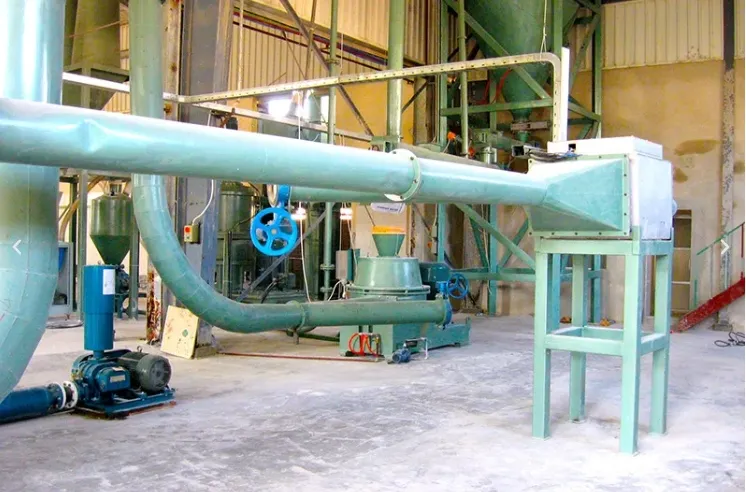
Industry Development Trends
Surface modification technology is evolving toward three main directions:
1. Customized Modification
Tailor-made formulations for specific downstream needs, enabling “one product–one formula” precision design.
2. Green Modification
Development of water-based and bio-based modifiers to reduce VOC emissions and environmental impact.
3. High Efficiency and Intelligent Control
Use of online monitoring and automated systems to precisely control coating uniformity and efficiency.
Conclusion
Surface modification technology has fundamentally reshaped the value structure of the calcium carbonate industry, enabling low-cost natural minerals to meet the performance requirements of high-end manufacturing.
As a core technological barrier in deep processing, its continuous evolution drives industrial upgrading and differentiation.
In the future, with the development of advanced materials industries, more efficient, functional, and environmentally friendly modification technologies will continue to emerge, pushing the calcium carbonate industry toward higher value-added development.

“Thanks for reading. I hope my article helps. Please leave a comment down below. You may also contact Zelda online customer representative for any further inquiries.”
— Posted by Emily Chen