
As global “plastic bans” gain momentum, biodegradable plastics represented by PLA (Polylactic Acid) and PBAT (Polybutylene adipate terephthalate) have become core materials in fields such as green packaging and ecological agriculture. However, due to challenges like high raw material costs and unstable processing performance, calcium carbonate (CaCO3)—as an abundant, eco-friendly, and low-cost inorganic mineral filler—has become the “golden partner” for the modification of biodegradable plastics.
In production practice, the core concern for manufacturers is often: “Exactly how many mesh of calcium carbonate is suitable?” Behind this question lies not only financial cost logic but also complex interface chemistry—specifically, how particle size affects dispersion within the polymer matrix, which in turn determines the mechanical strength and degradation efficiency of the finished product.
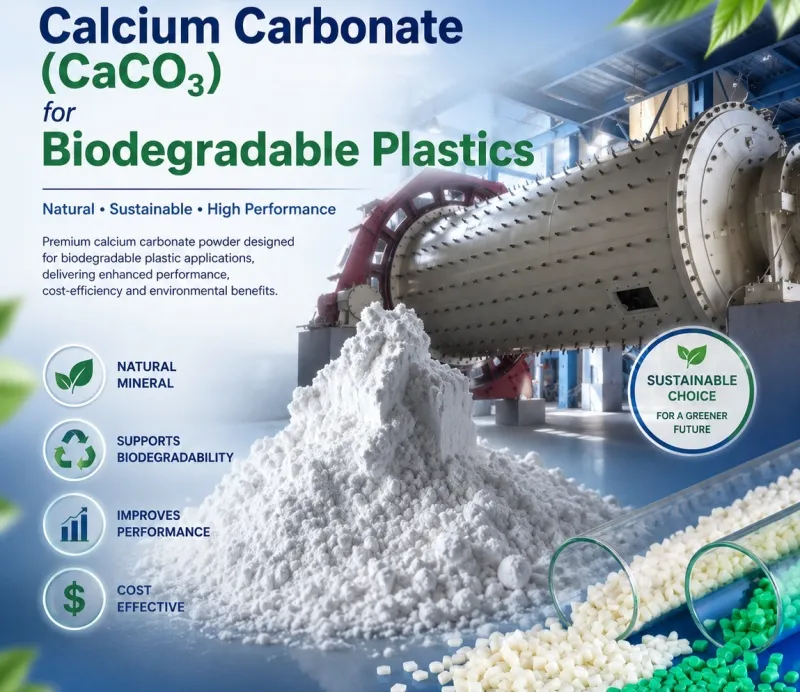
I. The Core Value of Calcium Carbonate in Biodegradable Plastics
- Reducing Terminal Costs: Biodegradable resins are expensive. Filling them with 30%–40% calcium carbonate(CaCO3) can significantly offset raw material costs, making green products more market-competitive.
- Mechanical Compensation and Toughening: Pure PLA suffers from high brittleness. Ultra-fine calcium carbonate particles act as “heterogeneous nucleating agents,” inducing resin crystallization, thereby improving the tensile strength and impact resistance of the product.
- Regulating the Degradation Environment: Calcium carbonate is weakly alkaline and can neutralize acidic oligomers produced during PLA degradation. This prevents acid accumulation that leads to premature degradation or local corrosion, while the micropores formed by particle detachment facilitate microbial erosion.
- Improving Processing and Texture: It enhances melt stability and imparts a paper-like matte texture and excellent printing performance to the plastic.
II. The Deep Relationship Between Particle Size (Mesh) and Dispersion
In the field of plastic modification, “mesh” directly corresponds to the fineness of the particles.
1. Definition and Application Performance of Different Mesh Sizes
- 800–1250 Mesh (General Grade): Larger particle size, mostly used for thick injection-molded parts (e.g., cutlery, thickened trays). The advantage is extremely low cost, but it reduces the transparency and tear resistance of films.
- 1500–2500 Mesh (Ultra-fine Grade): The mainstream specification for biodegradable shopping bags and roll bags. This range balances cost and performance, ensuring a delicate surface for the film material.
- 3000–6000 Mesh (Nano/Functional Grade): High-performance fillers. Their enormous specific surface area allows for strong interface bonding with the resin, providing significant reinforcement, but they require extremely high dispersion processes.
2. The Challenge of Dispersion
“Dispersion” refers to the process of transforming powder from an agglomerated state into single particles uniformly distributed within the resin.
- Finer Particles, Stronger Agglomeration: When particle size enters the range above 3000 mesh, Van der Waals forces and electrostatic attraction between particles increase exponentially, making the powder highly prone to “secondary agglomeration.”
- Damage to Products from Agglomeration: Undispersed calcium carbonate agglomerates appear as “fish eyes” or “grit” in films. During stretching, these act as stress concentration points, causing holes or breakage in the film.
III. How to Choose Mesh Size for Biodegradable Plastics?
Selecting the mesh size should follow the “Product Thickness Matching Principle”:
- Ultra-thin Films (10μm–30μm): Recommended 2500–5000 mesh. Since the film is extremely thin, the filler particle size must be much smaller than the film thickness; otherwise, it will severely damage the continuity of the film surface.
- Thermoforming Sheets (Lunch boxes, Trays): Recommended 1250–2000 mesh. These products are thicker, and the focus is on improving rigidity and heat resistance. This mesh range offers the best cost-performance ratio.
- Engineering Injection Parts (Cutlery, Accessories): Recommended 800–1500 mesh. The focus is on reducing shrinkage rate; coarser powder provides better processing flowability.
IV. Core Production Solution: Ball Mill + Classification Process for Precise Specification Control
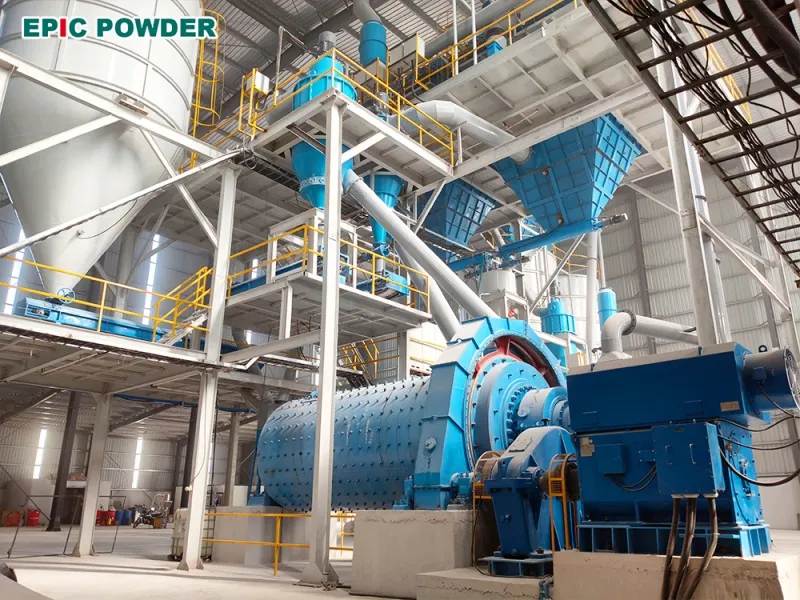
For the ultra-fine, narrow-distribution calcium carbonate (CaCO3) required by biodegradable plastics, the “Ball Mill + High-Precision Air Classifier” is currently the core mature solution for large-scale industrial production.
1. Technical Advantages of the Ball Mill Classification System
The ball milling process differs from traditional impact crushing; it uses the grinding and stripping action of grinding media (ceramic or steel balls) to produce powder with a rounder shape and more uniform particle size distribution.
- High-Precision Classification: The ground powder passes through an ultra-fine classifier. The speed of the classification rotor can be adjusted to precisely “cut off” coarse particles, ensuring D97 strictly meets the standard and effectively eliminating fish eyes in film processing.
- Large-scale Production: The ball mill system is highly stable and suitable for 24-hour continuous operation, making it the top choice for high-capacity production of 1500–3000 mesh ultra-fine powder.
2. “Grinding & Modification Integration” Process Design
At the rear end of the ball mill system, a spray modification device is usually integrated.
- Surface Coating: Calcium carbonate (CaCO3) remains in an active state after classification and immediately enters the modification machine for coating treatment.
- Low Moisture Control: The closed-loop ball mill system effectively controls powder moisture. For materials sensitive to water like PLA, the hot air drying function of the system can keep the final moisture content below 0.2%, preventing resin hydrolysis during processing.
3. Jet Mill
For extremely high-requirement applications (such as medical biodegradable suture fillers), supersonic airflow is used to make particles collide and crush themselves.
- Features: No metal contamination, extremely fine particle size (D50) can reach below 2μm), but energy consumption is higher.
V. Key Enhancement Tool: Active Modification
Regardless of the mesh size, untreated calcium carbonate (CaCO3) is “hydrophilic and oleophobic,” making it extremely difficult to fuse with “oleophilic” PLA/PBAT.
- Chemical Coupling: Stearic acid or aluminate coupling agents must be used to modify the surface of the calcium carbonate. Modified powder has lower frictional resistance and better wettability within the resin.
- Dispersion Verification: Excellent modified powder should “float” in water while rapidly sinking and dispersing uniformly in organic solvents. This directly determines its compatibility during plastic granulation.
VI. Summary and Outlook
In the field of biodegradable plastics, “the higher the mesh, the better” is not the rule; “suitability is best.”
- For high-quality films, purchase 2500–3000 mesh active calcium carbonate produced via the Ball Mill + Classification process.
- For extreme cost efficiency, 1250 mesh modified powder can be selected.
With continuous progress in calcium carbonate processing technology, high-capacity and intelligent ball milling production lines are helping the biodegradable plastics industry cross the cost threshold, allowing “green materials” to truly enter thousands of households.
(Note: This article is provided by the Epic Powder Technical Center, dedicated to providing you with the most professional industrial powder processing solutions.)

“Thanks for reading. I hope my article helps. Please leave a comment down below. You may also contact Zelda online customer representative for any further inquiries.”
— Posted by Emily Chen