
In the industrial minerals sector, ground calcium carbonate (GCC) is no longer a simple, inert filler. It is no longer used merely to cut raw material costs. Today, it is engineered as a highly functional additive. Manufacturers utilize it across premium paper coatings, breathable plastic packaging, automotive sealants, and architectural paints. The performance of GCC in these advanced applications depends entirely on one critical metric: Particle Size Distribution (PSD). It is not enough for a mill to achieve a specific average fineness; the entire spectrum of particles—from the largest grains (top cut) to the ultra-fine dust—must be strictly managed. Tight control over this distribution profile ensures optimal optical properties, perfect mechanical strength, and predictable oil absorption in downstream manufacturing. This comprehensive technical guide explores the exact mechanisms, machinery tuning, and process engineering required to precisely control PSD within a modern calcium carbonate production facility.
The Anatomy of Particle Size Distribution (PSD)
To effectively control PSD during calcium carbonate production, engineers must move beyond the traditional “mesh size” nomenclature and focus on statistical curve metrics. A standard laser diffraction PSD report typically tracks three key values:
- d97 (or Top Cut): The particle size diameter at which 97% of the mass of the powder sample is smaller. This value defines the absolute largest particles present and is critical for applications like plastic films, where a single oversized grain can cause a tear or pinhole puncture.
- d50 (Median Diameter): The split point where exactly 50% of the powder mass is finer and 50% is coarser. This indicates the central tendency of the product.
- The Steepness Factor (Slope): Calculated using ratios such as (d50 / d20) \times 100 or (d90 – d10) / d50. A high steepness factor means the particles are tightly clustered around the median size, while a low steepness factor signifies a broad distribution containing an irregular mix of massive grains and sub-micron dust.
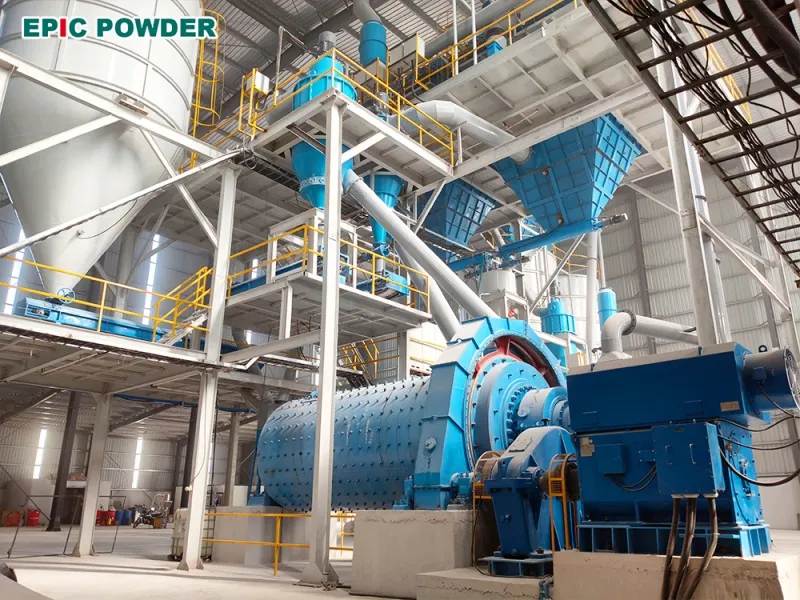
Primary Variables for Controlling PSD
Achieving a highly reproducible, narrow PSD requires balancing mechanical force, air dynamics, and raw material behavior. The following parameters serve as the primary control levers in a commercial calcium carbonate production line.
A. Air Classifier Dynamics (The Ultimate Gatekeeper)
In dry ultra-fine grinding circuits, the mill itself does not establish the final PSD curve. That responsibility falls to the high-efficiency rotor air classifier. This machine operates on a delicate balance between two opposing physical forces:
- Centrifugal Force: Generated by the rapid rotation of the classifier wheel, pushing larger, heavier particles outward away from the product stream.
- Drag Force (Centripetal Airflow): Created by the system’s main draft fan, drawing smaller, lighter particles inward through the wheel blades toward the cyclone collector.
To adjust the d97 and steepen the PSD curve, operators must manipulate the Rotor Speed (RPM) and the System Air Volume (m3/h). Increasing the rotor speed increases centrifugal force, rejecting finer particles and lowering the top cut (d97). Conversely, increasing the airflow increases drag force. This carries slightly larger particles through the wheel and shifts the entire PSD curve to the coarser side.
B. Grinding Media Optimization (Ball Mill Systems)
For factories utilizing continuous ball mill circuits, the composition of the grinding media directly influences the distribution profile. A ball mill breaks calcite crystals through a combination of impact (heavy balls dropping) and attrition (small media rubbing together).
- Media Size Grading: To achieve a narrow, ultra-fine PSD, a graduated “ball charge recipe” is mandatory. Large balls (40mm – 50mm) are needed to break down the incoming coarse feed. However, the media mix must not lack smaller balls (15mm – 20mm). Without them, the micro-gaps within the mill become too large. This allows semi-coarse particles to slip through without being polished, resulting in a broad, low-quality PSD curve.
- Media Material: Transitioning from traditional forged steel balls to high-density alumina or zirconia ceramic beads increases the number of micro-contact points per cubic meter, leading to a much higher concentration of fine particles and a steeper slope.
C. Mill Material Loading & Retention Time
The volume of material held within the grinding chamber at any given second alters how energy is distributed.
- Under-loading: If the feed rate is too low for the air volume, particles spend too much time inside the mill. They suffer from continuous “over-grinding,” creating an excessive volume of sub-micron ultra-fine dust. This might seem highly refined, but excessive dust spikes oil absorption rates. This spike renders the powder useless for many polymer compounding applications.
- Over-loading: Excessively high feed rates create a thick cushion of powder that dampens the mechanical impacts of the rollers or balls, leading to poor liberation and a highly irregular, coarse-heavy distribution.
Designing a Closed-Loop System for PSD Precision
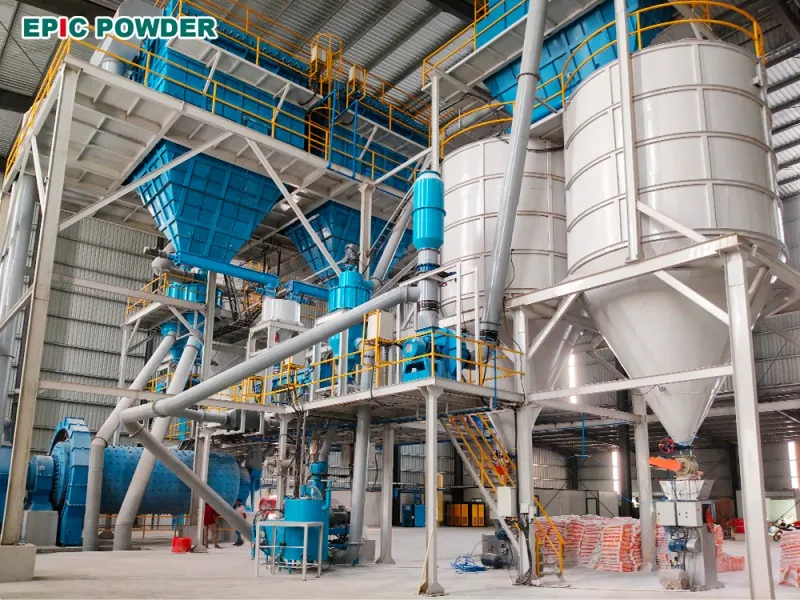
In modern calcium carbonate production, open-circuit grinding (where material passes through a mill once and goes straight to packaging) is obsolete for technical grades. Precise PSD control is only achievable through a tightly regulated Closed-Loop Circuit.
    [ Raw Calcite Feed ]
            │
            ▼
     ┌──────────────┐
  ┌─>│ Grinding Mill│
  │  └──────┬───────┘
  │         │ (Milled Discharge)
  │         ▼
  │  ┌──────────────┐
  │  │Air Classifier│
  │  └──────┬───────┘
  │         │
  │         ├─► [Rejected Coarse / Oversize] ──┐
  │         │                                  │
  │         └─► [Passed Fine Product Stream]   │
  │                                            │
  └────────────────────────────────────────────┘
In this setup, the mill discharges a broad-spectrum powder directly into the air classifier. The classifier strips away the exact particle profile demanded by the customer and immediately routes the rejected coarse material back into the mill inlet. By continuously recirculating the oversize fraction, the system avoids over-grinding, lowers energy draw, and maintains an incredibly consistent, stable particle slope hour after hour.
Technical Deep-Dive: Questions & Answers
Achieving real-world stability in a processing plant means navigating unexpected material science challenges. Below are two vital engineering questions regarding PSD control during industrial operations.
Question 1: How does moisture content in the raw calcite feed disrupt the air classifier’s ability to control PSD, and how can operators mitigate this?
Answer:
Moisture is one of the most disruptive enemies of precise particle size management in dry calcium carbonate production. Even a minor increase in raw material moisture—moving from 0.2% to over 1.0%—can completely degrade the accuracy of an advanced air classifier.
When ultra-fine calcium carbonate particles encounter moisture, capillary forces overcome standard aerodynamic forces. The particles begin to stick to one another, forming soft agglomerates.
- The Classifier’s Blind Spot: These fine particles clump together into clusters. When they reach the air classifier wheel, the machine treats the cluster as a single massive particle. This error happens due to the cluster’s combined weight and surface area. The classifier’s centrifugal force flings the cluster into the coarse reject stream, sending perfectly good, pre-milled fine powder back to the mill for unnecessary re-grinding.
- System Blinding: Simultaneously, moist powder cakes onto the classifier rotor blades and clogs the collection cyclones, altering the internal aerodynamics and causing the d97 top cut to wander erratically.
The Solution: To maintain total control over your PSD curve, a multi-layered drying approach must be integrated:
- Raw Material Pre-Drying: Store raw crushed calcite in covered, ventilated silos and utilize rotary drum dryers before feeding the milling circuit if the quarry faces high seasonal rainfall.
- Hot Air Integration: Inject clean, hot air generated by an upstream burner directly into the mill or the air classifier loop. Operating the classifier circuit at an internal temperature of 60°C – 80°C flashes off residual surface moisture instantly, flash-deagglomerating the powder so individual grains can be categorized accurately by the rotor.
Question 2: Why does an extremely narrow PSD curve (high steepness) lower operating costs for plastic masterbatch manufacturers, and how do you tune a mill to achieve it?
Answer:
Plastic compounding plants (especially those making breathable PE films or PVC profiles) require calcium carbonate with an incredibly strict “sweet spot” size. They want minimal large particles (d97) must be razor-sharp to prevent film tearing) and minimal ultra-fine dust (sub-micron dust absorbs expensive polymer binders and lubricants, driving up production costs). A steep PSD curve ensures they only pay for highly effective filler particles.
To tune your calcium carbonate production line to achieve this premium, high-steepness curve, you must balance the “Circulation Factor” and the “Classifier Rotor Wheel Design.”
- Increase the Circulation Factor: Do not try to grind the powder down to its final size in a single pass. Instead, increase the air velocity and feed rate to run a high circulation ratio. For example, recycle 3 to 4 tons of material for every 1 ton of finished product collected. Passing material through the mill quickly ensures it receives just enough impact to break along crystal boundaries without crumbling into fine dust. The efficient classifier removes the target size immediately, preserving the narrow slope.
- Rotor Blade Optimization: Use a classifier wheel with thin, tightly spaced, aerodynamically optimized blades. This minimizes local air turbulence around the rim of the wheel, ensuring a clean, uncompromised physical division between the accepted fines and rejected coarse grains.

Summary Control Reference Guide
To help production managers quickly troubleshoot deviations in their product profiles, use this operational response matrix:
| Desired PSD Shift | Primary Machine Action | Secondary Process Adjustment |
| To lower the Top Cut (d97) (Make the maximum size finer) | Increase the Classifier Rotor Speed (RPM) | Reduce system airflow slightly to minimize drag pull through the wheel. |
| To eliminate fine dust (d10) (Steepen the distribution slope) | Increase the raw feed rate / decrease residence time | Increase system air volume to sweep out target particles faster. |
| To handle highly abrasive calcite (Prevent PSD drift from wear) | Install alumina ceramic or tungsten carbide liners | Routinely check classifier blade tolerances for erosion every 500 operating hours. |
| To increase overall system yield (Maintain fixed d50 specs) | Transition to high-density ceramic grinding media | Fine-tune the variable frequency drive (VFD) on the main fan to maintain a constant system pressure drop. |
Conclusion
Controlling the particle size distribution in calcium carbonate production is not a static calculation; it is a dynamic balancing act. By combining a highly responsive, multi-wheel air classifier with a closed-loop milling system, operators can isolate the precise grain profiles demanded by high-tier modern industrial buyers.
Invest in robust automation, such as continuous online laser diffraction particle analyzers. These systems feed real-time data back to the classifier’s variable frequency drives. This setup enables a plant to instantly self-correct for raw feed variations. This level of process control minimizes energy waste, prevents product rejections, and maximizes the market value of every ton of calcite pulled from the quarry.

“Thanks for reading. I hope my article helps. Please leave a comment down below. You may also contact Zelda online customer representative for any further inquiries.”
— Posted by Emily Chen