
Ultrafine calcium carbonate (ultrafine/nano calcium carbonate) is a critical industrial filler. It is widely used in modern polymer composites, high-end plastic masterbatches, and the rubber and coatings industries. It provides both toughening and modification effects while reducing production costs, making it an indispensable raw material in these fields.
To improve its dispersibility and compatibility within polymer matrices, industrial producers must carry out surface coating modification using agents such as stearic acid, titanates, or silane coupling agents. Yet in actual production, many manufacturers face a major technical paradox: the coating process intended to eliminate agglomeration often intensifies secondary agglomeration due to improper operation during modification.
How can manufacturers completely suppress powder agglomeration during the coating modification process and achieve uniform single-particle-level coating? This article provides an in-depth analysis of industrial-grade anti-agglomeration solutions from four dimensions: physical shear, thermodynamic control, coating agent dispersion, and overall equipment system configuration.
I. Causes of Agglomeration: Why Does Ultra-Fine Calcium Carbonate Easily “Clump Together” During Coating?
To solve agglomeration, it is first necessary to understand the physical mechanisms behind it. The agglomeration of ultra-fine calcium carbonate during coating is mainly caused by the combined effects of the following three factors:
1. Van der Waals Forces and Electrostatic Attraction
When calcium carbonate particles reach the micron or submicron level, the distance between particles becomes extremely short. At this scale, intermolecular van der Waals forces become much stronger than the particles’ own gravitational force. Meanwhile, electrostatic charges generated during mechanical grinding or pneumatic conveying can further attract particles toward each other.
2. Coating Agent Agglomeration (“Over-Coating” Effect)
If the dosage of coating agents such as stearic acid is too high, or if the melting is uneven, the coating agent itself can become a solid “glue,” forcibly bonding originally dispersed calcium carbonate particles together and forming hard secondary agglomerates.
3. Moisture and Capillary Forces
Ultra-fine powders are highly hygroscopic. If the raw powder or system air contains excessive moisture, even trace amounts of water can form “liquid bridges” between particles. During subsequent heating and coating processes, these bridges dry and solidify, forming hard agglomerates that are extremely difficult to disperse.
II. Core Strategy 1: Achieve “Atomic-Level” Uniform Atomization of the Coating Agent
Traditional coating-agent feeding methods often involve directly adding solids or coarse liquid streams, which is disastrous for ultra-fine powder modification. To prevent the coating agent from becoming an adhesive that promotes agglomeration, highly efficient dilution and fine atomization of additives are essential.
Precision Twin-Fluid Atomization System
The coating agent (such as stearic acid) must first be heated until completely molten and then atomized into ultra-fine droplets using high-pressure air (or nitrogen) through a twin-fluid nozzle. The droplet size after atomization should be as close as possible to—or even smaller than—the particle size of calcium carbonate.
Batchwise and Continuous Micro-Dosing
The atomized coating agent must contact the powder in an extremely uniform ratio so that coating-agent molecules rapidly form a monomolecular layer on the calcium carbonate surface. This prevents localized overfeeding, which can lead to sticking and agglomeration.
III. Core Strategy 2: Provide Instantaneous, Intense, and Dead-Zone-Free Physical Shear Force
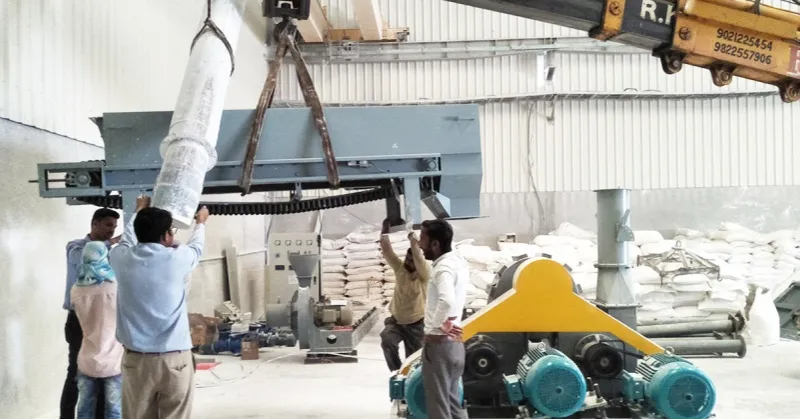
Mechanical dispersion is the key to breaking initial agglomerates and creating opportunities for coating. Static or low-speed mixing equipment simply cannot overcome the van der Waals forces between micron-scale powders. Efficient dynamic impact and shear mechanisms must therefore be introduced.
In continuous production lines, the use of the Epic Powder continuous three-roller coating machine system is recommended. Its anti-agglomeration logic lies in the following principles:
Fluidized Conveying State
Under the combined action of mechanical force and airflow, the material enters a highly dispersed “fluidized bed” state inside the coating chamber. Particles are fully separated from one another, maximizing interparticle distance.
Instantaneous Shear and Impact
The high peripheral speed rotating coating rotor provides extremely strong shear force to the powder. Within the fraction of a second when the initial agglomerates are stripped apart by mechanical force, the atomized coating agent immediately penetrates and adsorbs onto the newly exposed particle surfaces, locking the dispersed state in place and leaving no time window for secondary agglomeration.
IV. Core Strategy 3: Strict Control of Thermodynamic Parameters (Temperature Control Curve)
The thermodynamic environment during coating directly determines the activity of coating-agent molecules and the fluid properties of the material.
Temperature Control in the Main Coating Zone
Taking stearic acid coating as an example, the internal system temperature must be stably maintained between 100°C and 120°C.
- If the temperature is too low, stearic acid cannot fully melt or react completely, leading to physical entrapment and agglomeration.
- If the temperature is too high, the coating agent may thermally degrade, or excessive thermal motion on the powder surface may reduce the coating efficiency.
Rapid Downstream Cooling Mechanism
The modified powder must never accumulate while still hot after coating. At elevated temperatures, unreacted free coating agents remain sticky.
Therefore, the system must be equipped with an airflow cooling and conveying system capable of reducing the finished product temperature to below 60°C within seconds. This allows the coating layer to rapidly solidify and stabilize, completely eliminating “thermal compression agglomeration” caused by hot material stacking.
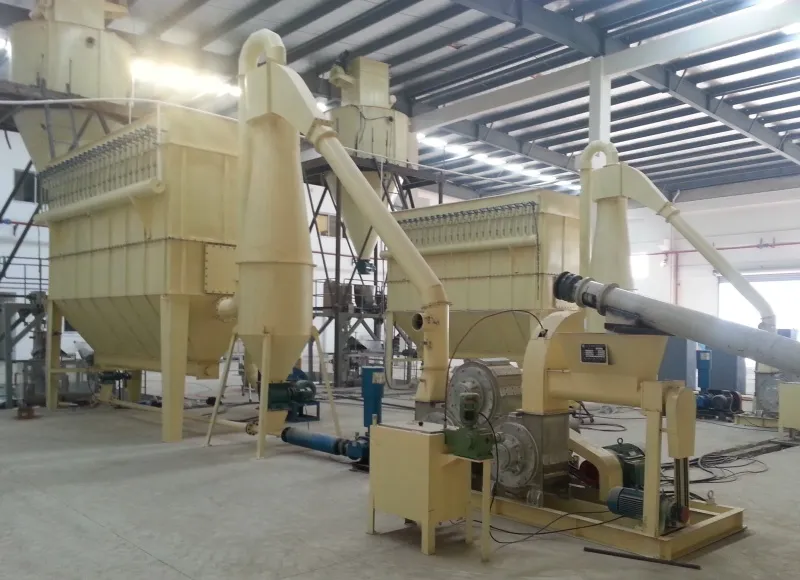
V. Core Strategy 4: Overall Process Coordination and Detailed System Design
Preventing agglomeration is a systematic engineering project. Beyond the coating machine itself, the design of upstream and downstream auxiliary systems also determines the final activation rate and dispersion performance.
1. Continuous and Stable Loss-in-Weight Feeding System
Ultra-fine calcium carbonate powder is extremely light and prone to bridging. Conventional screw feeders often generate pulsating feeding behavior—sometimes too much material, sometimes too little.
Anti-Agglomeration Design
The system must incorporate a weighing-type loss-in-weight feeder to ensure that powder enters the coating chamber at an absolutely constant volumetric flow rate. This enables a perfect balance between the atomized coating agent and powder in terms of gas-solid ratio and material-agent ratio.
This prevents:
- uneven coating caused by excessive material with insufficient coating agent;
- or adhesive agglomeration caused by excessive coating agent with insufficient powder.
2. Deep Dehumidification and Drying System
Anti-Agglomeration Design
All airflow entering the coating machine—whether conveying air or atomizing air—must pass through a high-efficiency refrigerated dryer to strictly control the air dew point.
At the same time, the ultra-fine calcium carbonate precursor should be preheated and dried before entering the coating line, ensuring the moisture content remains below 0.3%. This fundamentally eliminates hard agglomeration caused by moisture-induced capillary forces.
VI. Conclusion
In the surface coating process of ultra-fine calcium carbonate, the core principles for preventing agglomeration can be summarized as follows:
“Fine atomization is the prerequisite, powerful shear is the core, strict temperature control is the guarantee, and stable feeding is the foundation.”
Through the comprehensive process optimizations described above, manufacturers can not only completely eliminate powder agglomeration during coating but also maintain the activation rate (Activation Rate / Coating Rate) steadily above 98%.
The resulting ultra-fine modified calcium carbonate exhibits excellent hydrophobic and lipophilic properties. In downstream applications such as artificial leather, biodegradable plastics, high-grade PVC, and rubber composites, it can achieve nanoscale uniform dispersion, thereby significantly improving the tensile strength, impact toughness, and surface gloss of end products. Ultimately, this enables manufacturers to create higher technological added value and stronger market competitiveness.

“Thanks for reading. I hope my article helps. Please leave a comment down below. You may also contact Zelda online customer representative for any further inquiries.”
— Posted by Emily Chen