
In the production of ground calcium carbonate (GCC), grinding equipment is undoubtedly the core of the entire production line. However, many clients who are new to the calcium carbonate processing industry often have a question when selecting equipment. Since there is already a mill, why is it necessary to additionally equip it with an air classifier? Can’t the mill directly grind the material to the target particle size?
In fact, in the field of modern ultra-fine GCC production, air classifiers have become virtually standard equipment, regardless of whether the grinding process involves ball mills, vertical mills, ring roller mills, or mechanical impact mills. This is particularly true when producing products with D97 values of 10 μm, 8 μm, 5 μm, or even finer. In such cases, the importance of the air classification system is on par with that of the grinding mill itself. It can be said that without the support of a high-efficiency air classifier, the production of modern, high-quality calcium carbonate powder would be nearly impossible.
So, what exactly is the role of an air classifier? Why has it become an indispensable piece of equipment in calcium carbonate grinding systems?
Grinding Calcium Carbonate is Not a “One-Time” Process
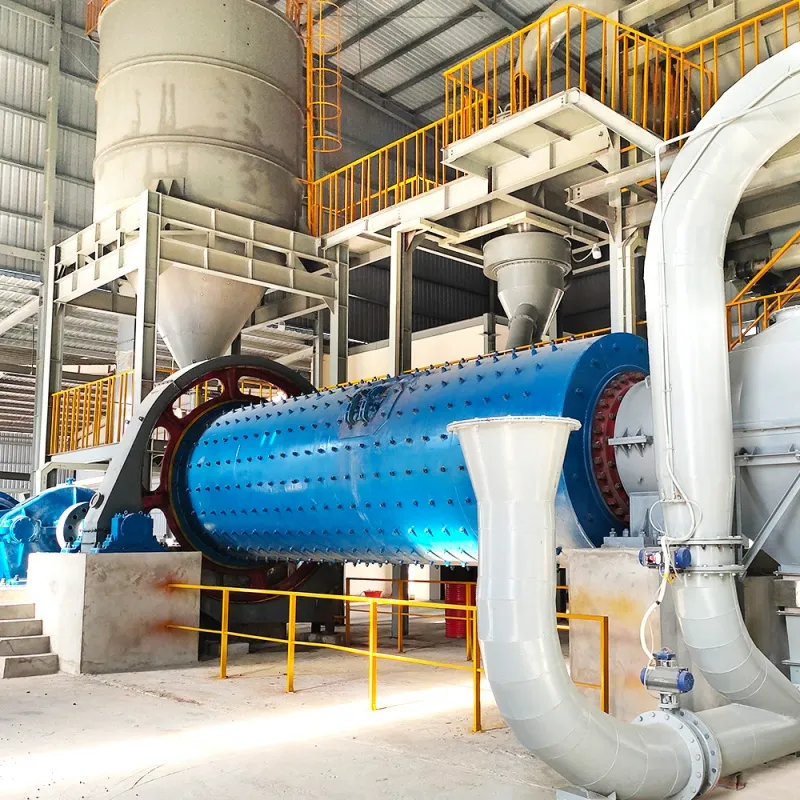
Many people think that the role of a mill is to directly grind large particles into fine powder that meets the specifications and then discharge it.
In reality, during the grinding process, materials do not all reach the target particle size simultaneously.
Take GCC production as an example: when calcite enters the mill, due to differences in particle size, shape, hardness, and the forces acting on each particle, some particles may have already reached below 5μm, while others remain at 20μm or even coarser.
In other words, the output from the mill is not a product with a single particle size, but rather a mixed powder with a broad particle size distribution.
Without further classification, the final product will contain:
- Ultrafine particles that meet specifications;
- Particles close to the target size;
- Coarse particles that have not yet been ground sufficiently;
- A small amount of ultrafine particles resulting from over-grinding.
Such a product, characterized by a wide particle size distribution and uneven particle sizes, struggles to meet the stringent requirements for calcium carbonate powder in industries such as plastics, coatings, papermaking, and high-end rubber.
Therefore, relying solely on the mill itself is insufficient to produce high-quality products; instead, an air classifier must be used to precisely separate particles of different sizes.
Air Classifiers Enable Precise Particle Size Control
Modern industry is imposing increasingly stringent requirements on the particle size of heavy calcium carbonate powder. For example:
- Ground calcium carbonate used in PVC pipes typically requires a D97 of 10–15 μm;
- Ground calcium carbonate used in high-end coatings requires a D97 of around 8 μm;
- Ground calcium carbonate used in high-end plastic masterbatches requires a D97 of 5 μm or even finer;
- Certain functional fillers require an extremely narrow particle size distribution.
These products not only require an average particle size that meets specifications, but also demand an extremely low content of coarse particles. The air classifier is the key piece of equipment for achieving this goal. Its operating principle primarily relies on the balance between the centrifugal force generated by the airflow and the drag force acting on the particles to achieve classification.
When the powder enters the classification zone:
- Coarser particles, due to their greater mass, are subjected to stronger centrifugal forces. They are flung outward and returned to the mill for further grinding.
- Finer particles, meanwhile, are carried by the airflow into the collection system, becoming the final product.
By adjusting the speed of the classification wheel, the airflow volume, and the system’s negative pressure, the final particle size can be precisely controlled.
This dynamic classification method results in a more concentrated particle size distribution. This meets the demands of high-end markets.
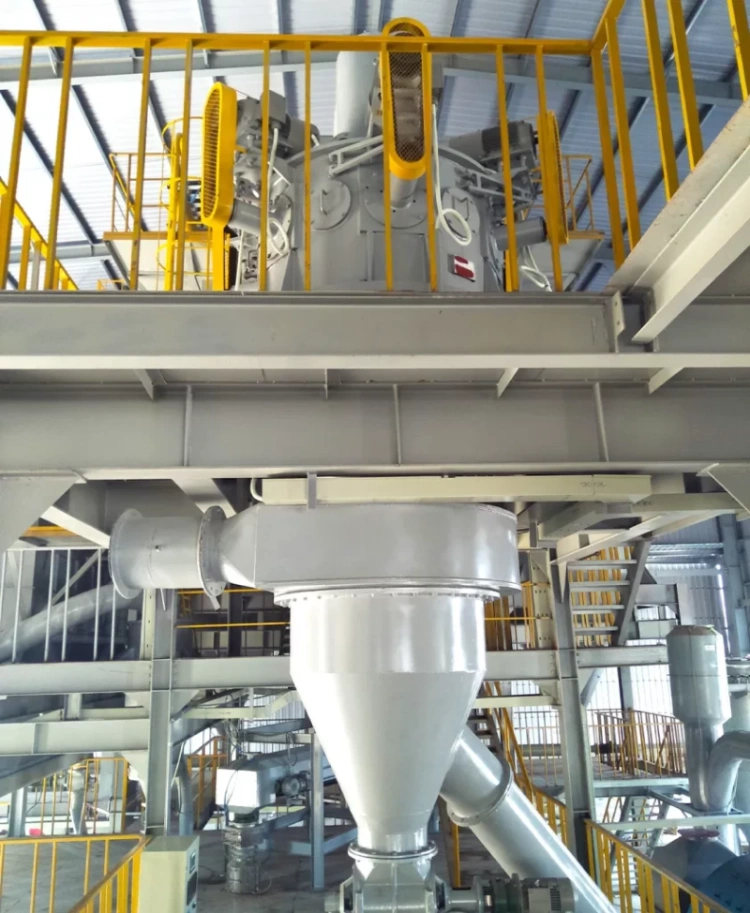
How to Prevent Over-Grinding and Improve Grinding Efficiency ?
Without a classification system, fine particles in the mill remain in the grinding zone for extended periods.
When these particles, which have already met the required size, continue to be impacted by the grinding media, severe over-grinding occurs.
The main issues caused by over-grinding include:
- Increased energy consumption;
- Decreased output;
- Broader product particle size distribution;
- Increased agglomeration of the powder;
- Deteriorated performance in subsequent modification processes.
An air classifier, however, can promptly separate qualified fine particles from the mill. Particles that meet the size requirements are quickly removed from the grinding zone. Coarse particles that do not meet the specifications are returned to the mill for further grinding.
This “grind-and-separate” operating mode forms a closed-circuit system.
Since the fine powder is no longer re-ground, the mill can devote more energy to breaking down coarse particles, thereby significantly improving overall grinding efficiency.
In actual production, when a ball mill is equipped with a high-efficiency air classifier, its output often increases by 20% to 50%. At the same time, power consumption per unit of product decreases significantly.
Improve Product Quality Stability
For industries such as plastics, rubber, and coatings, product quality stability is often more important than simple fineness.
If the particle size of calcium carbonate fluctuates, it directly affects downstream product performance.
For example:
- In PVC products, excessive coarse particles may cause rough surfaces;
- In coatings, coarse particles may affect gloss and coverage;
- In rubber, uneven particle size may reduce dispersion;
- In paper, it may affect smoothness and printability.
Air classifiers, with stable particle size cutting, ensure that the product always maintains a consistent particle size distribution.
Even if raw material hardness fluctuates or mill operating conditions change, the classification system can adjust within a certain range to ensure stable product quality.
This is why many large GCC production companies regard air classifiers as core equipment for quality assurance.
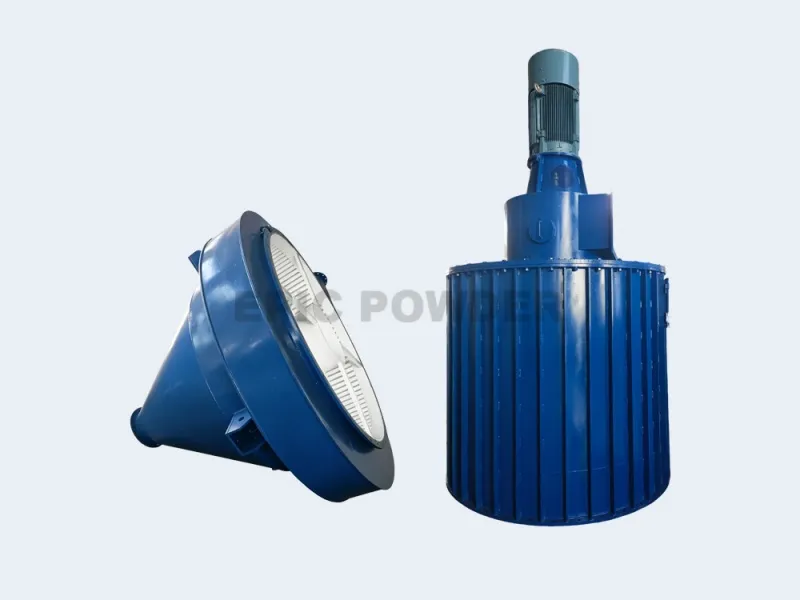
Reduce Energy Consumption and Production Costs
Energy cost has become an important part of operational expenses for powder enterprises.
Especially in ultrafine GCC production, grinding electricity consumption often accounts for the majority of total energy consumption.
Without an air classifier:
- Coarse and fine particles circulate in the mill simultaneously;
- Large amounts of already qualified fine powder are repeatedly ground;
- The equipment consumes energy for a lot of ineffective work.
An air classification system can quickly separate the finished product, keeping the mill focused on grinding only the particles that need further reduction.
This closed-loop grinding process significantly improves energy efficiency.
In actual projects, high-efficiency classification systems usually reduce unit energy consumption by 10% to 30%.
For enterprises producing tens of thousands or even hundreds of thousands of tons of GCC per year, the annual electricity savings are considerable.
Therefore, although adding an air classifier increases the initial investment, it often brings higher long-term economic benefits.
Meet the Requirements for Ultrafine and High-End Products
With market competition intensifying, profits from ordinary GCC products continue to decline.
More and more companies are developing ultrafine, high-value-added, and functional calcium carbonate products, such as:
- D97=5μm GCC;
- D97=3μm GCC;
- Ultrafine modified GCC;
- Nano-scale calcium carbonate precursor products.
For these products, relying solely on a mill is no longer sufficient to achieve target particle size.
Especially when producing micron or submicron powders, the precision of the air classifier directly determines the final product quality.
Modern high-efficiency vortex air classifiers can achieve extremely precise particle size cutting, keeping coarse particle content in ultrafine products at an extremely low level, thus meeting the requirements of high-end applications.
In this sense, the development of air classification technology has promoted the entire calcium carbonate industry toward high-end production.
Why Have Closed-loop Systems Become the Mainstream Configuration in the Industry?
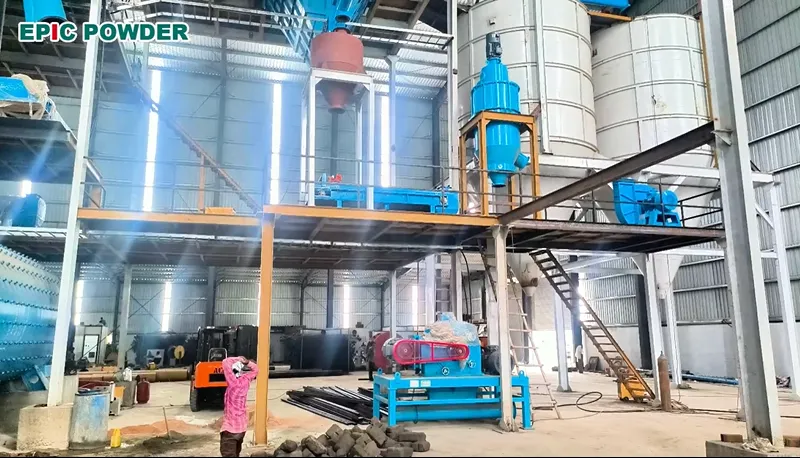
Currently, whether it is a large-scale ball mill classification line, a roller mill line, or a mechanical mill line, most advanced GCC projects adopt closed-loop grinding processes.
A typical process flow is:
Raw material crushing → Grinding → Air classification → Product collection → Return of coarse powder to the mill.
In this system, the air classifier acts as the “quality control center” of the production line.
It determines:
- Product particle size;
- Particle size distribution;
- Grinding efficiency;
- System energy consumption;
- Final product value.
Therefore, competition in modern GCC production lines is not only competition between mills but also the overall system efficiency of “mill + air classifier.”
Conclusion
For calcium carbonate grinding production, an air classifier is far more than an auxiliary device. It is a key piece of equipment that determines product quality, output, and energy consumption. Since the mill alone cannot achieve precise particle size control or effectively prevent over-grinding, an air classifier is required to separate qualified fine powder in time and return coarse particles for further grinding, forming an efficient closed-loop system.
With increasing quality requirements from industries such as plastics, rubber, coatings, paper, and new energy, high-efficiency air classification technology will become even more important. Companies are under growing pressure to produce finer, more consistent, and higher-value calcium carbonate products while maintaining cost efficiency. To achieve these goals, calcium carbonate processors must adopt high-performance grinding equipment combined with advanced air classifiers, enabling higher product quality, lower production costs, and stronger market competitiveness.

“Thanks for reading. I hope my article helps. Please leave a comment down below. You may also contact Zelda online customer representative for any further inquiries.”
— Posted by Emily Chen