
The western state of Rajasthan, India, is one of the world’s largest calcite mineral regions.
To meet the growing demand for high-fineness, highly activated, and well-dispersed GCC powder in the coatings, plastics, paper, and sealant industries, a well-known local GCC manufacturer decided to build a new 150,000-ton-per-year ultrafine ground calcium carbonate production line.
Core Performance Requirements
- Product fineness: D97 ≤ 12 μm (3250 mesh)
- Throughput: ≥ 6 tons/hour (single line)
- Activation rate: ≥ 98% after stearic acid surface modification
- Whiteness: ≥ 95%
- Excellent flowability and dispersion performance
Process Design & Equipment Configuration
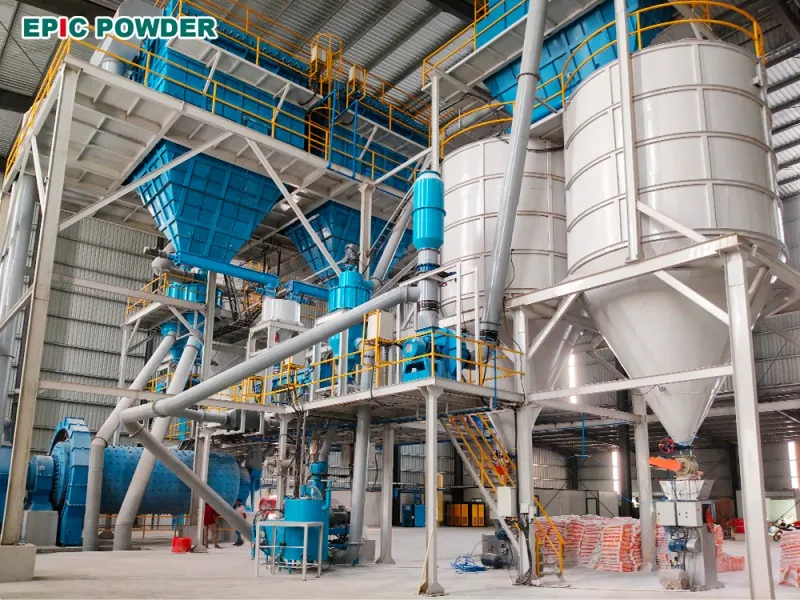
After evaluating multiple equipment suppliers, the client ultimately selected a complete set of high-end equipment from Epic Powder.
The GCC (Ground Calcium Carbonate) Production Line includes:
1. Primary Grinding System
- Model: Epic Powder Ultrafine Ball Mill
2. Precision Classification System
- Model: Epic Powder ITC Air Classifier × 2 units (parallel configuration)
3. Continuous Powder Surface Modification System
- Model: Epic Powder PinMill High-Speed Pin-Type Modifier
- Modifier: Industrial-grade stearic acid (metering accuracy ±0.1%)
- Modification temperature: Adjustable between 85–105 °C
- Activation rate: Stabilized at ≥ 98.5%
4. Auxiliary Systems
- Pulse jet baghouse dust collector + waste-heat recovery
- Fully automated PLC + DCS control system
- Nitrogen protection + explosion-proof design (compliant with India PESO standards)
Actual Operating Data (Acceptance Test, December 2025)
Product fineness (D97): 11.6–11.9 μm (laser particle size analysis)
D50: 3.8–4.1 μm
Particle size distribution: (D97 – D10) / D50 ≤ 2.1, extremely narrow
Throughput: 6.2–6.5 t/h (peak measured: 6.8 t/h)
Activation rate after modification: 98.7%–99.1%
Whiteness: 95.8–96.2%
Specific surface area: 2.1–2.3 m²/g
Oil absorption value: 18–20 g/100 g (significantly reduced after modification)