
With the rapid development of infrastructure construction as well as the paper and plastics industries in Southeast Asia, Indonesian customers are showing an increasing demand for high-whiteness, ultrafine limestone powder. Ultrafine limestone grinding has therefore become a critical processing step to meet the stringent requirements of these downstream applications. The customer aimed to produce high-end ultrafine limestone with a target fineness of D97: 10 μm (approximately 1250 mesh), requiring the system to deliver not only stable capacity but also international-standard performance in energy efficiency and classification accuracy.
Core Challenges
Stringent fineness requirement:
D97 ≤ 10 μm falls within the ultrafine powder range, placing extremely high demands on the collection efficiency and rotational stability of the air classifier.
High throughput requirement:
Achieving large-scale, continuous production of 8 t/h while maintaining ultrafine particle size.
Adaptability to local environment:
The system had to account for Indonesia’s hot and humid climate, which can affect airflow stability and powder moisture absorption.
Solution: Epic Powder Ball Mill–Air Classifier System
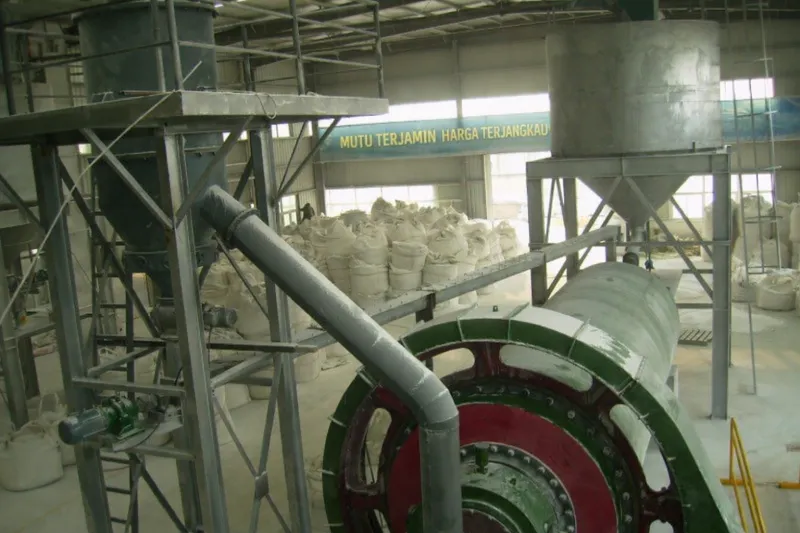
In response to the customer’s requirements, Epic Powder designed a customized closed-circuit production line consisting of a ball mill combined with an ITC air classifier.
High-Efficiency Grinding System:
The system adopts dedicated ceramic liners and optimized ratios of alumina grinding media.
Technical advantages:
This configuration effectively avoids metal contamination during grinding, ensuring the high whiteness of the limestone. The optimized length-to-diameter ratio of the mill provides scientifically controlled material residence time, significantly improving grinding efficiency.
Ultrafine Classification Technology:
The production line is equipped with Epic Powder’s independently developed high-precision turbine classification system.
Classification principle:
After grinding, the coarse powder is carried by airflow into the classification zone, where a high-speed rotor controlled by a variable-frequency drive generates strong centrifugal force. Only fine particles meeting the 10 μm specification can pass through the blade gaps, while oversized particles are automatically returned to the ball mill for regrinding.
Key performance indicators:
High classification accuracy and a precise cut point ensure strict compliance with the D97 requirement.
Intelligent Control System
The entire production line is operated via PLC-based automated control.
Real-time monitoring:
The system automatically adjusts the feed rate, airflow, and classifier rotor speed. Even under complex operating conditions, it maintains a stable output of 8 t/h.
Project Results
After installation and commissioning, the ultrafine limestone grinding line demonstrated excellent on-site performance in Indonesia:
| Item | Performance |
|---|---|
| Product Quality | The finished product shows a very narrow particle size distribution, with D97 consistently maintained below 10 μm. Powder whiteness and surface activity fully meet the requirements of downstream coating and plastic filler applications. |
| Actual Output | The system operates stably and reliably, achieving an average actual output of 8.2 t/h, exceeding the customer’s expectations. |