
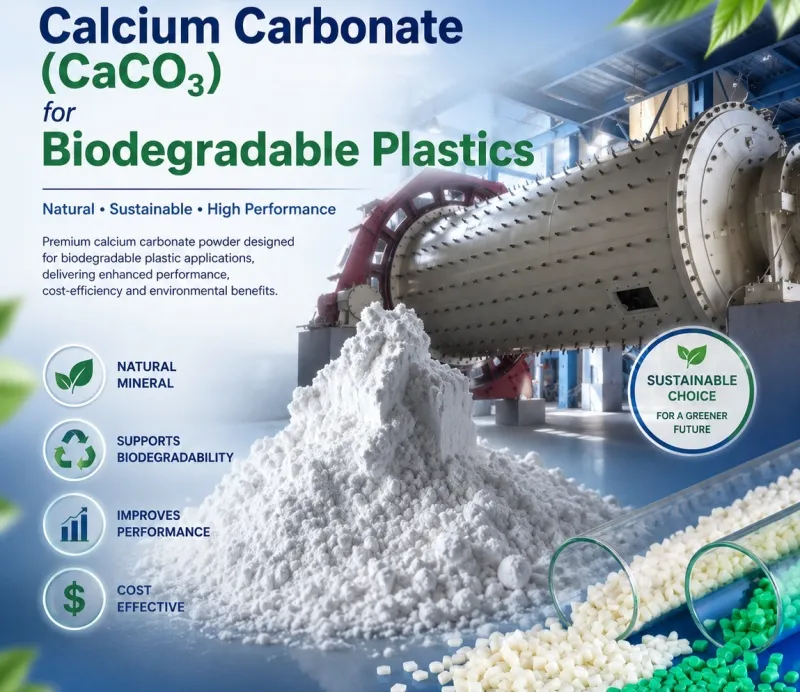
In the paper industry, calcium carbonate—including Ground Calcium Carbonate (GCC) and Precipitated Calcium Carbonate (PCC)—serves as a critical raw material for enhancing paper quality and reducing production costs. It improves whiteness, opacity, and smoothness. It also enhances ink absorbency and printability. However, raw limestone or coarse calcium carbonate cannot be directly used in high-standard papermaking processes. Whether calcium carbonate can perform at its best largely depends on the front-end equipment. Calcium carbonate ultra-fine grinding equipment must provide precise control over particle size and distribution. Surface modification equipment must properly adapt interfacial affinity and coating.
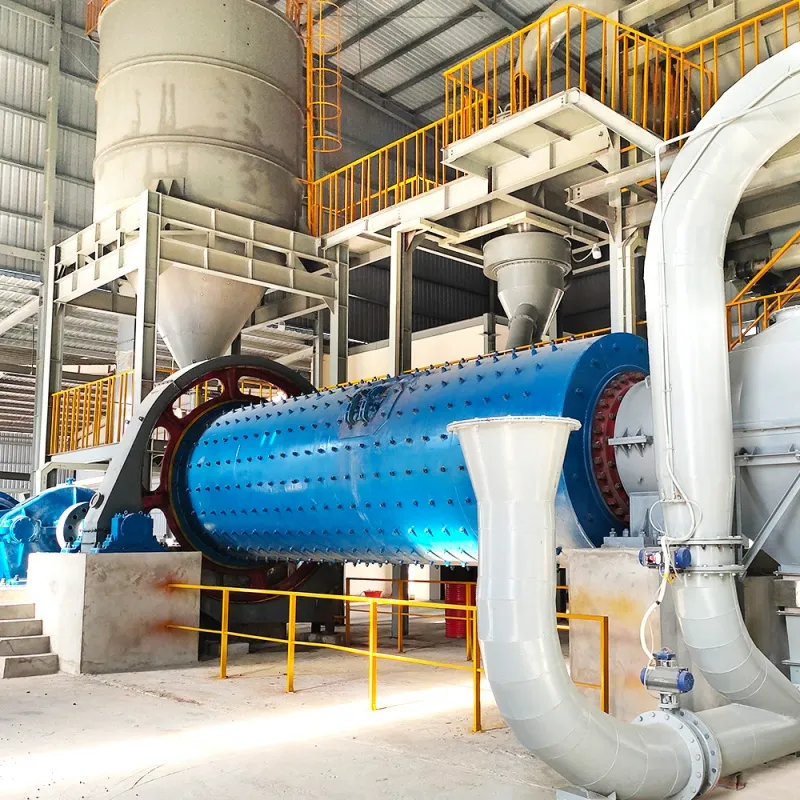
I. Ultra-fine Grinding Equipment: The Foundation for “Filling” and “Coating” Roles
Calcium carbonate is classified into Ground Calcium Carbonate (GCC) and Precipitated Calcium Carbonate (PCC) based on processing methods. Grinding equipment plays a central role in the production of both types, especially for GCC.
Calcium Carbonate Ore ──> Coarse Crushing ──> Dry/Wet Ultra-fine Grinding ──> Particle Classification ──> High-Quality Papermaking Filler/Coating Pigment
1. Two Primary Roles of Calcium Carbonate in Papermaking
- As Paper Fillers:
- GCC: GCC is mainly used in printing paper, writing paper, office paper, and advertising paper. Standard filler-grade GCC (such as 325 mesh, whiteness ≥ 92%, CaCO3 ≥ 98%) is mostly processed using Raymond mills or vertical roller mills. Higher-grade ultra-fine GCC (above 1250 mesh) for paperboard requires efficient processing via dry ring-roller mills or ball mill classification production lines.
- PCC: In principle, PCC can be used in all types of paper. It is primarily used as a filler for high-end paper, such as cigarette paper, inkjet printing paper, and lightweight coated paper. It is produced through chemical precipitation paired with downstream deagglomeration and classification equipment.
- As Coating Pigments:
- GCC can be used for both pre-coating and top-coating. Pre-coating requires particles smaller than 2 μm to account for over 75% of the total mass. Top-coating requires particles smaller than 2 μm to reach 90%–100%. These ultra-fine particles significantly enhance paper surface gloss and flatness.
2. Core Grinding Equipment Selection for Papermaking-Grade Calcium Carbonate
To meet the strict particle size and distribution requirements in different papermaking stages, specific industrial grinding process lines have been developed:
| Application | Particle Size / Quality Requirement | Recommended Ultra-fine Grinding Equipment | Process Features & Advantages |
| Filler-Grade GCC | 325–1250 mesh (d_90≤ 10μm) | Vertical Roller Mill / Ring-Roller Mill / Coarse Mill + Air Classifier | High capacity, low energy consumption, good particle morphology. Ideal for large-scale filler processing. |
| Pre-Coating Grade GCC | 2μm particles ≥75% | Dry Ball Mill Classifier Line / Wet Stirred Mill | Uniform particle size distribution and good fluidity. Suitable for formulating high-solid-content coatings. |
| Top-Coating Grade GCC | <2μm particles 90% -100\% | Wet Ultra-fine Stirred Mill / Horizontal Bead Mill | Uses media grinding for micro- and sub-micron delamination. The high micro-particle ratio yields high surface gloss. |
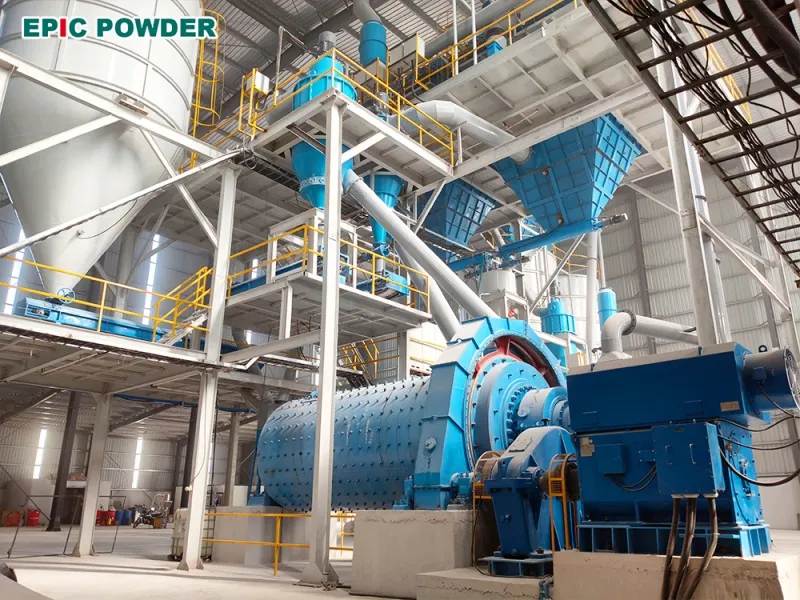
II. Surface Modification Equipment: The Key to Compatibility and Retention
Ultra-fine grinding gives calcium carbonate a high specific surface area and fine texture. However, unmodified calcium carbonate remains an inorganic, hydrophilic material. It has poor compatibility and bonding strength with organic plant fibers, which are also hydrophilic but carry a negative surface charge. This incompatibility leads to low filler retention, reduced mechanical strength, and paper dusting or linting.
To solve these issues, high-efficiency continuous modification machines are essential for chemical coating or surface modification.
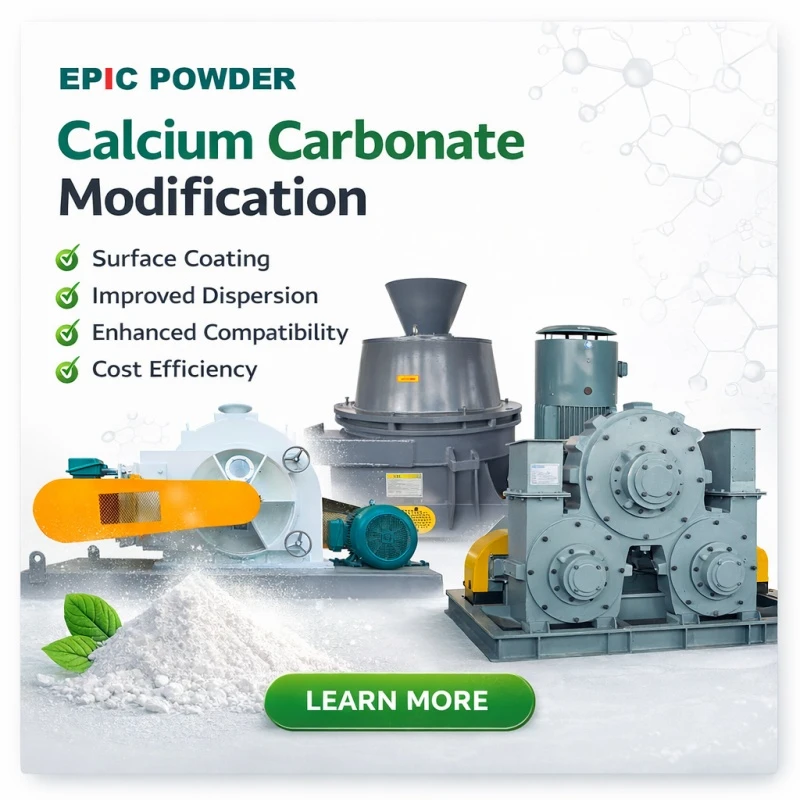
1. Main Modification Equipment and Working Principles
- Three-Ring / Multi-Cell Hive Modification Machine: Strong shear and centrifugal forces are generated by a high-speed rotor. Calcium carbonate powder is fluidised and rapidly mixed with atomized modifying agents (such as sodium stearate or coupling agents) to achieve molecular-level single-layer coating.
- Turbine Continuous Modification Machine: This equipment is suitable for the high-speed dry modification of ultra-fine calcium carbonate. Materials and modifying agents collide at high frequencies within the turbine chamber. This design delivers a high coating rate and effectively prevents ultra-fine powder re-agglomeration.
- Wet Modification Reactors / Stirred Vessels: Modifying agents (such as cationized chitosan, CMC, or coupling agent KH570) are added directly into the slurry during or after wet ultra-fine grinding. This process enables liquid-phase surface grafting or coating.
2. Modification Processes and Equipment Benefits
(1) Chemical Coating Process
Chemical coating modifies the surfaces of GCC or PCC within a reaction system. For example, polyelectrolyte complexation can be used inside modification equipment to deposit cationized chitosan and carboxymethyl cellulose (CMC) onto PCC surfaces:
- Equipment Role: Forced mixing and temperature-controlled precipitation make particle distribution more concentrated and uniform, doubling the specific surface area.
- Papermaking Performance: The coated calcium carbonate stays stably in fiber pores through mechanical trapping and colloidal adsorption. This process increases retention rates and significantly improves tensile index, bursting strength, and folding endurance.
(2) Surface Chemical Coupling Process
Coupling agents (such as KH570) or organic surfactants (such as sodium stearate) are used to modify calcium carbonate powder:
- Equipment Role: High-speed modification machines use thermal shearing to apply sodium stearate or hydrolyzed silanols (Si-OH) evenly onto nano-calcium carbonate surfaces, forming stable chemical bonds (such as Ca-O-Si bonds).
- Papermaking Performance: Modified calcium carbonate shows reduced polarity, lower surface energy, and significantly better dispersibility. When applied in coatings, it enhances surface strength, hydrophobic properties, and friction performance (commonly used for anti-slip liners and packaging trays).
III. Synergy Between Ultra-fine Processing and Modification
- Creating Exceptional Whiteness (Grinding Cleavage + Impurity Removal):Natural calcium carbonate crystal structures inherently possess high whiteness. Precise grinding with wet ultra-fine stirred mills or ball mill classifiers avoids iron contamination while reducing particles to optimal light-scattering sizes (around 0.2 – 0.5μm). This maximizes visible light reflection, significantly boosting overall paper whiteness and opacity.
- Achieving High Smoothness and Gloss (Ultra-fine Particles + Anti-Agglomeration):
- Micro-particles processed by ultra-fine grinding equipment (<2μm > 90%) fill gaps between fibers, forming an ultra-thin and flat coating layer on the paper surface.
- After surface energy reduction and coating treatment in modification equipment, ultra-fine calcium carbonate avoids secondary re-agglomeration in coating systems. It maintains good fluidity and high solid content. Consequently, the paper exhibits excellent smoothness and high gloss after calendering, while reducing dusting and linting during printing.
Ultra-fine grinding equipment provides precise control over particle size, while modification equipment alters surface characteristics. Together, they allow calcium carbonate to fully release its physical and chemical advantages, establishing it as a high-quality, cost-effective core mineral raw material in the paper industry.

“Thanks for reading. I hope my article helps. Please leave a comment down below. You may also contact Zelda online customer representative for any further inquiries.”
— Posted by Emily Chen