
As a typical resource-processing powder industry, the development of the calcium carbonate industry has always been deeply intertwined with the iteration of processing equipment technology. Equipment is the carrier of the process and the underlying support for product quality and production efficiency.
Historically, processing started with simple crushing and grinding. Today, it features fully intelligent production lines. Production has also evolved from coarse powder of a few hundred mesh to nanoscale, high-purity, and functionalized high-end powders. Every technological breakthrough in processing equipment has reshaped the industry’s product boundaries, cost structure, and competitive landscape.
Indeed, China’s calcium carbonate industry has grown from small to large and shifted from low-end to high-end. This transformation is essentially driven by the continuous upgrade of processing equipment and the enhancement of independent controllability.
Therefore, analyzing the technological evolution path of processing equipment is crucial. Clarifying the intrinsic relationship between equipment upgrades and industrial efficiency provides a key perspective for understanding industrial development and grasping future upgrade directions.
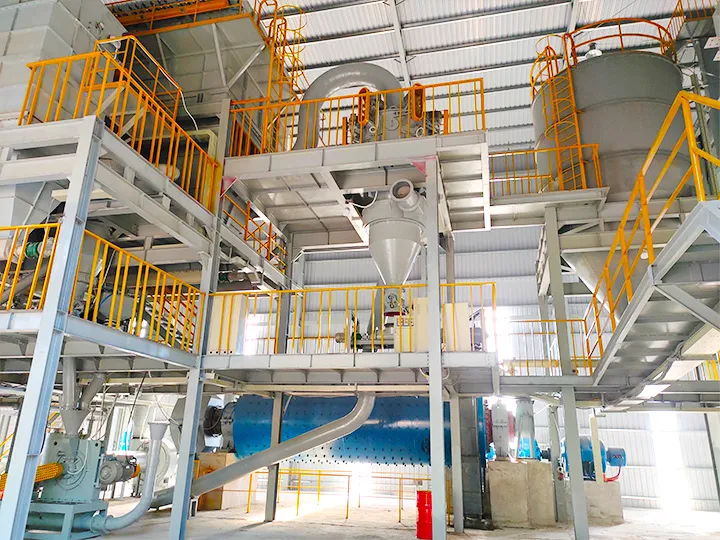
Technical Characteristics and Industrial Limitations of Traditional Processing Equipment
Early calcium carbonate processing primarily relied on extensive dry methods. The calcium carbonate powder processing equipment was simple and limited in function, resulting in a low-level, low-value-added development stage for the industry as a whole.
Traditional calcium carbonate powder processing equipment mainly used jaw crushers and impact crushers, which could only perform coarse and medium crushing of large ores. This resulted in a small crushing ratio, low efficiency, and large fluctuations in product particle size. The grinding process was centered on Raymond mills and ordinary ball mills. Raymond mills, with their low investment and ease of operation, became the main equipment for small and medium-sized enterprises in the early days. However, they generally suffered from low upper limits for fineness, wide particle size distribution, and poor classification accuracy.
Typically, the finest particle size could only be produced to 325-800 mesh, with high slag content and unstable whiteness. This only met the needs of the low-end building materials and ordinary filler markets. While ordinary ball mills could improve fineness by extending grinding time, they suffered from high energy consumption, low efficiency, and severe over-grinding. This resulted in severe damage to powder morphology and poor application performance.
The grading and sorting processes are particularly weak. Early methods relied heavily on simple screening using vibrating screens and rotary screens. This resulted in low grading accuracy, poor control of large particles, and an inability to produce products with narrow particle size distributions. Purification equipment such as magnetic separation and color sorting is almost nonexistent, hindering its entry into mid-to-high-end applications.
Disadvantages of traditional production lines:
- Low automation and high reliance on manual labor;
- Inadequate environmental protection facilities, resulting in severe fugitive dust emissions;
- Low production efficiency, leading to significant environmental and safety issues.
This level of equipment limited the early growth of added value in the calcium carbonate industry.
Technological Iteration and Performance Breakthroughs in Core Processing Units
Downstream industries are demanding higher quality calcium carbonate, while equipment manufacturing technology continues to advance. In response, equipment in each core unit of processing has undergone iterative upgrades. This evolution has driven the formation of two major process routes—dry and wet processing—covering the full spectrum from coarse to ultrafine powders, and ordinary to modified products.
1. Calcium Carbonate Powder Processing Equipment: A Leap from Coarse Grinding to Ultrafine Grinding
Grinding is the core process in calcium carbonate processing, directly determining the fineness, morphology, and production efficiency of the product. Currently, mainstream grinding equipment has formed two main technical routes: dry ultrafine grinding and wet ultrafine grinding, each suited to different product positioning.
Dry Ultrafine Grinding Field:
Vertical roller mills and ring roller mills are gradually replacing traditional Raymond mills. They are now the mainstay of large and medium-sized dry grinding production lines.
Vertical roller mills utilize the principle of layer grinding with a built-in classifier. This design completes grinding, grading, and drying in a single pass. Product fineness adjusts flexibly between 80 and 2500 mesh, while unit power consumption drops to just 60%–70% of a Raymond mill. Delivering a capacity of tens of tons per hour, it offers major advantages in scale, energy efficiency, and automation. Consequently, it is the preferred choice for large-scale production of both ordinary and ultrafine heavy calcium carbonate.
Ring roller mills are widely used in small and medium-sized production lines due to their moderate investment costs and flexible fineness adjustment. They can stably produce 1000–1500 mesh ultrafine powders. This capability effectively bridges the market gap between Raymond mills and large vertical mills.
Wet ultrafine grinding field:
Horizontal sand mills, vertical sand mills, and stirred mills are now widely applied. Their mature application has driven major breakthroughs in coated calcium carbonate production.
Wet grinding relies on media grinding principles, achieving ultrafine pulverization through collision and shearing. The resulting products reach submicron or even nanometer scale. They also feature a narrow particle size distribution, regular morphology, and a smooth surface. Because of these qualities, sand mills serve as the core equipment for producing high-end coated papermaking calcium and coating-grade calcium.
Meanwhile, the single-machine capacity of large wet sand mills continues to increase. When combined with multi-stage series grinding processes, they enable large-scale continuous production with stable quality. This directly promotes the upgrading of China’s calcium carbonate industry from ordinary fillers to high-end functional powders.
2. Classification and Purification Equipment: Precise Control of Product Quality
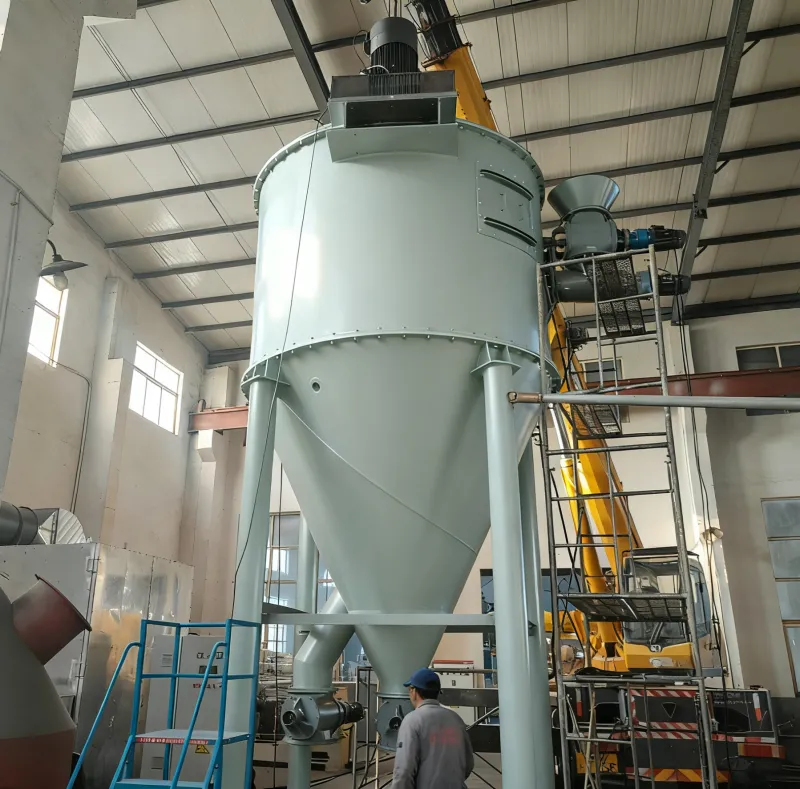
Classification equipment plays a key role in ensuring powder particle size distribution and product consistency.
In dry classification, high-precision turbine air classifiers are becoming increasingly popular. They achieve precise particle classification using the centrifugal force field generated by high-speed rotating turbine impellers. Featuring high classification accuracy and precise cut points, they can produce fine powders with a strictly controllable narrow distribution (D97). When paired with vertical roller mills and modification production lines, they significantly enhance product quality. Additionally, the application of multi-wheel and multi-stage classification processes enables the simultaneous production of various particle size fractions, optimizing resource efficiency.
In wet classification, hydrocyclones, horizontal spiral classifiers, and fine classifiers are widely used. Combined with wet grinding production lines, they achieve precise classification and impurity separation for ultrafine powders. This guarantees particle size uniformity and low coarse-particle content for coating-grade products. Consequently, these machines are essential for producing high-end papermaking calcium and coating-grade calcium.
For purification equipment, optoelectronic color sorters and high-gradient magnetic separators have become standard for high-end products. Ore color sorting accurately removes off-color and discolored ore blocks after crushing, improving whiteness and purity from the source. Meanwhile, multi-stage magnetic separation effectively removes iron impurities and magnetic minerals introduced during processing. This lowers the iron content in the powder, meeting the strict whiteness and impurity requirements of high-end coatings, papermaking, and daily chemicals.
3. Surface Modification Equipment: Core Carrier of Functional Upgrades
Surface modification is the core process for upgrading calcium carbonate from an inert filler to a functional material. The performance of modification equipment directly determines coating effectiveness and product activity.
Early modification mainly relied on high-speed batch mixers. These batch processes often suffered from uneven modifier blending, unstable coating performance, and fluctuating activation ratios.
Today, continuous powder modification machines have become the mainstream choice. They feature an integrated design incorporating vortex deagglomeration, spray coating, and constant temperature control. The modifier is uniformly atomized, and the powder is thoroughly dispersed, leading to high coating integrity. These machines enable continuous, automated production, maintaining stable product activation ratios above 95% and significantly improving batch consistency.
To address different modifiers and product requirements, specialized processes have emerged. These include thermal modification, vapor deposition, and composite modification equipment. These systems adapt to various modification formulas—such as stearic acid, coupling agents, and polymers—to produce functional calcium carbonate tailored to different applications.
High-end nano-calcium carbonate production lines integrate in-situ modification and continuous coating processes. Surface treatment is completed during carbonation or grinding, preventing secondary powder agglomeration. By integrating preparation and modification, these systems significantly enhance the dispersibility and practical performance of nano-products.
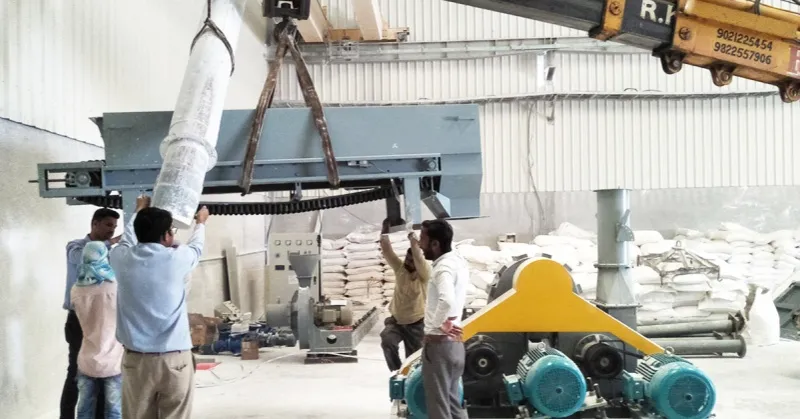
4. Environmental and Finished Product Processing Equipment: Supporting Clean and Efficient Production
Upgrading environmental equipment provides the core guarantee for the industry’s green transition. Efficient baghouse dust collectors and negative-pressure collection systems are now widespread, enabling fully enclosed, negative-pressure operation across the entire production line. Dust emission concentrations are far below national standards, completely altering the traditional image of leaky powder plants. Additionally, wet production lines feature wastewater recycling systems. These achieve full closed-loop water circulation with zero wastewater discharge while recovering ultrafine powder from the water to boost resource utilization.
In finished product processing, automated packaging machines, ton-bag packers, and palletizing robots are replacing manual labor. They offer high metering accuracy and fast packaging speeds while preventing manual contamination. Furthermore, intelligent automated storage and retrieval systems (ASRS) automate warehousing, retrieval, and inventory checks. This ensures precise, efficient inventory management and significantly improves logistics efficiency.
Systematic Transformation Driven by Equipment Upgrades
The comprehensive upgrade of processing equipment represents a systematic transformation rather than a simple machine replacement. It impacts product quality, production efficiency, cost structure, and industry structure alike.
| Aspect | Transformation & Impact |
| Product Grade | Technical bottlenecks in fineness, purity, and modification have been broken. Production has shifted from coarse powders (325–800 mesh) to fine powders (1250–2000 mesh), modified active powders, and nano-functional powders. High-end products now enter value-added markets like papermaking, coatings, sealants, and new energy. |
| Production & Energy Efficiency | Large-scale automated lines yield several times the per capita output of traditional small lines. Unit energy consumption has dropped by 20% to 40%, while production cycles and operating costs are significantly reduced. Industry leaders benefit from strong economies of scale. |
| Environmental & Safety Standards | Enclosed production, negative-pressure dust removal, and wastewater recycling have transformed calcium carbonate from a high-pollution sector into a clean manufacturing industry, meeting increasingly strict environmental standards. |
| Industry Concentration | High investment thresholds and technical demands for advanced equipment prevent small enterprises from competing. As a result, capacity is concentrating among leading enterprises, driving the transition from scattered workshops to modern, large-scale industrial operations. |
Future Trends in Equipment Technology
As the calcium carbonate industry moves toward intelligent, high-end, and green operations, equipment technology will evolve along four main paths:
- Deep Integration of Intelligence and Digitalization: Smart equipment will feature more online sensors to monitor metrics like fineness, whiteness, and activation ratios in real time, automatically adjusting process parameters. Digital twin technology will be applied to line design and commissioning, linking virtual simulation with physical production to enhance efficiency and stability.
- Large-Scale and Integrated Systems: Larger sets of grinding, classification, and modification equipment will emerge to increase single-line capacity, reducing fixed costs and energy consumption. Integrated turnkey equipment combining crushing, grinding, classification, modification, and packaging will be widely adopted to streamline operations.
- Green and Low-Carbon Upgrades: Waste heat recovery, residual pressure utilization, and energy-efficient motors will become standard equipment features, driving down carbon emissions per unit of product. Fully enclosed, zero-emission, low-noise production lines will set the new industry benchmark.
- Specialized and Customized Equipment: Tailored production lines for specific downstream industries will become mainstream. Examples include ultrafine grinding lines for paper coating, continuous modification lines for plastic modification, and clean production lines for food and pharmaceutical applications, optimizing product performance through specialized hardware.
Conclusion
From Raymond mills to intelligent vertical roller mills, simple screening to precise classification, and batch mixing to continuous modification, the evolution of calcium carbonate processing equipment has advanced in tandem with the industry. Equipment serves as the backbone of the industry, while process technology is its soul. Their deep integration is driving calcium carbonate away from crude resource processing toward refined, advanced material manufacturing.
Looking ahead, as domestic high-end calcium carbonate powder processing equipment continues to break new ground and intelligent technologies see broader application, China’s calcium carbonate industry will overcome resource and equipment constraints. This will achieve higher levels of self-reliance and high-quality development, delivering superior and more diverse powder materials to global manufacturing.

“Thanks for reading. I hope my article helps. Please leave a comment down below. You may also contact Zelda online customer representative for any further inquiries.”
— Posted by Emily Chen