
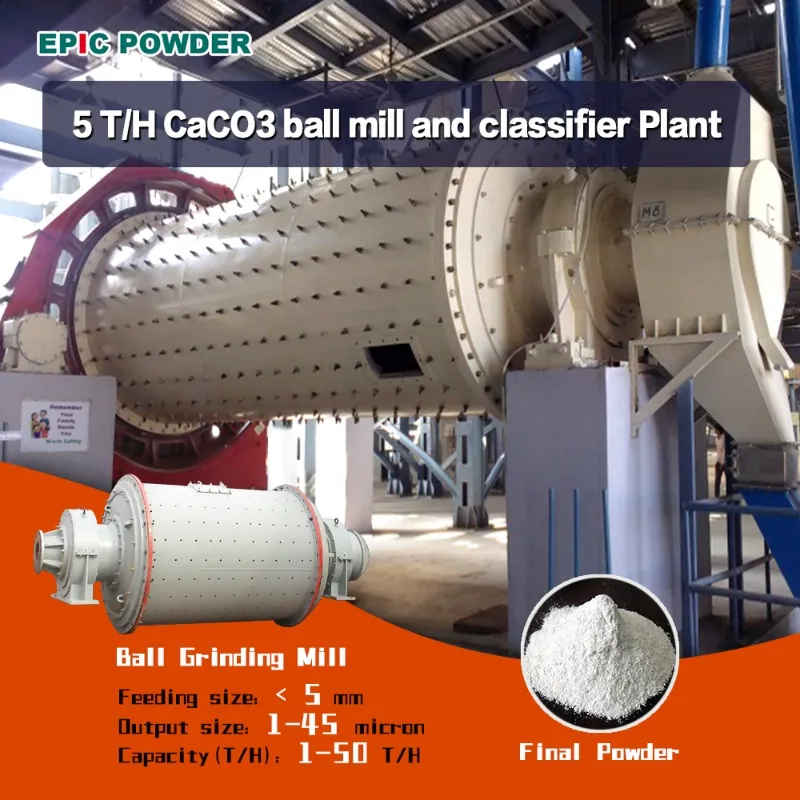
1. Introduction: Why calcium carbonate need ultrafine grinding
Calcium carbonate (CaCO₃) is one of the most abundant and widely used non-metallic minerals in the Earth’s crust. It is used in plastics, rubber, paper, coatings, inks, sealants, food, and pharmaceuticals. As downstream industries demand finer and ultrafine particles, ultrafine grinding technology has become a key factor in determining the added value of calcium carbonate powders. Common ultrafine grinding technologies include jet milling, colloid milling, and ball milling.
Among them, ball milling uses mechanical energy and thermal effects to alter the structure and properties of materials through friction, collision, and shearing. It offers stable samples, high processing quality, low cost, and environmental friendliness with no pollution. For this reason, ball milling is one of the most widely used and cost-effective routes for processing ground calcium carbonate (GCC).
Ultrafine calcium carbonate powders (e.g., 400–2500 mesh, with d50 down to 1–3 μm) significantly improve reinforcement, opacity, and dispersion in filled materials. Precise control of milling conditions—equipment type, media, time, ball-to-powder ratio, and more—therefore directly determines particle size distribution, whiteness, oil absorption, and activation performance.
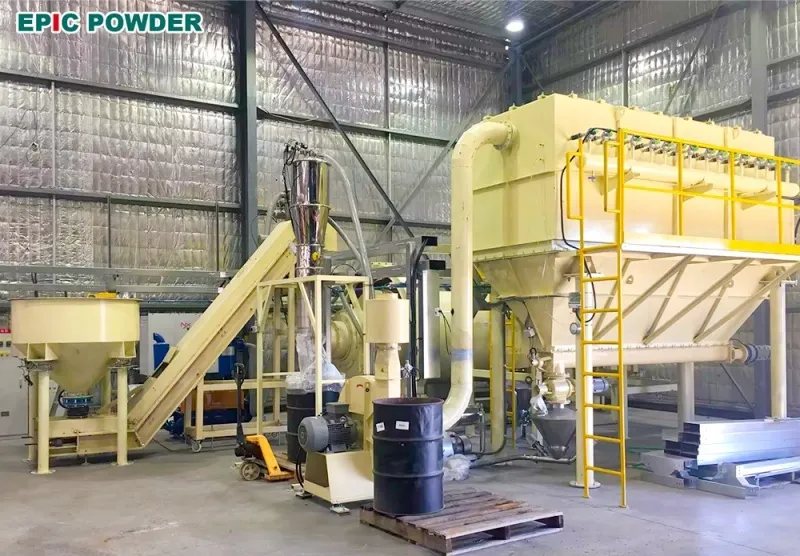
2. Working Principle and Main Types of Ball Mills for Calcium Carbonate
The basic working principle of a ball mill is as follows. Material and grinding media (steel balls, alumina balls, zirconia balls, or natural pebbles) move inside the mill cylinder along with the cylinder or the agitator. The material rotates around the mill’s axis while the supporting structure rotates in the opposite direction. The combination of these two speeds generates centrifugal force, which subjects calcium carbonate particles to full friction and shearing until they are ultrafinely ground.
Based on working principles and characteristics, ball mills are generally classified into three types: stirred, vibratory, and planetary. Their positioning in calcium carbonate processing is summarized below:
| Mill Type | Grinding Principle | Features in CaCO₃ Processing | Typical Applications | Typical Fineness |
| Vibratory Ball Mill | High-frequency harmonic vibration of the cylinder drives intense impact, compression, and shear between media and material | Fast size reduction and uniform mixing; strong capability for continuous production | Dry fine crushing; large-scale production of medium-fine calcium carbonate | Micron level |
| Stirred Ball Mill (Stirred Mill / Bead Mill) | A high-speed rotating agitator transfers kinetic energy directly to the grinding media and material; particles are ground by intense collision, friction, and shear | Simple structure, easy operation, high grinding efficiency, low contamination; suitable for both dry and wet milling (wet milling dominates) | Wet ultrafine grinding of GCC slurry; paper-making and coating grades | Submicron (d50 below 1 μm) |
| Planetary Ball Mill | The cylinders revolve around the common axis while rotating around their own axes, generating powerful centrifugal force with high impact speed and frequency | Good reproducibility, safe handling, short processing time | Laboratory sample preparation, nano-grade CaCO₃ development, colloid grinding | Submicron to nanometer |
Large-scale industrial production of paper-making and plastic-filler grades of GCC usually adopts wet stirred mills or multi-stage ball mill systems in series. Laboratory formulation development and new-product trials mainly rely on planetary ball mills, which offer good reproducibility and flexible batch changes.
3. Grinding Media: Dry vs Wet Ball Milling for Calcium Carbonate
Depending on whether a liquid dispersion medium is added, calcium carbonate ball milling falls into two processes: dry and wet.
- Dry ball milling: Dried crude powders of calcite, marble, or limestone are loaded directly into the mill for grinding. The process is short, easy to operate, and energy-efficient, and the product requires no dewatering or drying. For these reasons, it is widely used in traditional filler-grade calcium carbonate production. However, the achievable fineness is limited—typically around 400–800 mesh at reasonable cost—and particles tend to agglomerate at higher fineness.
- Wet ball milling: Water or another dispersion medium is added to the material, often together with dispersants/grinding aids such as sodium polyacrylate. Grinding relies on friction, collision, and impact between the media and the material. Although process control and operating conditions are more complex, wet mills have a relatively simple structure and deliver uniform grinding. Products feature narrow particle size distribution and little agglomeration, making wet milling the mainstream process for ultrafine GCC above 800 mesh and for paper-coating slurry grades.
Whether dry or wet, the ultrafine grinding process applies powerful shearing, impact, and collision forces. These forces convert calcium carbonate into powders or slurries of different particle size grades, meeting diverse application requirements in plastic filling, paper coating, paints, and more.
Dry vs wet at a glance: Dry milling offers a short process, low cost, and suits medium-fine grades. Wet milling gives finer, narrower, more uniform products for premium ultrafine grades.
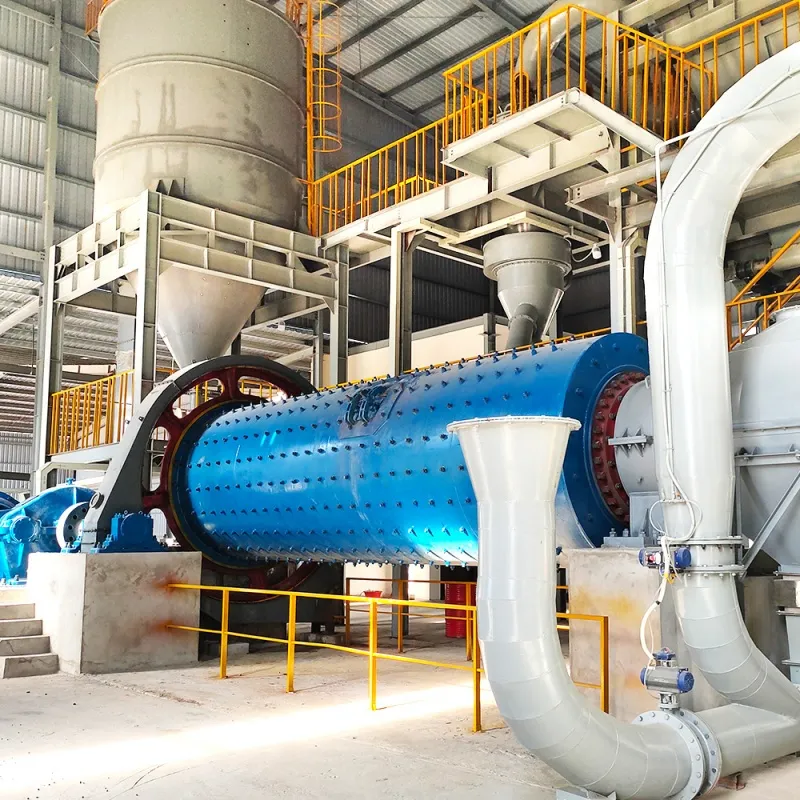
4. Effect of Milling Conditions on Calcium Carbonate Quality
Ball milling performance is affected by multiple factors: the density of the grinding media, the number and size of the grinding balls, milling speed, milling time, milling temperature, ball-to-powder ratio, and filling ratio (slurry solids content). Different combinations of these variables produce very different milling energies.
- Low-energy milling: Changes are mainly physical—particles are reduced in size and specific surface area increases. This is the target range for conventional ultrafine grinding.
- High-energy milling: When the energy is high enough, chemical bonds can be broken and chemical reactions can occur. High-energy milling of calcium carbonate can induce surface hydroxylation and polymorph control (calcite/aragonite/vaterite transformation), or mechanochemical combination with other substances to produce surface-modified and functional composite materials.
Therefore, to meet target fineness (e.g., d90 ≤ 2 μm or 2500 mesh), whiteness (≥ 92–95), and oil absorption requirements, the optimal milling conditions must be determined through testing:
- Grinding media selection: Alumina and zirconia balls have high hardness and low wear, helping preserve the whiteness of calcium carbonate.
- Ball size grading: Large balls break coarse particles while small balls refine fine ones. Multi-stage grading improves grinding efficiency.
- Grinding aids and dispersants: Adding an appropriate amount in wet milling reduces slurry viscosity, suppresses agglomeration, and improves efficiency.
- Milling time and slurry concentration: Over-grinding raises energy consumption and can cause size rebound due to agglomeration. An economic fineness turning point must be identified.
5. Application Value and Prospects
As one of the core methods of ultrafine grinding, ball milling combines strong mechanical force with thermal effects. Research on its use in advanced calcium carbonate processing continues to deepen, and applications have expanded from conventional grinding to the following areas:
- Release and activation of functional components: Mechanochemical activation improves the dispersion and interfacial bonding of calcium carbonate in polymer matrices.
- Polymorph and morphology control: High-energy milling controls the crystal form of calcium carbonate, developing needle-like, plate-like, and other shaped products.
- Composite material development: Combined milling of calcium carbonate with other minerals (talc, kaolin, etc.) or organic substances enhances filling performance.
- Comprehensive utilization of by-products: Limestone tailings and marble scraps are ball-milled into powders, realizing the high-value use of resources.
Numerous studies have shown that ball milling can significantly influence the physical, chemical, and functional properties of calcium carbonate. With the intelligent upgrading of equipment (variable-frequency control, online particle size monitoring) and deeper research into milling mechanisms, ball milling technology will show broad application prospects in the precise release of calcium carbonate functional components, the development of new powder materials, and the comprehensive utilization of mining by-products.
FAQ: Frequently Asked Questions About Ball Milling Calcium Carbonate
Q1: How fine can a ball mill grind calcium carbonate?
A: Dry ball milling economically produces 400–800 mesh powders. Wet stirred milling can reduce ground calcium carbonate (GCC) to d50 ≤ 1–2 μm (approx. 1250–2500 mesh). Planetary laboratory mills can reach submicron and even nano scale.
Q2: Should calcium carbonate be milled dry or wet?
A: It depends on target fineness and application. Choose dry milling for cost-sensitive filler grades at medium fineness. Choose wet milling for ultrafine products above 800 mesh and paper-coating grades. Wet milling gives a narrower size distribution and less agglomeration, but requires dewatering and drying.
Q3: What grinding media and grinding aids are used for calcium carbonate?
A: Alumina or zirconia balls are recommended to preserve whiteness and minimize contamination. In wet milling, sodium polyacrylate dispersants are commonly added as grinding aids. They lower slurry viscosity, prevent agglomeration, and improve efficiency.
Q4: What is high-energy ball milling and what special effect does it have on calcium carbonate?
A: When milling energy is sufficiently high, particles undergo mechanochemical reactions rather than mere size reduction. High-energy milling of CaCO₃ can induce polymorph transformation (calcite → aragonite/vaterite), surface activation, and modification. These effects enable functional CaCO₃ composites.
Q5: What parameters affect calcium carbonate ball milling performance?
A: Mill type, media density and size grading (ball size and number), milling speed, milling time, temperature, ball-to-powder ratio, and slurry solids content. Optimal settings should be determined through lab trials, balancing fineness, whiteness, and energy consumption.
Need a ball mill solution for calcium carbonate? [Get a free quote →]