
Introduction: Three powder Process Routes, Three Different Equipment Sets
Every calcium carbonate specification on the market comes from one of three industrial routes.
| Route | Product | Typical process chain | Core equipment |
| GCC (Ground Calcium Carbonate) | Ground calcium carbonate, mainly dry-processed | Crushing → grinding → classification → surface treatment → packing | Jaw crusher, hammer crusher, impact crusher, Raymond mill, ring-roller mill, vertical roller mill, dry ball mill, turbo classifier, continuous surface modifier |
| PCC (Precipitated Calcium Carbonate) | Light / precipitated calcium carbonate, produced by chemical precipitation | Limestone calcination → slaking → carbonation → surface treatment → drying → deagglomeration | Lime kiln, slaker, carbonation tower, filter press, flash dryer, spray dryer, belt dryer, pin-disc mill, high-speed mixer |
| Nano-CaCO₃ | Nano calcium carbonate, made by carbonation plus wet surface treatment | Same front end as PCC, but wet modification is mandatory | Carbonation tower, wet-modification tank, filter press, low-temperature dryer, jet mill deagglomerator, precision classifier |
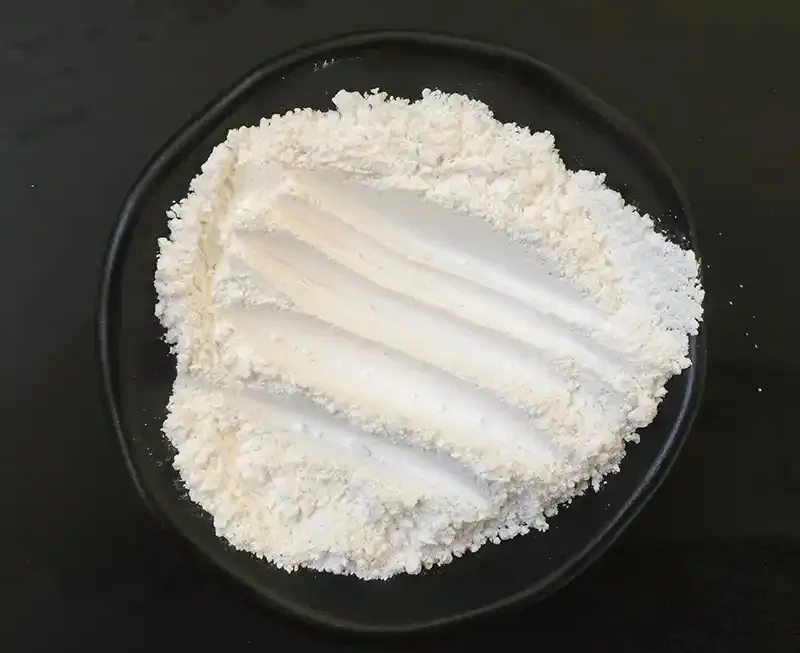
The key difficulty of nano-CaCO₃ lies in drying and deagglomeration. It also lies in preventing secondary agglomeration. These three points separate a real nano product from an ordinary fine powder.
Equipment Map by Process Step
| Step | Main equipment | Function | Notes |
| Crushing | Jaw crusher, hammer crusher, impact crusher | Crush the ore to below 30 mm | Fit a magnetic separator for iron removal |
| Dry grinding | Raymond mill, ring-roller mill, vertical roller mill, dry ball mill | 80–2500 mesh | The mainstream GCC route |
| Classification | Turbo classifier, rotor classifier | Control D97 and cut out coarse particles | Run in closed circuit with the mill |
| Wet grinding | Stirred media mill, sand mill | D50 0.5–2 μm | For paper, toothpaste and high-purity grades |
| Drying | Filter press with flash dryer, spray dryer, belt dryer | Remove water and start deagglomeration | Essential for wet routes |
| Surface treatment | Continuous surface modifier, high-speed mixer, kneader | Coating with stearic acid, titanate or silane | The core step for activated grades |
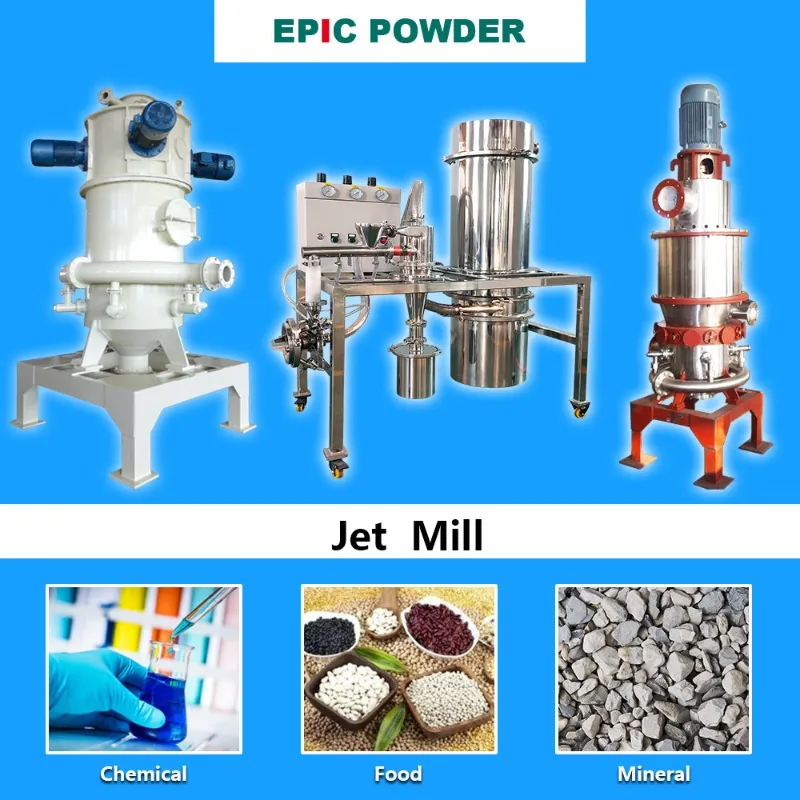
| Deagglomeration | Jet mill, pin mill | Break up agglomerates | Critical for nano-CaCO₃ |
| Packing | Packing machine, ton bags, baghouse dust collector | Moisture-proof and dust-free | Moisture control matters here |
| Testing | Laser particle size analyzer, whiteness meter, oil absorption tester, moisture analyzer | Final quality control | Online particle size is recommended |
Field 1: Plastics — The Largest Market, Over 40% of Consumption
Key Functions
- Replaces a large share of resin. This cuts manufacturing cost significantly.
- Improves rigidity, heat resistance and dimensional stability. It also reduces shrinkage and warpage in injection molding and extrusion.
- Ultra-fine and nano grades improve impact strength and surface gloss. In PE film, they help form breathable micro-pores.
- Improves melt flow. It shortens the injection cycle and lowers machine energy use.
Selection and Application
- Pipes, crates and strapping tape: use activated GCC at 800–1500 mesh. Loading level: 30%–50%.
- PE breathable film and high-gloss appliance housings: use ultra-fine PCC above 1250 mesh, or nano-CaCO₃. Loading level: 10%–25%.
- PLA and PBAT biodegradable plastics: use modified nano-CaCO₃ at 20%–35%. It also helps tune the degradation rate.
🔧 Matching Powder Processing Equipment
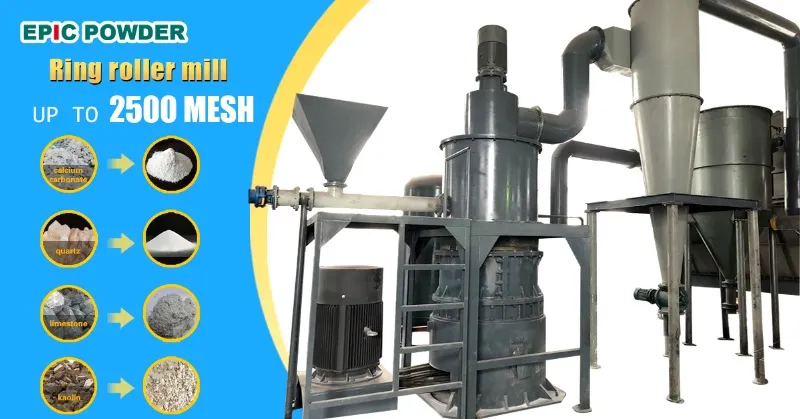
Recommended chain: jaw crusher + impact crusher → ultra-fine ring-roller mill or vertical roller mill, 800–1500 mesh → turbo air classifier → continuous surface modifier, stearic acid or aluminate coupling agent → ton-bag packer or bulk tanker.
- Grinding selection. The 800–1500 mesh range is medium-fine. A ring-roller mill or an ultra-fine vertical roller mill is the right choice. Forcing a standard Raymond mill up to 1250 mesh is a bad idea. Throughput drops by half. Power use per ton roughly doubles. Over-grinding becomes severe.
- Classification is critical. Plastic film is most sensitive to a single oversized particle. The classifier must hold down the top cut, D98 or D100. Add screening as a safeguard. Coarse particles above 45 μm should be close to zero. They are the main cause of film breakage and pinholes.
- Surface treatment. At 30%–50% loading, the filler–resin interface decides impact strength. A continuous modifier suits high-volume, cost-sensitive GCC. Target an activation degree of at least 95%. Treatment temperature is usually 110–130 °C. Add the agent based on specific surface area, typically 1.2%–2.0%.
- Oil absorption control. A low oil absorption value, commonly 18–25 g/100 g for activated GCC, means less resin demand at the same loading. It also means lower melt viscosity. Both translate directly into shorter cycles and lower energy use.
- Downstream masterbatch equipment. Masterbatch is the standard way to handle high loading. Use a high-speed mixer plus a twin-screw compounding extruder or a continuous kneader. Add loss-in-weight feeders and a vacuum vent to remove moisture and low-molecular volatiles.
- Nano-CaCO₃ in breathable film. Use a twin-screw extruder with a high-shear screw design. This avoids agglomerates, which show up as fish eyes.
Field 2: Rubber — A Common Semi-Reinforcing Filler
Key Functions
- Partly replaces carbon black and silica. It lowers raw material cost and suits light-colored rubber products.
- Improves tensile strength, tear strength, abrasion resistance and flex-cracking resistance.
- Improves mixing and extrusion flow. It shortens cure time and lowers Mooney viscosity.
Selection and Application
- Low-end mats and ordinary shoe soles: GCC at 400–800 mesh. Loading: 30–50 phr.
- Sealing strips and hoses: activated PCC at 800–1500 mesh. Loading: 25–40 phr.
- Tire sidewalls and precision silicone seals: nano-CaCO₃. It can replace about 30% of the silica.
🔧 Matching Powder processing Equipment
Recommended chains:
- GCC grade, 400–800 mesh: Raymond mill or ring-roller mill plus a classifier. Surface treatment is optional. Cost comes first here.
- Activated PCC grade, 800–1500 mesh: carbonation tower → dewatering → drying → high-speed heating mixer or continuous modifier, with fatty acid or coupling agent.
- Nano grade: carbonation → wet surface treatment → filter press → drying → deagglomeration.
Field 3: Paper — Both Filler and Coating Pigment
Key Functions
- As a wet-end filler, it reduces pulp consumption. It improves brightness, opacity and porosity. It saves fiber.
- As a coating pigment, it improves smoothness, ink absorbency and print gloss. It reduces the amount of kaolin needed.
Selection and Application
- Filler for ordinary writing paper and white board: ground GCC at 400–1250 mesh. Loading: 15%–25%.
- Top coating for art paper, inkjet paper and cigarette paper: use ultra-fine PCC. The goal is higher smoothness and gloss.
🔧 Matching Powder Processing Equipment
Two recommended chains:
- Dry filler line: ring-roller mill or ultra-fine vertical roller mill → classification → bulk tanker to the paper mill → on-site slurrying with a high-speed disperser and dispersant.
- Wet coating line, the mainstream route: dry or coarse powder → wet stirred media mill, disc or pin type → decanter centrifuge to control the top cut → concentration to 68%–72% solids → slurry tank.
- Coating-grade GCC is judged by the −2 μm content, not by mesh. Common grades are −2 μm ≥ 60%, ≥ 75% and ≥ 90%. Each matches a different coating level. The value is tuned through grinding media gradation, tip speed and residence time in the wet mill. The number of mills and their series/parallel arrangement sets the capacity.
Field 4: Coatings and Inks
Key Functions
- Acts as an extender. It partly replaces titanium dioxide and clearly lowers raw material cost.
- Adjusts film hardness, scrub resistance, crack resistance and weatherability.
- Controls leveling, matting and anti-settling behavior. High oil absorption powder lets matte coatings skip the matting agent.
Selection and Application
- Interior and exterior latex paint and putty: GCC at 1250–2000 mesh. Loading: 15%–35%.
- Wood topcoat and automotive coatings: use ultra-fine PCC. Nano-CaCO₃ made for MS and silicone sealants gives excellent thixotropy.
- Offset printing ink: use GCC with low oil absorption. UV ink needs transparent nano-CaCO₃ to keep print clarity and gloss.
🔧 Matching Powder Processing Equipment
Recommended chain: ring-roller mill, ultra-fine vertical roller mill or ball mill → precision classification → optional surface treatment → packing. Ultra-fine PCC and transparent nano-CaCO₃ take the wet PCC route with wet surface treatment, drying and deagglomeration.
- GCC at 1250–2000 mesh. The ultra-fine vertical roller mill has the best advantage in scale and energy use. For a narrower distribution and higher fineness, use a ball mill with a multi-stage turbo classifier in closed circuit.
- Oil absorption should be made to order. Matte coatings need high oil absorption, which saves the matting agent. Offset ink needs low oil absorption, for low viscosity and high gloss. Oil absorption comes from particle size distribution, particle shape and the treatment agent. One mill can produce several oil absorption grades simply by shifting the classifier cut point. This is where coating-grade plants make their margin.
- Transparent nano-CaCO₃ for UV ink. Three things matter: small enough particle size, complete deagglomeration and very low iron. After drying, use a jet mill or a pin-disc mill to break soft agglomerates. Keep D50 in a narrow nano range. Iron ruins brightness and shade, so use ceramic linings plus magnetic removal.
- Downstream dispersion equipment. Coating plants use high-speed dispersers, sand or basket mills and three-roll mills. Final fineness is checked with a grind gauge.
- Anti-settling. Powder that is coarse and narrow in distribution settles fast. The formulation side then needs an anti-settling agent. On the powder side, keeping a share of fine particles improves suspension.
Field 5: Building Materials — Putty, Cement, Engineered Stone, Ceramic Tile
Key Functions
- In putty and dry-mix mortar, it fills and levels. It improves sandability and adhesion. It also lowers powder cost.
- In concrete and engineered stone, it improves density and compressive strength. It reduces cement consumption.
- In ceramic tile bodies, it adjusts firing shrinkage. It improves flatness and lowers the defect rate.
Selection and Application
Ordinary GCC at 800–1500 mesh is enough. Strict activation is not required. Exterior weather-resistant mortar can add a small amount of ultra-fine PCC to improve crack resistance.
🔧 Matching Powder Processing Equipment
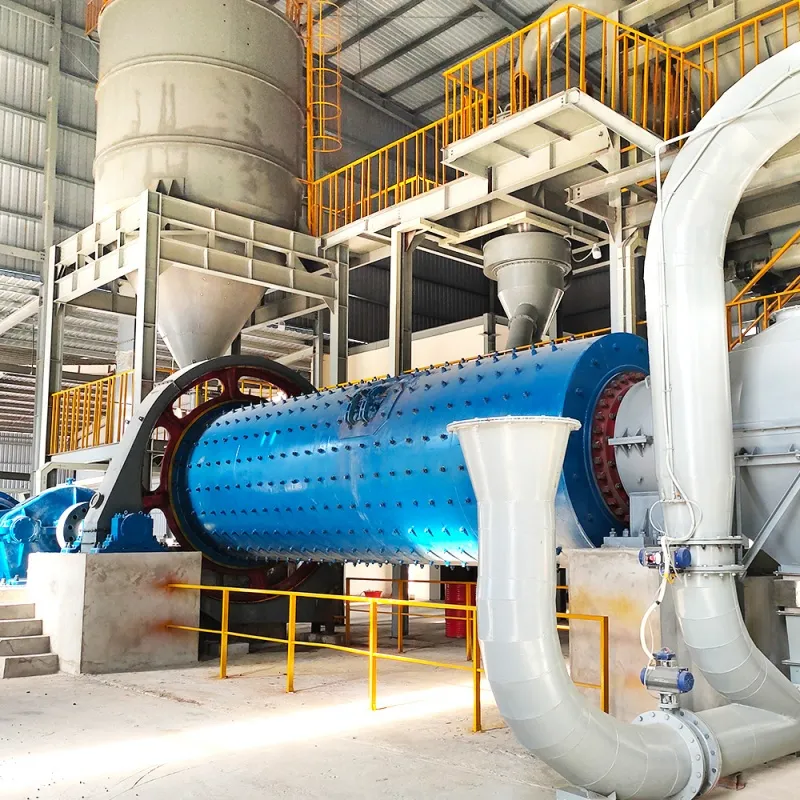
Recommended chain: jaw crusher + impact or hammer crusher → Raymond mill or ring-roller mill, 800–1500 mesh → classification → iron removal → bulk or ton-bag packing.
- This is the most price-driven field. The first selection criterion is kWh per ton and wear-part life. The Raymond mill gives the best cost-performance in the medium-fine range. Large-scale lines can choose an ultra-fine vertical roller mill. It offers high single-machine capacity, a high level of automation and low labor.
- Usually no activation. Skipping the modifier and the agent is standard practice for construction grades. However, if exterior mortar uses a little ultra-fine PCC, that PCC still needs a modifier.
- Whiteness and iron. Putty is sensitive to visual whiteness. Control wear iron in crushing and grinding. Use magnetic separators and a sensible mix of ceramic and high-manganese steel parts. Add a magnetic separator if needed. Wash the ore where clay content is high.
- Downstream dry-mix mortar line. Use a weightless mixer or a ploughshare mixer. Add a valve-bag packer and a palletizing line. Move powder with screw conveyors or pneumatic conveying, using a bin pump and a Roots blower.
- Engineered stone and tile. These need a graded particle size distribution. Mixing coarse and fine raises packing density and cuts resin or cement demand. The powder plant therefore needs multiple silos and blending capability, not just one fineness grade.
Field 6: Food and Pharmaceuticals — High-Purity Special Grades
Key Functions
- Food use, complying with GB 1886.214: a calcium fortifier. It also improves texture in bakery, dairy and confectionery, and prevents sticking.
- Medical use: the active ingredient in calcium tablets, and a filler/disintegrant in tablets. It also neutralizes gastric acid and relieves acid reflux.
- Carrier use: high-purity porous vaterite calcium carbonate can serve as a sustained-release and targeted drug carrier.
Hard Standard
Lead and arsenic must be controlled below the limits. Industrial-grade modifiers are prohibited. Only food-grade or pharmaceutical-grade purified powder may be used.
🔧 Matching Powder Processing Equipment
Recommended chain: ore beneficiation, by hand sorting, optical sorting or flotation → ore washing → iron-free grinding, using stainless or ceramic-lined ball mills, jet mills or ceramic-lined vertical roller mills → enclosed air classification or air-jet sieving → high-gradient magnetic separation → clean packing.
- Heavy metal control starts at beneficiation. Lead and arsenic come mainly from the raw ore and its associated minerals. Solve it up front with flotation plus acid washing or purification. Clean downstream equipment cannot fix a bad raw material.
- Eliminate iron contamination. Use stainless steel, ceramic or food-grade polyurethane on all contact surfaces. Use ceramic or high-purity grinding media. Keep classification, conveying and packing fully enclosed. Avoid contact with carbon steel.
- Porous vaterite structure. This is a functional product. It depends on the carbonation process plus a crystal-growth director, with control of temperature, pH, CO₂ flow rate and additives. Equipment-wise, it needs a carbonation tower with precise temperature control and online pH, plus high-shear dispersion. Drying should be gentle, such as spray or vacuum drying, to avoid crystal transformation and pore collapse.
- Cleanliness and compliance. Design the workshop to food or GMP requirements: enclosed, washable, dust-recovered and protected against cross-contamination. Install metal detection and magnetic removal. Test every batch with ICP-MS or AAS for heavy metals and microbial limits.
- Absolute prohibition. Never produce food or pharmaceutical calcium carbonate on lines shared with industrial equipment and industrial modifiers. Modifier residue is the biggest compliance risk.
Field 7: Daily Chemicals — Toothpaste, Cosmetics, Skin Care
Key Functions
- The main abrasive in toothpaste. It removes plaque gently without damaging enamel. Budget toothpaste uses coarse GCC. Sensitive-teeth and whitening products use ultra-fine PCC.
- In color cosmetics and creams, it fills, thickens and opacifies. It adjusts skin feel and improves paste stability.
Selection
Toothpaste grades usually run 400–2000 mesh, in size-graded fractions. Skin care products should use ultra-fine PCC that is free of heavy metal contamination.
🔧 Matching Powder Equipment and Process
Recommended chain: for GCC grades, a ring-roller mill or vertical roller mill plus precision classification. For high-end ultra-fine grades, wet ball or stirred milling plus drying and deagglomeration, or a jet mill. Keep the whole process enclosed, with clean-grade packing.
- RDA is the core index for toothpaste grades. Relative dentin abrasivity depends on particle size, size distribution and particle shape. At the same mesh, a narrow distribution with rounded particles is less abrasive. Classification accuracy therefore matters more than how fine you grind.
- Product tiering strategy. Budget toothpaste, 400–800 mesh GCC, uses a Raymond or ring-roller mill. Cost comes first. Sensitive and whitening products, ultra-fine PCC or nano-CaCO₃ above 1250 mesh, take the PCC route with wet surface treatment and gentle drying.
- Microbiology and cleanliness. Toothpaste and cosmetic grades must meet microbial limits. Equipment must be easy to clean, dead-leg free and sealable. Packing must be in a clean environment. Avoid wood or ordinary carbon steel contact surfaces.
- Cosmetics and skin care grades. These are strict on heavy metals, including lead, arsenic and mercury, and on shade. They also need iron-free grinding and magnetic removal. Skin feel depends on a narrow distribution and surface treatment. Small amounts of silane or amino-acid treatments can be used, subject to the cosmetic ingredient inventory.
Field 8: Environmental Treatment — Flue Gas Desulfurization, Wastewater, Soil Remediation
Key Functions
- Flue gas desulfurization at power plants and steel mills: it neutralizes SO₂. The gypsum by-product can be reused as a resource.
- Industrial acidic wastewater: it adjusts pH and adsorbs heavy metal ions and suspended solids.
- Acidic soil improvement: it neutralizes soil acidity and supplies calcium. It is also used to remediate heavy-metal-contaminated land.
Selection
Large desulfurization and water treatment jobs can use cheap ordinary GCC. Deep heavy metal adsorption can add a small amount of nano-CaCO₃.
🔧 Matching Powder Processing Equipment
Recommended chains:
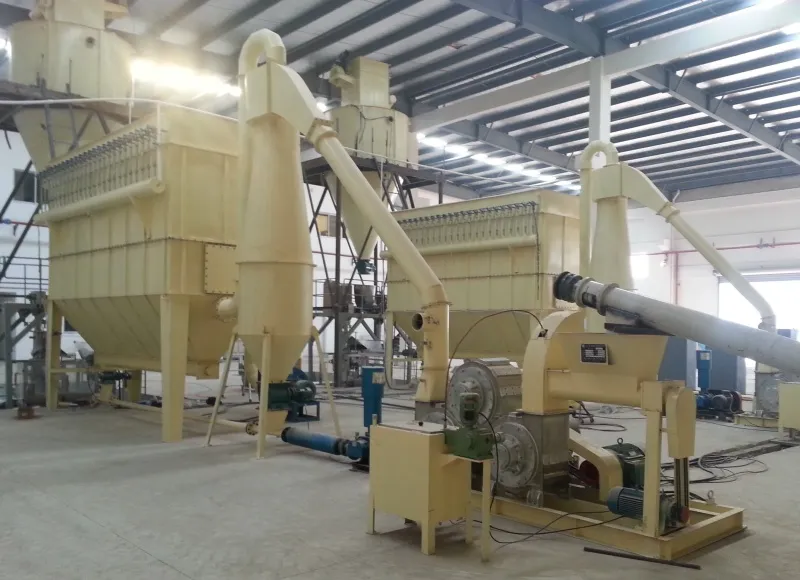
- Desulfurization powder: crushing → Raymond mill or vertical roller mill, making limestone powder at 250–325 mesh, commonly with 325 mesh residue ≤ 10% → pneumatic conveying to a silo → direct injection into the furnace, or slurrying.
- Wet desulfurization: on-site slurry preparation with a wet ball mill or stirred mill → hydrocyclone classification → slurry tank feeding the absorber.
- Wastewater and soil remediation: crushed and screened coarse powder, or Raymond mill fines. Here the goal is the lowest cost per ton.
- This is a classic high-volume, low-price market. Selection focuses on large capacity, low power use and high uptime. Vertical roller mills and large Raymond mills lead. Single-machine capacity often matters more than fineness.
- Do not cut fineness casually. Desulfurization reaction rate is directly linked to powder fineness and specific surface area. Grinding too coarse lowers desulfurization efficiency. It also raises limestone consumption and degrades gypsum quality.
- Build close to the customer. Desulfurization powder is sensitive to transport distance. Satellite grinding stations near power plants and steel mills are the mainstream model. They include silos and pneumatic conveying.
- Soil remediation. The product applied is coarse powder or powdered limestone. Crushing, screening and iron removal are enough. There is no need to grind to several hundred mesh. Spreading machinery is used for application.
- Nano-CaCO₃ for deep adsorption. The volume is small and the price is high. It is only blended in for advanced heavy metal treatment. It requires a wet-modified nano line, and drying and packing must be managed as fine chemicals.
Field 9: New Energy Advanced Materials — Lithium Batteries and Photovoltaics
Key Functions, nano-CaCO₃ only
- Electrolyte additive for lithium batteries: it adsorbs HF impurities and stabilizes the SEI layer. This extends cycle life.
- Separator coating: plate-like ultra-fine calcium carbonate improves heat resistance and thermal shutdown safety.
- PV encapsulant film: nano-CaCO₃ adjusts thixotropy and aging resistance. It improves module weatherability.
Selection Requirements
The powder must be high in purity and low in impurities. Use nano-CaCO₃ made by wet surface treatment. Keep moisture at 0.1% or below.
🔧 Matching Powder Processing Equipment
Recommended chain: high-purity limestone → calcination, slaking and refining → clean carbonation tower, with precise control of crystal form and particle size → wet modification tank plus high-shear emulsification → filter press or centrifuge dewatering → low-temperature drying, spray drying or a paddle plus flash combination → jet mill deagglomeration → precision classification → magnetic removal and clean packing.
- This field has the highest equipment barrier. Line investment and technical difficulty far exceed an ordinary GCC line. It is essentially fine chemicals plus powder engineering.
- Moisture ≤ 0.1% is stricter than the 0.2% used in rubber. Drying temperature and residence time must satisfy three goals at once: reach the moisture target, avoid hard agglomerates, and avoid decomposing the treatment agent. A two-stage system with low temperature and long residence time is common. Add dew-point control and an online moisture analyzer.
- Magnetic foreign matter control. Lithium battery materials are extremely sensitive to metal contaminants such as Fe, Cu and Zn. Use high-gradient magnetic separation or electromagnetic iron removal. Keep the whole line free of metal contact, using ceramic, PU and stainless steel. Test magnetic substances to battery-grade standards.
- Plate-like ultra-fine grades for separator coating. These are not ordinary spherical nano-CaCO₃. A crystal-growth director is needed during carbonation to obtain the shape. Wet grinding, or delamination, plus classification controls the aspect ratio. This places higher demands on both the stirred mill and the classifier.
- Grades for PV encapsulant film. The key properties are thixotropy and aging resistance. The treatment agent must be weather-resistant and low in volatiles. The drying step must avoid thermal decomposition of the organic agent.
Field 10: Sealants and Adhesives — MS Polymer, Silicone and Epoxy
Key Functions
- Gives the system good thixotropy. The sealant does not run during application and does not sag on vertical surfaces.
- Improves elongation, crack resistance and bond strength.
- Replaces fumed silica. This lowers the manufacturing cost of high-end sealants.
Selection
Use activated nano-CaCO₃ as the main filler. Blend in 5%–10% ultra-fine GCC to reduce viscosity and control total cost. Total loading range: 40%–60%.
🔧 Matching Powder Processing Equipment
Recommended chains:
- Nano-CaCO₃ main filler: carbonation tower, with particle size controllable in the 60–100 nm range → fatty acid wet surface treatment → plate-and-frame filter press → drying, using paddle, flash or belt dryer → deagglomeration → classification → packing.
- Blended ultra-fine GCC: ring-roller mill or vertical roller mill → classification → continuous modifier. Used at 5%–10%.
- Thixotropy comes from treatment plus deagglomeration. Treat without deagglomerating, and agglomerates make the sealant rough and hard to extrude. Deagglomerate without treating, and the thixotropic index stays low. Wet surface treatment plus strong deagglomeration is therefore the standard combination. Target an activation degree of at least 98%.
- The drying method directly affects sealant performance. Belt and paddle dryers are gentle and protect particle structure. They suit high-end sealants. Flash drying is efficient and high in capacity, but hot-air temperature must be controlled to prevent charring of the treatment agent.
- Blended ultra-fine GCC. Its role is to lower viscosity and cost. Its fineness is usually a step away from the nano main filler, for example 1250–2500 mesh. The gradation effect improves packing and rheology.
Conclusion
The industrial logic behind calcium carbonate is simple. The ore sets the lower limit. The equipment sets the upper limit. The application sets the price.
Take the same limestone. Run it through a Raymond mill and make 400-mesh construction powder. Or take it through wet carbonation, surface treatment and deagglomeration, and make activated nano-CaCO₃. The price gap can be several times over, and sometimes more than ten times.
So plan a calcium carbonate project in this order. First decide which field you will sell into. Then work backwards to the equipment chain. How large should the mill be? Is classification needed? Should surface treatment be dry or wet? Which dryer type is the right one? Once the target field is clear, the answers come by themselves.

“Thanks for reading. I hope my article helps. Please leave a comment down below. You may also contact Molly online customer representative for any further inquiries.”
— Posted by Emily Chen