
Calcium carbonate (CaCO3) is arguably one of the most versatile industrial minerals on the planet. From serving as a critical filler in plastics, rubber, and PVC to acting as a functional coating pigement in the paper and paint industries, its applications are vast.
However, in the mineral processing world, calcium carbonate raw material (whether it is limestone, marble, or calcite) has zero commercial value in its rocky, quarried state. Its worth is unlocked entirely through industrial grinding.
For plant managers, engineers, and investors, the multi-million-dollar question is always: How do we grind this material to the exact required specification while keeping energy consumption and operational costs as low as possible?
Choosing the wrong industrial mill can lead to catastrophic operational expenditures (OpEx), high equipment wear, poor product whiteness, and a failure to meet particle size requirements. This comprehensive guide breaks down the core grinding mechanics, equipment options, and selection criteria to help you choose the right calcium carbonate grinding mill efficiently.
1. Ground vs. Precipitated: Understanding Your Starting Material
Before looking at machinery, you must classify your feed material. Calcium carbonate fillers are broadly split into two categories, each requiring a fundamentally different handling strategy:
Ground Calcium Carbonate (GCC)
GCC is produced by mechanically crushing and grinding natural mineral deposits such as limestone, marble, or chalk. The material is crystalline, abrasive, and ranges in Mohs hardness from 3.0 to 4.0. The goal of grinding ground calcium carbonate is top-down particle size reduction—shattering hard mineral crystalline bonds into fine powders.
Precipitated Calcium Carbonate (PCC)
PCC is synthesized chemically via a carbonation process. When it leaves the chemical reactor, it already possesses a primary chemical structure, but the particles naturally cluster together into agglomerates. The goal of milling PCC is usually de-agglomeration and surface modification rather than heavy crystalline crushing, requiring milder, highly precise shearing mechanics to avoid destroying the engineered crystal shapes.
This guide will primarily focus on GCC production, which represents the vast majority of heavy-duty industrial milling installations globally.
2. Define Your Target Particle Size (The Ultimate Selection Factor)
In the powder industry, efficiency cannot be calculated without defining your “destination”—the exact final fineness required by your end buyers. Industrial specifications use both Mesh sizes and Microns (μm), typically measured by D97 (meaning 97% of the total powder mass passes through that specific size threshold) or D50 (the median particle size).
The target particle size distribution (PSD) is the single biggest factor determining your equipment path:
| Powder Category | Micron Range (D97) | Equivalent Mesh Size | Typical Industrial Applications |
| Coarse Powder | > 45μm | 80 – 325Mesh | Construction aggregates, artificial stone, animal feed, basic glass manufacturing. |
| Medium-Fine Powder | 10 – 45μm | 325 – 1250Mesh | Standard rubber compounding, PVC pipes, cables, joint compounds, basic paints. |
| Ultra-Fine Powder | 2 – 10μm | 1250 – 6000 Mesh | High-end plastics, breathable films, automotive coatings, premium paper coating. |
| Nano-Grade Powder | < 1μm | > 6000Mesh | Specialized sealants, pharmaceutical applications, advanced polymer nanocomposites. |
3. The Core Contenders: Comparing Industrial Calcium Carbonate Grinding Mills
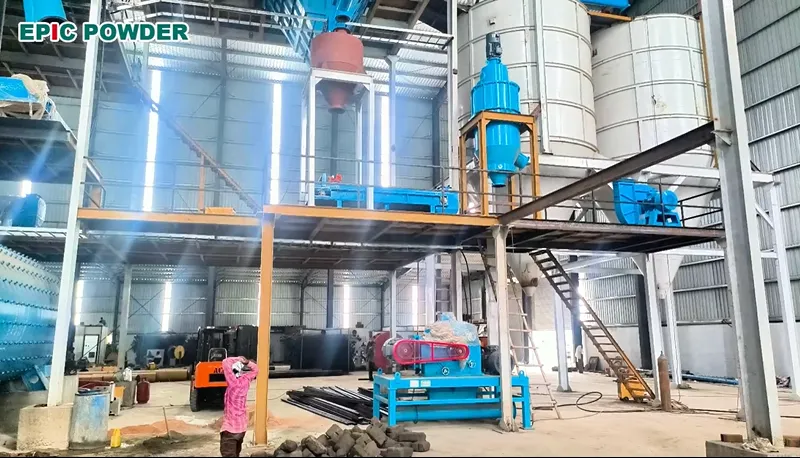
Different mills employ different mechanical forces—such as impact, attrition, pressure, or shearing—to reduce particle size. Let’s analyze the four primary industrial grinding mills utilized for calcium carbonate processing.
A. Raymond Roller Mills (The Traditional Workhorse)
Raymond mills use centrifugal force to press suspended rollers outward against a stationary grinding ring. Material is scooped up by blades and pushed between the rollers and the ring, where it is crushed by pure pressure.
- Best Suited For: Coarse to medium-fine GCC (200 – 400mesh).
- Efficiency Profile: Highly cost-effective for coarse ranges. According to industrial data, Raymond mills consume 30% to 50% less electricity than traditional ball mills when producing standard 200 – 325mesh powder.
- Limitation: They hit an efficiency wall beyond 600mesh. Attempting to grind finer causes high vibration, extreme mechanical wear, and a sharp drop in hourly capacity.
B. Vertical Roller Mills / VRM (The Modern Standard for Scale)
A VRM features a large, horizontally rotating grinding table where heavy hydraulic-loaded rollers apply massive, controlled downward pressure onto a bed of material.
- Best Suited For: Large-scale production spanning medium to ultra-fine ranges (400 – 2500mesh).
- Efficiency Profile: Exceptionally high specific energy efficiency. Because it combines drying, grinding, and classifying into a single enclosed loop, it eliminates the need for multi-stage external transport equipment. Its internal dynamic classifier ensures material is evacuated the moment it hits target size, completely eliminating over-grinding.
- Limitation: Very high initial capital expenditure (CapEx). It is rarely economical for small operations producing less than 5 to 10 tons per hour.
C. Ring Roller (The Specialty Choice)
These mills feature multiple layers of rings and rollers arranged vertically. The material drops through successive stages, subjected to repeated high-frequency impact, rolling, and grinding attrition.
- Best Suited For: High-value, ultra-fine powders (1250 – 6000mesh) at moderate production volumes.
- Efficiency Profile: For producing highly micronized fillers (e.g., D97 = 5μm) at lower capacities, these systems offer a lower capital cost setup compared to a VRM while maintaining crisp classification control.
- Limitation: Higher wear parts consumption over time if the raw limestone contains silica contaminants.
D. Ball Mills + Multi-Wheel Air Classifier Systems (The Heavy-Duty Giant)
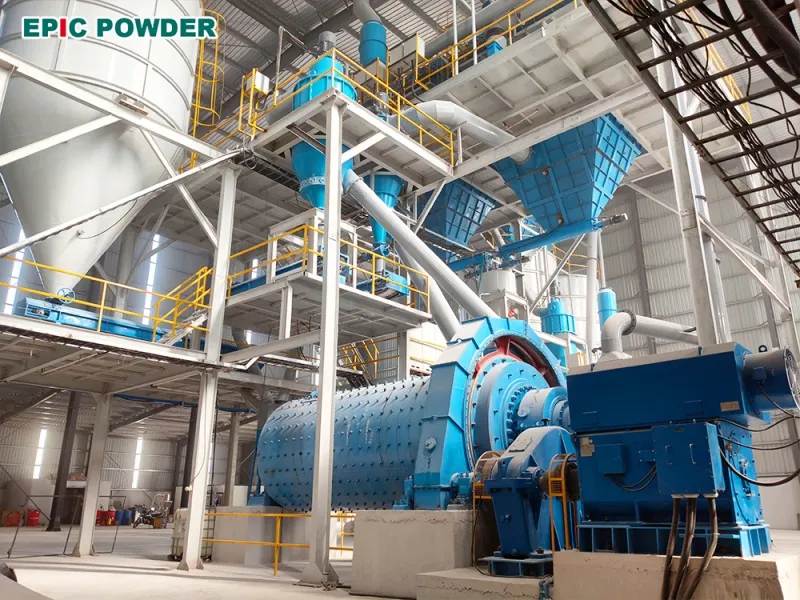
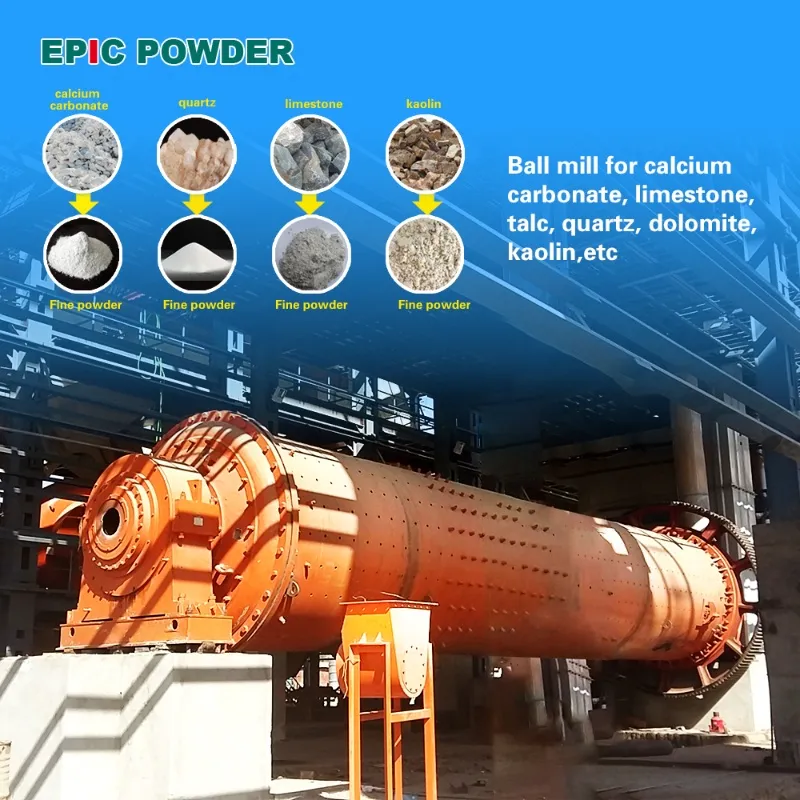
A ball mill consists of a large, horizontally rotating cylinder filled with grinding media (steel or ceramic balls). As the cylinder spins, the balls are lifted and cascade downward, crushing the mineral via impact and friction.
- Best Suited For: Mega-capacity, continuous production lines delivering ultra-fine powders (2500 – 6000mesh).
- Efficiency Profile: When paired with high-efficiency multi-wheel air classifiers, ball mills can run continuously for days with minimal downtime. They tolerate varied feed sizes well and offer highly predictable grain shapes.
- Limitation: High internal friction leads to substantial energy loss through heat. It has the highest specific energy consumption (kWh/t) among all options for medium ranges, meaning it is only efficient when deployed for massive, ultra-fine operations.
4. Key Engineering Metrics for True Process Efficiency
True grinding efficiency is measured far beyond the initial price tag of the machinery. To optimize your long-term return on investment, design your production line around these four critical engineering parameters:
1. Specific Energy Consumption (kWh/T)
Power consumption is the single largest component of operating costs in mineral processing. Calculate efficiency by dividing the total electrical draw of the system (including fans and classifiers) by the net hourly output of qualified powder.
Efficiency Rule: If your target is 325mesh, a Raymond mill or standard VRM provides optimal kWh/ton. If your target is 2500mesh, choosing a standard ball mill without a hyper-efficient multi-wheel air classifier will cause your energy bills to devour your profit margins.
2. Whiteness Preservation & Contamination Control
Calcium carbonate’s market price is deeply tied to its whiteness index (often requiring >92% to 95%). Traditional steel liners and steel grinding balls shed microscopic iron particles during high-impact milling. This iron oxidizes, staining the powder and turning it grey or yellow—rendering it useless for premium paint or plastic applications.
- Solution: For high-whiteness applications, ensure the mill uses alumina ceramic, polyurethane, or specialized high-chromium alloy liners to minimize metallic contamination.
3. Classification Efficiency (Preventing Over-Grinding)
Grinding efficiency is often determined by how fast you can get the finished powder out of the mill. If finished particles float around inside the grinding chamber too long, they continue to absorb mechanical energy and crush further, a phenomenon known as over-grinding. This wastes power and creates an excess of undesirable ultra-fine dust.
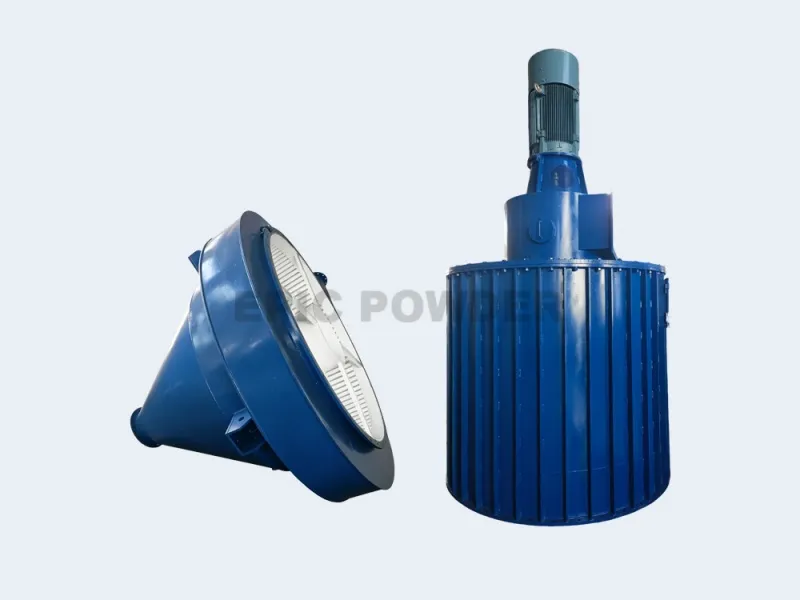
- Look for integrated, frequency-inverter controlled dynamic classifiers that instantly separate qualified target sizes and recycle oversized grains back to the grinding bed.
4. Raw Material Moisture & Feed Size
If your raw limestone has a moisture content greater than 1% to 2%, it will become sticky during fine milling, coating the grinding media and blinding the internal screens or classifiers.
- Efficient mill layouts integrate hot air furnaces directly into the air-swept circuit of a VRM or Raymond mill, drying the material while it is being crushed, saving the massive footprint and fuel costs of installing a standalone rotary rotary dryer beforehand.
5. Step-by-Step Selection Framework
When designing or upgrading your plant, use this logical checklist to eliminate unsuitable equipment and pinpoint the exact mill combination you need:
1.Step 1: Analyze the Raw Feed Properties
Conduct laboratory testing on your source mineral. Determine its Mohs hardness, moisture content, and silica content (SiO2). High silica means high abrasiveness, instantly ruling out high-speed impact mills due to extreme wear parts costs.
2.Step 2: Establish Your Target Size Distribution (D97)
Identify your primary market buyers. Do you need a broad particle size distribution for construction, or a highly narrow, steep curve (D97 < 5μm) for functional plastic masterbatches?
3.Step 3: Calculate Required Hourly Production Capacity
Define your scale. For under 3 t/h, look at small-scale Raymond or ring roller mills. For 5 to 20 t/h, medium VRMs and ball mill dominate. For large mining operations exceeding 30 to 50 t/h, massive vertical roller mills or ball mill lines are the only viable solutions.
Conclusion
There is no single “best” mill for grinding calcium carbonate; there is only the right mill for your specific parameters. If you are processing coarse filler at a low budget, the traditional Raymond mill remains highly efficient. For modern, large-scale setups targeting high-grade fine and ultra-fine fillers, the Vertical Roller Mill (VRM) offers unmatched specific energy efficiency and automated control. For massive ultra-fine operations, a rugged Ball mill combined with specialized classifiers ensures continuous reliability.
By precisely mapping out your raw material characteristics, target micron size, and long-term utility costs, you can construct a highly optimized, energy-efficient processing line that yields maximum powder quality at the lowest possible running cost.

“Thanks for reading. I hope my article helps. Please leave a comment down below. You may also contact Zelda online customer representative for any further inquiries.
— Posted by Emily Chen
“