
In the context of accelerating global industrialization and increasingly stringent environmental regulations, industrial wastewater treatment has become a core challenge for sustainable manufacturing. Calcium carbonate (CaCO3), as a natural mineral that is widely available, cost-effective, and non-toxic, has long been utilized in construction, papermaking, and plastics. However, the application of ordinary industrial-grade calcium carbonate in wastewater treatment is often hindered by its small specific surface area, low reactivity, and limited physicochemical properties.
In recent years, the deep integration of ultrafine grinding technology and surface modification has enabled modified ultrafine calcium carbonate powder to demonstrate superior performance in heavy metal removal, acid neutralization, and dye wastewater treatment. This article explores how to fundamentally enhance wastewater treatment efficiency through particle size control, physicochemical modification, and process integration.
Ultrafine Grinding — The First Step in Activating Environmental Potential
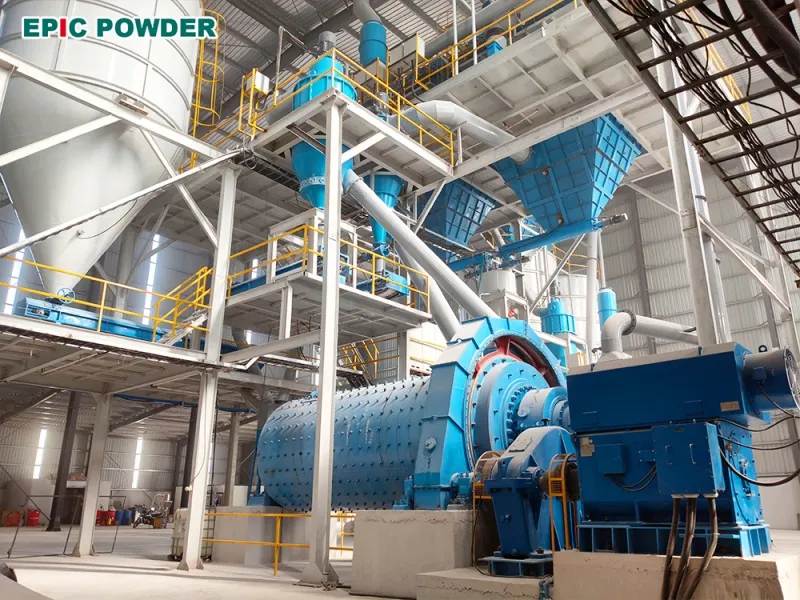
Ultrafine grinding is not merely a change in size; it represents a qualitative leap in the physical properties of the material.
1. Exponential Increase in Specific Surface Area
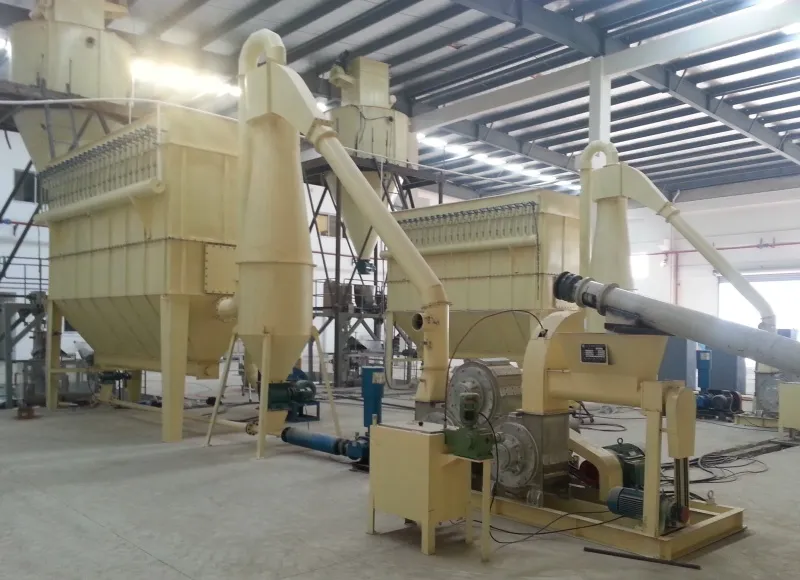
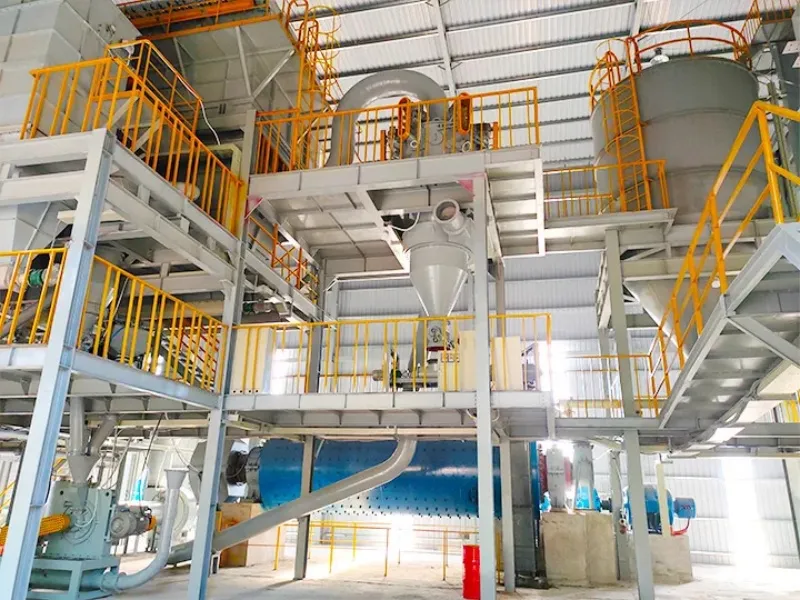
Adsorption and neutralization reactions in wastewater treatment are highly dependent on the contact area. While ordinary 200-mesh calcium carbonate powder has limited active sites, processing it to an ultrafine grade (D50 ≤2μ) via fluidized bed jet mills or ball mill classification lines results in an exponential increase in specific surface area. This allows a unit mass of calcium carbonate to provide significantly more active sites to capture heavy metal ions (e.g., Pb²+, Cd²+) or neutralize acidic substances.
2. Surface Free Energy and Reactivity
Mechanochemical effects are a vital phenomenon during ultrafine grinding. During high-speed impact and shearing, the crystal lattice of calcium carbonate undergoes distortion, leading to increased surface energy. This ensures that the ultrafine powder possesses higher chemical reactivity when dispersed in water, allowing for faster participation in chemical precipitation.
Calcium Carbonate Modification — Empowering “Recognition” and “Capture”
Pure ultrafine processing cannot solve the issues of dispersibility and selectivity in complex wastewater environments. Functionalization must be achieved through calcium carbonate modification.
1. Surface Chemical Modification: Building “Chemical Grippers”
By coating ultrafine calcium carbonate with organic modifiers (such as silane coupling agents, stearic acid, or quaternary ammonium salts), the surface charge properties can be strategically altered:
- Anionic Modification: Imparts a negative charge to the surface, enhancing the electrostatic adsorption of cationic heavy metal ions.
- Chelating Functional Group Grafting: Grafting molecules with chelating functions onto the ultrafine powder allows it to precisely “clamp” and capture specific pollutants.
2. Inorganic Coating Modification
Using silica (SiO2) or activated alumina for surface coating enhances the acid resistance of calcium carbonate. This prevents premature dissolution in highly acidic environments, thereby extending adsorption time and improving treatment depth.
3. Hydrophilic/Lipophilic Balance Adjustment
For oily wastewater, calcium carbonate modification can render the powder hydrophobic and oleophilic. This allows it to act as an efficient demulsifier, adsorbing and removing oil components effectively.
Core Mechanisms for Enhancing Treatment Efficiency
1. Synergistic Heavy Metal Treatment
Modified ultrafine calcium carbonate follows a triple mechanism of “Adsorption-Exchange-Precipitation”:
- Adsorption: Physical adsorption generated by the ultra-high specific surface area.
- Ion Exchange: Active groups provided by the modification layer exchange with metal ions.
- In-situ Neutralization: The alkalinity produced by the hydrolysis of calcium carbonate promotes the formation of metal hydroxides, which wrap around the particles to form large, easily settleable flocs.
2. Precise Neutralization of Acidic Wastewater
Compared to traditional sodium hydroxide or quicklime, modified ultrafine calcium carbonate offers a gentler neutralization process. It avoids secondary pollution caused by localized over-alkalinity and produces by-products (like calcium sulfate) with uniform particle sizes that are easy to separate.
3. Enhanced Flocculation and Sedimentation
Ultrafine particles act as “micro-nuclei.” When high-molecular flocculants (like PAM) are added, the modified particles guide pollutants to aggregate rapidly. The improved dispersibility ensures the powder does not clump upon dosage, maximizing chemical utilization.
Case Study and Economic Analysis
1. Dye Wastewater Decolorization
In a large-scale printing and dyeing plant, quaternary ammonium salt-modified ultrafine calcium carbonate was introduced:
- Decolorization Rate: Increased from 75% to over 96%.
- Dosage: Calcium carbonate consumption was reduced by 30% due to increased activity.
- Sludge Management: The resulting mineral sludge exhibited excellent dewatering properties, lowering downstream costs.
2. Economic and Environmental Benefits
- Cost Advantage: Modified calcium carbonate costs only a fraction of activated carbon or specialized ion-exchange resins.
- Waste-to-Value: Many industrial calcium carbonate by-products can be returned to the environmental sector after ultrafine modification, achieving a circular economy.
Conclusion
By utilizing ultrafine grinding technology to boost physical activity and applying targeted calcium carbonate modification, this traditional mineral is transformed into a high-precision tool for wastewater treatment. This is not just an advancement in material science, but a necessity for industrial green transformation.
For wastewater treatment enterprises, choosing ultrafine powder solutions with precise particle size control and high-efficiency modification processes will be the most effective path to reducing environmental costs and meeting compliance standards in 2026 and beyond.
“Thanks for reading. I hope my article helps. Please leave a comment down below. You may also contact Zelda online customer representative for any further inquiries.”
— Posted by Emily Chen