
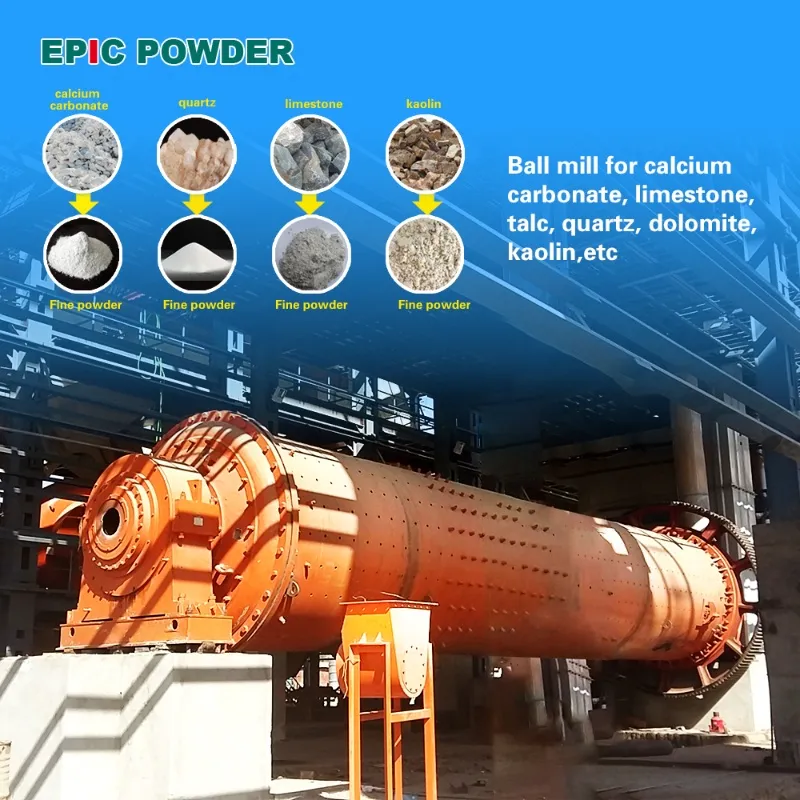
Ground Calcium Carbonate (GCC) is an industrial powder produced by the mechanical grinding of natural calcite, marble, or limestone. As the most widely used inorganic filler, the quality of ultrafine grinding for ground calcium carbonate—reaching micron or even sub-micron levels—directly determines its value in high-end manufacturing sectors like papermaking, plastics, rubber, and coatings.
As downstream industries demand narrower particle size distribution, higher whiteness, and lower oil absorption, production has evolved. It is no longer just simple crushing but a precisely controlled system engineering process. Below are the six most prevalent ultrafine grinding processes used in the industry today.
Traditional Raymond Mill Grinding (Primary Dry Process)
The Raymond Mill is a “perennial favorite” in GCC processing. While it lacks competitiveness in the strict “ultrafine” field (D90 < 5μm), it still holds a massive share of the mid-range market for 200 to 400 mesh powders.
- Process Principle: It relies on centrifugal force generated by grinding rollers suspended on a star rack. As they rotate, the rollers press tightly against the grinding ring. Material is crushed and ground between them. An internal fan blows the ground powder to the classification zone at the top.
- Advantages: High integration, small footprint, low investment threshold, and extremely simple operation.
- Limitations: High wear rate. It easily introduces metallic iron impurities, which reduce whiteness. Due to classification limits, it is difficult to produce high-end ultrafine powder above 800 mesh.
Ultra-fine Vertical Roller Mill (V-R Mill) Process (Large-Scale Dry Process)
The Ultra-fine Vertical Roller Mill represents the modern trend toward large-scale and intelligent dry processing. It is currently one of the most efficient methods for ultrafine grinding for ground calcium carbonate.
- Process Characteristics: It uses the principle of material bed comminution. Grinding rollers, powered by a hydraulic system, exert pressure and shear force on the material layer on a rotating disc. This process usually integrates multi-head, high-precision turbine classifiers.
- Core Advantages:
- Extremely Low Energy Consumption: Compared to traditional ball milling, the energy consumption of a vertical mill can be reduced by over 30%.
- High Capacity: A single machine can produce 5–20 tons per hour. This makes it ideal for large-scale factories with an annual output exceeding 100,000 tons.
- In-line Modification: It is easy to inject coating agents into the system. This allows grinding and surface modification to be completed simultaneously.
- Applications: Plastic masterbatch, artificial marble, and PVC pipes where cost control is critical.
Dry Ball Mill + Classifier Closed-Circuit Process (High-Flexibility Dry Process)
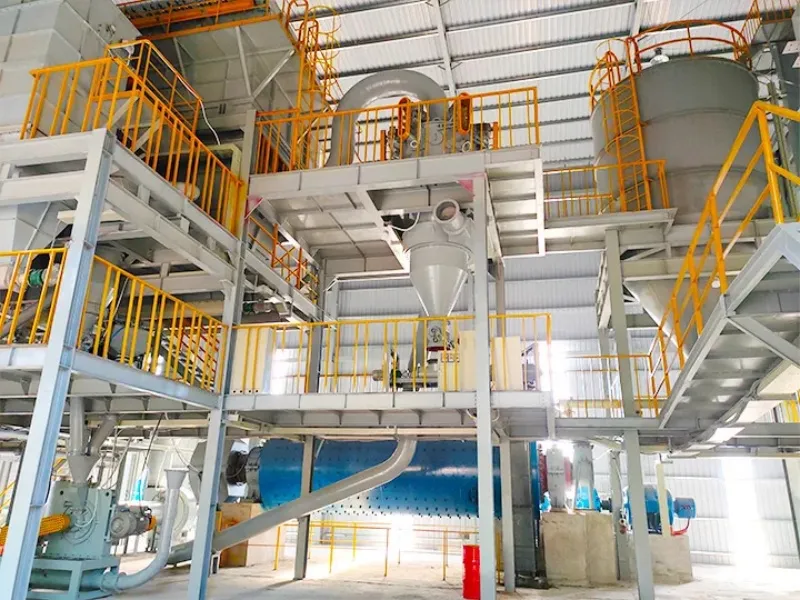
This is currently the most mature and stable solution for producing high-end GCC powder between 1,250 and 2,500 mesh (D90: 5–12μm).
- Process Flow: The ball mill acts as the main grinding unit. It is lined with ceramic plates and filled with high-alumina balls. After grinding, the material is sent to an ultrafine air classifier via an elevator. The classifier selects the qualified fine powder. The oversized particles (rejects) are returned to the ball mill for re-grinding.
- Technical Highlights:
- Superior Particle Morphology: Long-term grinding in a ball mill rounds off the edges of particles. This results in nearly spherical shapes, which helps lower oil absorption in downstream plastic processing.
- Multi-Stage Linking: By connecting multiple classifiers with different speeds in a series, a single ball mill circuit can simultaneously produce various grades (e.g., 800 mesh and 2,500 mesh).
- Key Consideration: Ball consumption and temperature rise must be strictly controlled to prevent the powder from yellowing due to overheating.
High-Speed Impact Mill / ACM Process (Short-Flow Dry Process)
For applications requiring a very narrow particle size distribution (PSD), high-speed impact processes like those from Epic Powder perform excellently. This short-flow setup is a highly reactive approach to ultrafine grinding for ground calcium carbonate.
- Equipment Selection: Typical examples include the ACM series or air jet mill systems from Epic Powder.
- Mechanism: Hammers on the rotor strike the material at high linear speeds. The material undergoes high-frequency impact and shear between the stator liner and the rotor.
- Advantages:
- High Efficiency: For products between 400 and 1,000 mesh, its efficiency far exceeds that of a Raymond mill.
- Easy Maintenance: Compared to complex vertical or ball mill systems, the wear parts of an impact mill can be replaced very quickly.
- Applications: High-end coatings and pre-treatment for paper coating fillers.
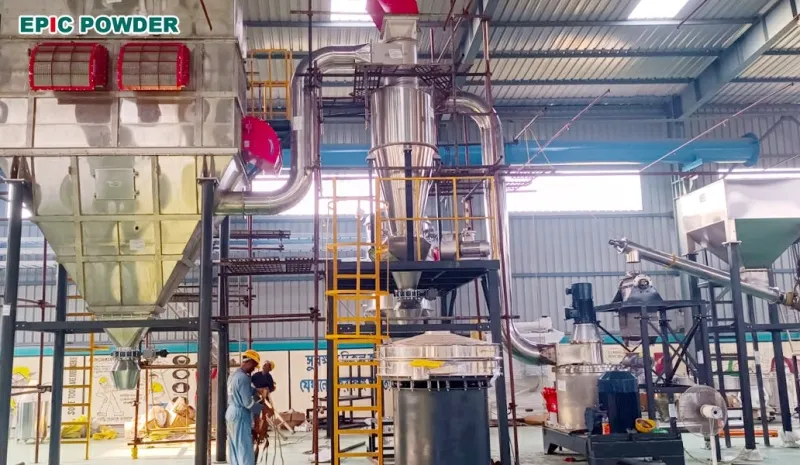
Wet Ball Mill / Stirred Mill Process (Nano-Level Breakthrough)
When GCC requirements reach D90 < 2μm (or even D50 < 0.5μm), dry processes fail due to particle agglomeration and electrostatic interference. At this stage, wet processing is mandatory.
- Process: Pre-ground powder (such as 400 mesh) is mixed with water and high-efficiency dispersants to form a slurry. This enters a horizontal or vertical stirred mill. The mill is filled with ultrafine zirconia beads (0.5–2mm in diameter).
- Performance Benefits:
- Extreme Fineness: Capable of producing sub-micron, “milky white” slurries.
- High Opacity: The extremely fine particle size gives the GCC excellent hiding power and smoothness in paper coatings.
- Cost Considerations: Wet processing requires high energy for subsequent drying (e.g., spray drying). Therefore, it is often supplied directly as a slurry to nearby paper or coating mills.
Two-Stage Composite Grinding Process (Combined Dry & Wet)
To achieve the best cost-to-performance ratio, industry leaders often use a two-stage composite process: “Dry Pre-grinding + Wet Ultrafine Grinding.”
- Stage 1: A vertical mill or ball mill processes the raw ore to D90 = 20–30μm. Dry processing is most efficient and cost-effective at this stage.
- Stage 2: The dry powder from the first stage is used as raw material for a wet stirred mill. It is ground deeply until D90 < 2μm.
- Advantages: This avoids the inefficiency and severe wear caused by feeding large particles directly into a wet mill. By optimizing each stage, the total energy consumption of the line can be reduced by more than 20%.
Key Considerations for Process Selection
In actual production, the “best” process is not necessarily the most expensive one. It requires a balance of three factors:
1. Target Particle Size and Distribution (PSD)
- For D90: 10–15μm, the vertical roller mill is the efficiency leader.
- For D90: 2–5μm, choose a ball mill with a high-precision classifier or move directly to wet grinding.
2. Oil Absorption
This directly affects the costs for downstream customers. Ball milling produces rounded particles, which usually have lower oil absorption than the needle-like particles from impact mills.
3. Environment and Automation
Modern mining requires “green and dust-free” operations. Advanced systems, such as those from Epic Powder, provide negative-pressure environments to ensure PM2.5 compliance. Furthermore, integrated PLC systems can monitor D90 in real-time to ensure consistent quality.
Conclusion
Ultrafine processing of GCC is no longer just “grinding.” It is a comprehensive application of fluid mechanics, material mechanics, and surface chemistry. From traditional Raymond mills to the pinnacle of wet stirred mills, each process has its own space.
Future trends will move toward massive capacity (200,000+ tons per line), extreme fineness (sub-micron), and integrated surface modification. For producers, scientifically selecting the right grinding solution is the key to evolving from “selling rocks” to “selling advanced materials.”

“Thanks for reading. I hope my article helps. Please leave a comment down below. You may also contact Zelda online customer representative for any further inquiries.”
— Posted by Jason Wang