
Plastics and rubber have penetrated every aspect of our daily lives. Their applications range from household PVC pipes and appliance housings to automotive tires and seals, as well as industrial protective products and engineering components. The performance of these materials directly determines the product’s service life, safety, and user experience. Behind the performance upgrades of these common materials lies calcium carbonate modification technology.
What is Calcium Carbonate Modification Technology?
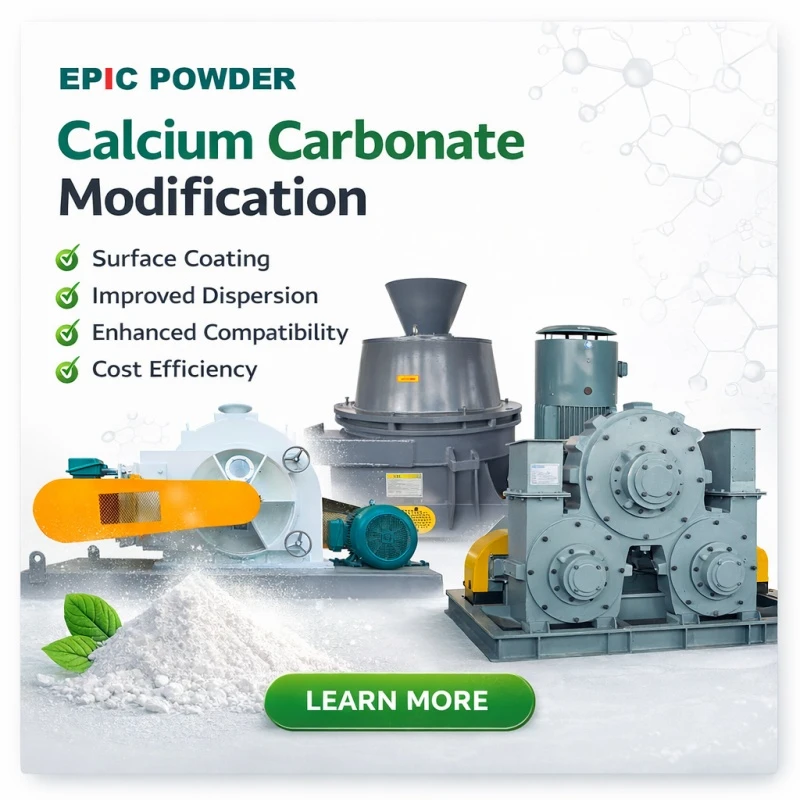
Simply put, calcium carbonate modification technology involves using physical, chemical, or composite methods to “customize” the surface properties and particle size distribution of calcium carbonate powders. This breaks the limitations of the raw material, allowing it to integrate better with plastics, rubber, and other organic matrices. It also imparts new functional properties to the materials.
Unmodified calcium carbonate has a hydrophilic surface, while plastics and rubber are hydrophobic. Mixing them without modification often leads to aggregation and weak bonding, which reduces material performance. After modification, a hydrophobic protective layer forms on the calcium carbonate surface. This allows it to disperse evenly in the matrix and form a strong bond with the matrix, providing reinforcement, toughness enhancement, and processing optimization.
The main modification technologies currently include:
- Surface modification: Using coupling agents or surfactants; this is the most common method.
- Composite modification: Combining calcium carbonate with talc, glass fibers, etc., for synergistic effects.
- Nano modification: Processing calcium carbonate to the nanoscale to enhance reinforcement effects.
Different technologies are suited to different material needs, precisely empowering a wide range of applications.
Modified Calcium Carbonate Makes Plastics Stronger, Tougher, and More Cost-Effective
The core demands of the plastics industry are “cost reduction, quality improvement, and ease of processing.” Calcium carbonate modification technology perfectly meets these three requirements, appearing in materials from common plastics to high-end engineering plastics.
- Cost Reduction and Processing Optimization
Calcium carbonate costs only 1/3 to 1/5 of general plastics. By adding 30%-40% of modified calcium carbonate to PVC pipes, manufacturers can reduce raw material costs by 15%-20%. Furthermore, modified calcium carbonate acts as a “lubricant” for the plastic melt. This reduces friction during processing, shortens molding cycles, and improves extrusion and injection efficiency. It also minimizes shrinkage, resulting in smoother surfaces and more uniform coloration. - Reinforcement and Toughness Enhancement
Surface-modified calcium carbonate forms a strong interface with the plastic matrix, providing both reinforcement and toughness. For example, adding nano-calcium carbonate (modified with silane coupling agents) to polypropylene (PP) increases flexural strength by 35% and impact strength by 28%. Similarly, in polyethylene (PE) films, ultra-fine modified calcium carbonate improves tear resistance by 40% and puncture resistance by 30%. - Functional Enhancement and Green Transformation
Modified calcium carbonate works synergistically with biodegradable plastics, such as PLA and PBS. It improves their rigidity and heat resistance while simultaneously reducing costs. By incorporating functional additives—such as flame retardants or antibacterial agents—modified calcium carbonate can also impart flame resistance, antibacterial properties, and anti-aging features to plastics. For instance, flame-retardant modified calcium carbonate can raise the oxygen index of plastics above 28. This achieves a “difficult-to-burn” rating, making it suitable for home appliances and automotive applications.
Calcium Carbonate Modification Equipment Drives Industry Upgrades
In the process of calcium carbonate modification, equipment is a critical factor to ensure uniform powder dispersion, stable surface modification, and optimized material performance. Different modification processes correspond to different types of equipment, each with unique advantages and application scenarios.
Three-Roller Coating Machine
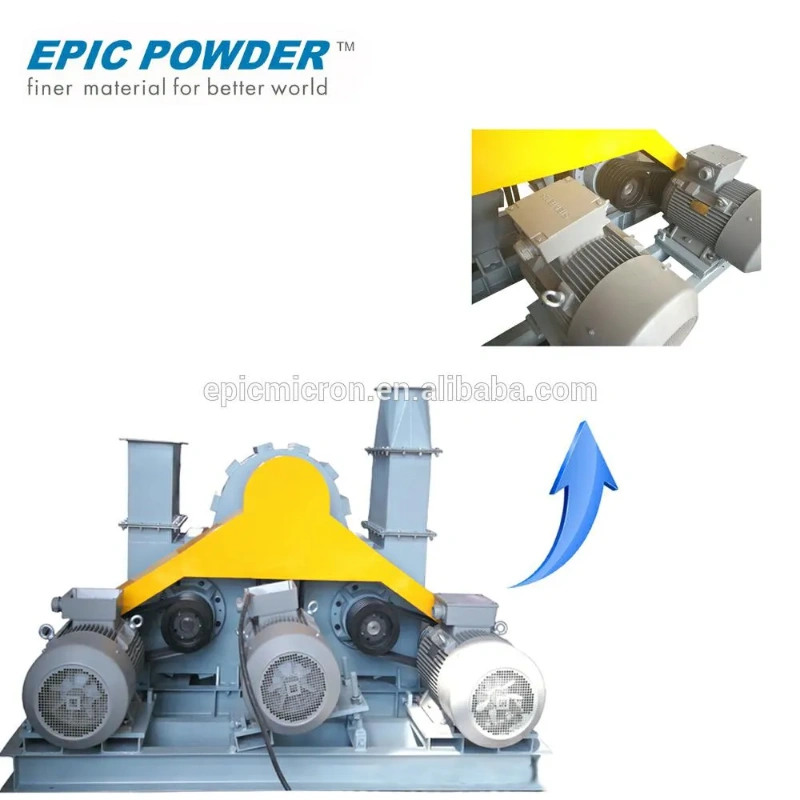
The three-roller coating machine uses three sets of high-speed rotating rollers to compress and evenly coat the surface of calcium carbonate powders with modifiers. The friction and shear forces between the rollers also help disperse the powders. This equipment is ideal for surface modification and composite modification, especially in medium-to-high viscosity systems. Its advantages include uniform coating, high precision control, easy operation, and suitability for continuous production on an industrial scale.
Pin Mill Coating Machine
The pin mill works by high-speed collisions and shearing between a rotating pin disc and a stationary disc, achieving fine grinding and surface modification of calcium carbonate. It is suitable for nanoscale powder processing, providing excellent modifier coverage and uniform particle distribution. This equipment is especially suited for plastic and rubber products that require ultra-fine powders and high dispersibility, significantly improving mechanical properties and processing performance
Turbo Mill Coating Machine
The turbo mill uses high-speed airflow or vortex flow to induce intense collisions, shearing, and coating of calcium carbonate powders with modifiers inside the milling chamber, achieving ultra-fine and continuous modification. It offers high productivity and efficiency, making it ideal for industrial-scale production of ultra-fine modified calcium carbonate. The turbo mill can precisely control particle size distribution and specific surface area while ensuring uniform modification, and it is widely used in high-end engineering plastics, functional rubber, and biodegradable materials
The use of these machines allows enterprises to achieve:
- Uniform Modification: Even coating of modifiers on powder surfaces reduces aggregation and improves dispersibility.
- Stable Performance: Mechanical, processing, and functional properties of powders become more stable and reliable.
- Industrial-Scale Production: Continuous, large-scale production increases output and processing efficiency.
- Customized Modification: Process parameters can be flexibly adjusted to meet the specific requirements of different plastics, rubber, and functional materials.
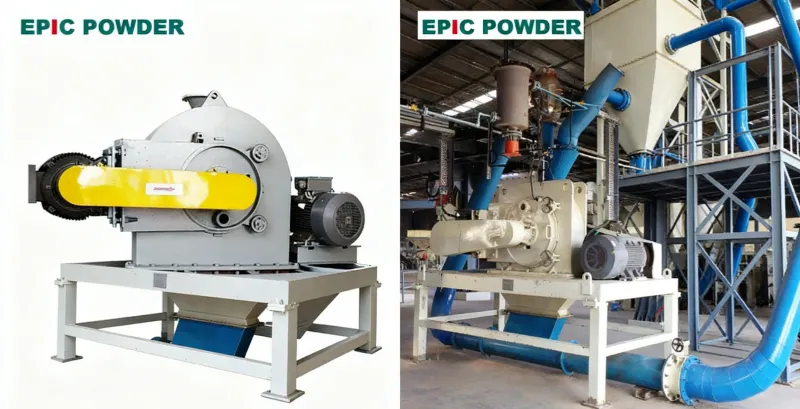
These equipment play a core role in the calcium carbonate modification industry. They provide strong technical support for optimizing the performance of plastics and rubber products, and they also offer a reliable foundation for the development of high-end and green materials.
Typical Application Scenarios (Compressed Version)
Modified calcium carbonate is widely used in PVC pipes, PE films, plastic toys, automotive bumpers, appliance housings, and electronic components. In the rubber industry, it is the third largest inorganic filler and reinforcing agent after carbon black and silica.
- Automotive Parts: PP modified with calcium carbonate and talc can reduce bumper weight by 10%-15%, increase flexural strength by 30%, and lower production costs.
- Child Safety Equipment: Nano calcium carbonate-modified helmet liners improve low-temperature impact resistance by 30%, preventing breakage even at -20°C.
- Rubber Products: Adding 30%-50% modified calcium carbonate reduces costs by 20%-30% while enhancing tensile strength, tear resistance, abrasion resistance, and aging resistance.
Special morphologies of modified calcium carbonate, such as chain-like crystalline structures, have low surface energy and large specific surface area, ensuring excellent dispersion. This further strengthens the mechanical properties and wear resistance of rubber.
With continuous advancements in modification technology, calcium carbonate has evolved from a low-cost filler to a performance enhancer. It not only lowers production costs but also addresses material performance limitations and promotes industry-wide green and high-end transformation.

“Thanks for reading. I hope my article helps. Please leave a comment down below. You may also contact Zelda online customer representative for any further inquiries.”
— Posted by Emily Chen