
The selection of calcium carbonate (GCC, PCC, and ACC) depends not only on the performance requirements of the final product but also on the production process and the choice of crushing and modification equipment. The processing precision, modification efficiency, and energy consumption of the equipment directly determine the microstructure and application performance of the powder.
Below, we will reconstruct a guide for selecting calcium carbonate and matching it with the production process, based on the technical characteristics of crushing and modification equipment.
I. Key Differences
| Types of Calcium Carbonate | Raw Materials and Production Process | Core Equipment | Particle/Surface Characteristics | Selection and Positioning |
| Heavy Calcium Carbonate (GCC), | Mechanical crushing of natural ore | Jaw Crusher/Raymond Mill/Ring Roller Mill/Vertical Mill/Ball Mill/Wet Sand Mill | Coarse/Medium-Fine Particle Size, High Density, Low Oil Absorption, Good Dispersibility | Prioritizing Cost-Effectiveness (Cost Reduction/Basic Filling) |
| Light Calcium Carbonate (PCC) | Calcination and chemical precipitation of limestone | Calcination Kiln/Digestion Reactor/Carbonation Tower/Dehydration and Drying Equipment | Fine/Micro-Fine Particle Size, Low Density, High Whiteness, Semi-Reinforcing | Performance Upgrade (High Whiteness/Volume Filling) |
| Active Calcium Carbonate (ACC) | Surface modification of heavy or light calcium carbonate | Continuous Modifier/High-Speed Mixer/Wet Modifier | Fine Particle Size, Oleophilic/Hydrophobic Surface, Excellent Compatibility | High-End Needs (High Reinforcement/High Filling) |
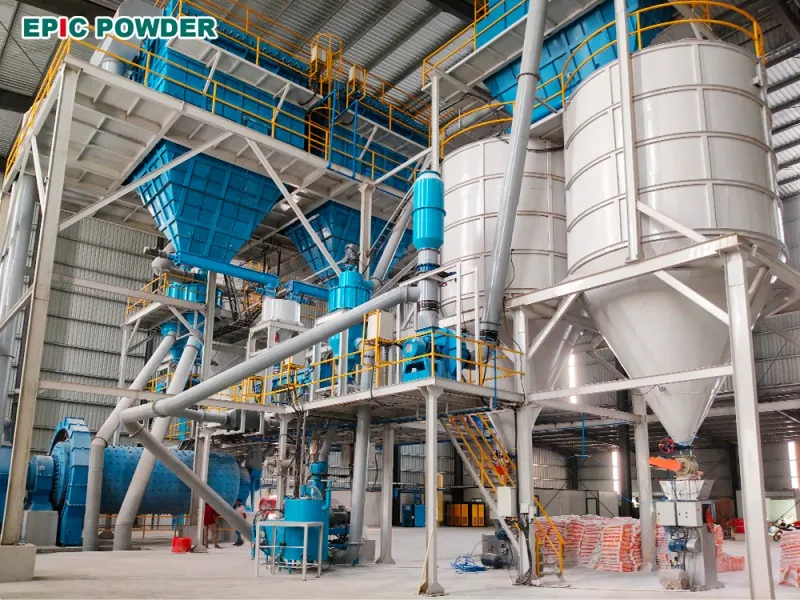
II. Selection Logic and Scenario Matching
Heavy Calcium Carbonate (GCC): Cost-Effectiveness First Choice
Particle Size Classification and Application Based on Crushing/Classifying Equipment
The performance of heavy calcium carbonate (CCalcium Carbonate) is highly dependent on the processing capacity of mechanical crushing and classifying equipment. Different equipment determines the product mesh size (particle size distribution) and its final application scenarios:
Coarse Powder and Medium-Fine Powder (400 mesh ~ 1250 mesh):
Main Control Equipment: Raymond mill, ring roller mill, vertical mill.
Application Scenarios: General plastics (pipes, plastic bags, turnover boxes), building exterior wall coatings, low-end rubber (rubber sheets, floor mats), and paper filling materials.
Selection Logic: Vertical mills and ring roller mills have high production efficiency and low energy consumption, making them suitable for large-scale production of cost-reducing heavy calcium carbonate.
Ultrafine powder (2500 mesh ~ 6000 mesh and above):
Main control equipment: Dry ball mill + air classifier system, wet stirred mill/sand mill.
Application scenarios: High-end films, adhesives, high-gloss industrial coatings.
Selection logic: Ultrafine heavy calcium carbonate requires a micron-level air classifier or wet sand mill to ensure a narrow particle size distribution and prevent large particles from passing through the sieve.
Light Calcium Carbonate: Performance Upgrade
Performance Control Based on Reaction and Pin Mill Deagglomeration.
The crystal form and whiteness of light calcium carbonate depend on the carbonization reaction. The degree of deagglomeration of the dried powder directly determines its dispersion performance:
Carbonization and Drying Control:
Reaction temperature and stirring rate are controlled via a carbonization tower, allowing for customized spindle-shaped, needle-shaped, or spherical crystals. Rapid drying is achieved using a rotary flash dryer after dehydration.
Pin Mill Deagglomeration:
Light calcium carbonate is highly prone to secondary agglomeration during drying. Using a Pin Mill, high-speed rotating pin bars subject the precipitated calcium carbonate to high-frequency impact and shearing, efficiently dispersing pseudo-agglomerates without damaging the primary crystal morphology, significantly reducing oil absorption and improving dispersibility.
Applications and Selection:
Suitable for appliance casings, plastic doors and windows, interior wall coatings, and daily chemical powders (such as toothpaste). Light calcium carbonate has a low specific gravity and large bulk volume, resulting in lower overall volumetric cost in products priced per unit/per area.
Activated Calcium: High-end demand, Suitable for “High-filler” and “High-Reinforcement” Scenarios
Applicable Scenarios:
High-end fields with extremely high requirements for product mechanical properties (impact resistance, tensile strength), interfacial bonding, and processing fluidity.
Applicable Scenarios: High-end fields with extremely high requirements for product mechanical properties (impact resistance, tensile strength), interfacial bonding, and processing fluidity.
- Typical Applications: High-end plastics (such as modified automotive plastics and engineering plastics), high-end coatings (such as automotive paints and industrial anti-corrosion paints; activated calcium has good dispersibility and can improve paint film adhesion), high-end rubbers (such as automotive tire treads, shock absorbers, and precision seals; activated calcium has good reinforcing properties and can significantly reduce rubber usage).
- Selection Recommendations: Suitable for high-value-added, high-filler formulations (activated calcium has good compatibility, and the filler volume can reach 2-5 times that of ordinary calcium, with potentially lower overall costs).
Note: Activated calcium is expensive. It is necessary to assess whether the added value brought by the performance improvement covers the cost. Furthermore, it is necessary to match the appropriate activator according to the base resin (e.g., silane modification is suitable for rubber, stearic acid modification is suitable for plastics).
III. Comparison and Selection of Mainstream Modification Equipment Technologies
The core quality of activated calcium lies in its coating rate and activation degree (usually requiring an activation degree ≥ 95%). The choice of modification equipment directly determines the utilization rate of modifiers and the surface properties of powders:
Pin Mill Modifier (Needle Mill/Pin-type Continuous Modifier)
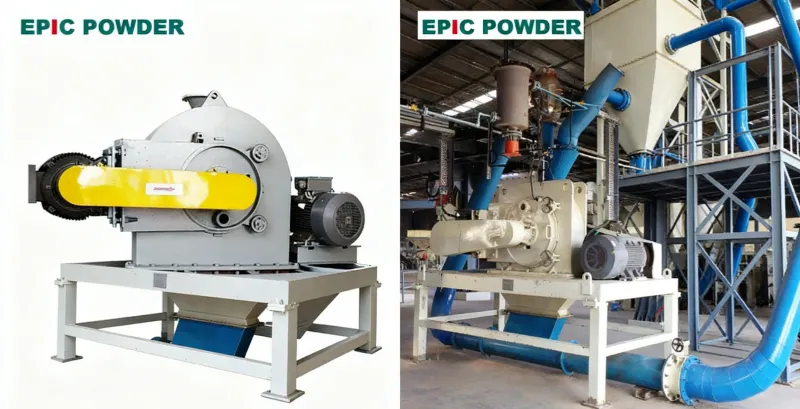
Working Principle: Utilizes pins on a high-speed rotating disc to subject the powder and modifier to intense high-frequency impact, shearing, and collision. Typically equipped with a bidirectional rotating disc, achieving extremely high linear speeds.
Technical Advantages: Simultaneous “depolymerization + modification”. Ideal for light calcium carbonate or easily agglomerated ultrafine heavy calcium carbonate, instantly and uniformly coating the molten or atomized modifier onto the surface of the virgin particles while dispersing agglomerated particles.
Applicable Scenarios: Active modification of ultrafine light calcium carbonate, modification of ultrafine heavy calcium carbonate with a mesh size of 2000 or larger, widely used in plastic masterbatches, films, and high-end coatings.
Three-Roll Modifier
Working Principle: Consists of three vertical modifying cylinders connected in series. Utilizing the vortex airflow, shear force, and frictional heat generated by the high-speed rotating impeller at the bottom, the powder is fluidized and suspended, fully coating it with the modifier.
Technical Advantages: Strong continuous production capacity. Materials undergo preheating, coating, and maturation sequentially within the three cylinders, resulting in extremely uniform modifier dispersion. Low operating costs and easy industrial scaling.
Applicable Scenarios: Large-scale continuous modification of medium to large-scale dry-process heavy calcium carbonate (800-2500 mesh) and light calcium carbonate. It is currently the main equipment for modified calcium carbonate in China.
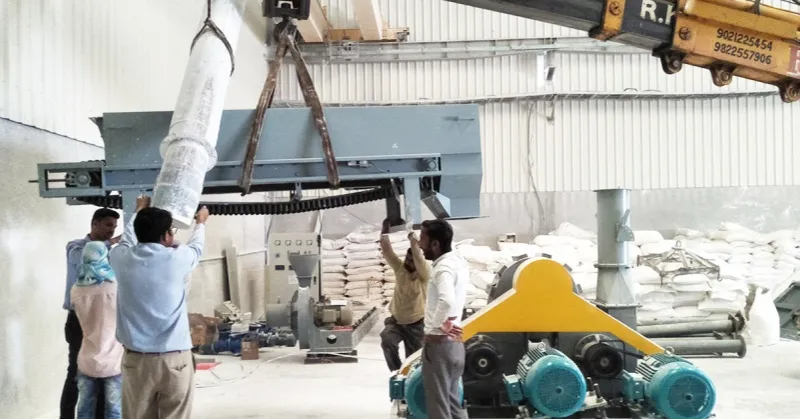
Cell Mill Modifier (Pin Mill Upgrade/Air-Machining Mill)
Working Principle: Multi-layer rotors rotate at high speed, generating ultra-high linear velocity and air pressure, integrating drying, ultrafine depolymerization, air classification, and surface modification.
Technical Advantages: Can process wet materials with a certain moisture content; large air volume, precise temperature control, high modification coating rate, and large single-machine capacity.
Applicable Scenarios: Coating of ultrafine heavy calcium carbonate and nano-calcium carbonate with high dryness requirements, and high-end modification fields with extremely stringent requirements for dispersibility.
High-Speed Mixer (High-Speed Mixer / Intermittent Modification)
Working Principle: High-speed rotating impellers generate heat through friction, melting the modifier and mixing it with the hot powder for coating.
Technical Advantages: High flexibility, suitable for customized modification formulations with multiple varieties and small batches; low equipment investment.
Applicable Scenarios: Small and medium-sized enterprises, pretreatment of color masterbatches, and intermittent modification of special coupling agents (such as titanates and silanes).
III. Selection Summary
- Cost priority, basic filler: Choose heavy calcium carbonate (LCC).
- Balancing cost and performance, high whiteness requirements: Choose light calcium carbonate (LCC).
- Ultimate performance, high added value, high filler content: Choose activated calcium carbonate (ACTC).
Practical “Gradient Combination” Recommendation: In actual industrial formulations, a “processing equipment + powder gradient synergy” strategy is often adopted. For example: using heavy calcium carbonate as a base to reduce costs, adding light calcium carbonate to adjust the system’s stiffness and surface gloss, and then compounding a small amount of ultrafine activated calcium carbonate produced by high-efficiency modification equipment to improve interfacial bonding and flowability, thereby achieving optimal product performance with the lowest overall equipment and raw material costs.

“Thanks for reading. I hope my article helps. Please leave a comment down below. You may also contact Zelda online customer representative for any further inquiries.
— Posted by Emily Chen
“