
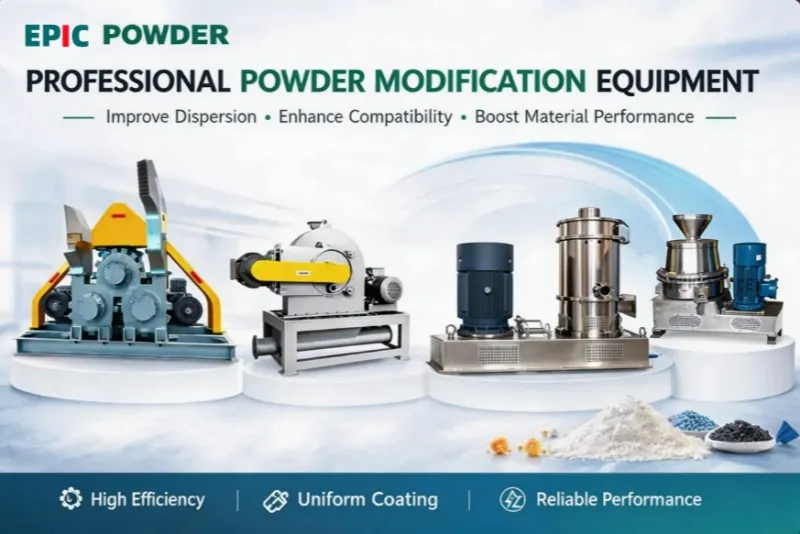
Calcium carbonate is the most widely used and consumed mineral filler in the plastics industry. In blown films and other plastic products, calcium carbonate serves not only as a cost-reducing filler but also as a high-performance mineral modifier. However, the efficiency with which calcium carbonate functions within the plastic matrix is determined by the upstream grinding equipment (ball mill classification system, ring roller mill) and surface modification equipment (continuous modifier).
I. The Source of High-Quality Plastic-Grade C: Grinding Equipment and Continuous Modification Processes
Selecting the correct type of calcium carbonate powder is a prerequisite for excellent performance in plastic applications. This requires the mineral powder to have a specific and narrowly concentrated particle size distribution, high purity, and optimized surface modification effects.
Ball Milling and Classification System: Large-Scale, High-Precision Micropowder Preparation
Process Features:
Employs a dry ultrafine ball mill combined with a high-precision air classifier in series/parallel operation for efficient calcium carbonate grinding.
Performance Advantages:
Capable of stably producing ultrafine heavy calcium carbonate with a mesh size of 800–3000 mesh or higher. Strict control through the air classifier effectively retains excessively large particles. Eliminates damage to thin-walled areas of blown films caused by coarse particles. Ensures uniform particle size distribution. Prevents “crystal points” or stretching film breakage during blown film production.
Ring Roller Mill: A Cost-Effective Choice for Medium to High Fineness
Process Features:
Utilizes the rolling and grinding principle of multi-layer ring tracks and rollers, integrating calcium carbonate grinding and classification.
Performance Advantages:
Compared to traditional mills, ring roller mills have lower unit energy consumption, produce powder particles with good sphericity, and have a moderate specific surface area, making them extremely cost-effective. Commonly used for producing medium-to-high fineness blown film filler-grade calcium carbonate powder.
Continuous Coating Machine: The Key Step in Transforming “Hydrophilic” to “Oleophilic”
Process Characteristics:
Native calcium carbonate powder has a hydrophilic and oleophobic surface. Direct mixing with polyolefin resins easily leads to agglomeration. The continuous modifier utilizes high-speed dispersion, controlled-temperature heating, and efficient atomization spraying of coating agents (such as aluminates, stearic acid, or coupling agents). It can achieve high coverage coating of calcium carbonate particles.
Performance Advantages:
After treatment with the continuous modifier, the surface energy of calcium carbonate is significantly reduced, transforming it from hydrophilic to oleophilic. It can be perfectly dispersed in the polymer melt, greatly improving compatibility and interfacial bonding with plastic resins.
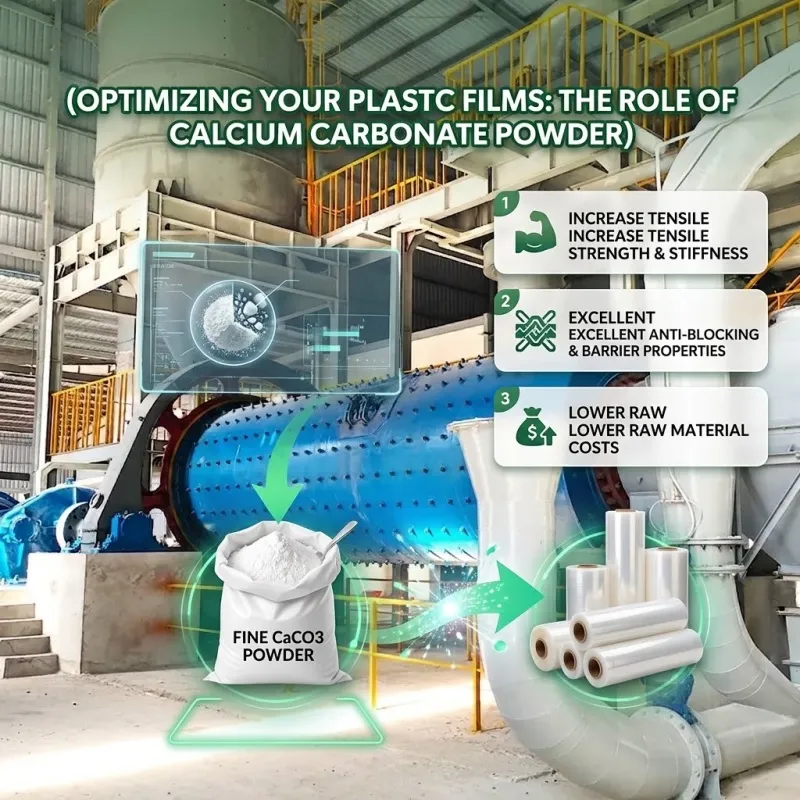
II. How to Directly Add CaCO3 Powder to a Blown Film Production Line?
In traditional processes, calcium carbonate is typically processed into a filler masterbatch before being added to polyolefins. Now, specialized production lines integrating super-fusion technology can directly add milled and modified CaCO3 powder to pipe, polypropylene sheet, and blown film production lines.
Equipment Configuration: Equipped with a special co-rotating twin-screw extruder, possessing excellent shearing and dispersing mixing capabilities.
Production Structure: Can be designed as a single-layer production line, or a three-layer production line equipped with two standard extruders for producing ultra-thin surfaces.
Advantages of Direct Addition: Completely eliminates the energy consumption of secondary granulation of the masterbatch, resulting in a significant reduction in raw material costs.
III. Core Advantages of CaCO3 in Blown Films
Besides its anti-blocking properties, calcium carbonate possesses a wide range of other properties. It can alter the physical characteristics of polymer melts. Compared to unfilled polyolefins, CaCO3 has higher density, lower thermal conductivity, and lower heat capacity, and it maintains a solid form during extrusion.
Improved Processing Efficiency
Increased Extruder Output: The high thermal conductivity of the mineral accelerates resin melting and cooling.
Reduced Equipment Load: Reduces melt pressure and extruder torque, resulting in better melt homogenization.
Accelerated Cooling Efficiency: Improves production efficiency and accelerates the cooling rate of the film bubble.
Improved Performance of Blown Films
Adding CaCO3, refined through ball milling/ring milling and surface-treated by a continuous modifying machine, to a semi-crystalline polymer matrix can lead to the following performance improvements:
Stiffness and Impact Resistance: Increases film stiffness and improves drop hammer impact resistance.
Physical Properties: Excellent anti-blocking effect, improved barrier properties, enhanced tear propagation resistance (Elmandorf), slightly increased surface tension.
Density Control: Increases film density when unstretched; decreases density after stretching, providing permeability when necessary.
Typical Applications: Shopping bags, vest bags, garbage bags, paper films, agricultural films, heavy-duty packaging bags, and backing films, etc.
Cost Reduction and Sustainability
Reduced Formulation Costs (Down-Metering): The addition of CaCO3 increases film density, but a constant film weight can be maintained by reducing film thickness. For example, with a CaCO3 content of 30%, the film thickness only needs to be reduced by 20% to maintain a constant weight.
Direct Feeding Cost Reduction: Direct feeding can significantly reduce raw material costs (based on a polymer price of approximately €1100/ton), and even in scenarios where down-metering is not possible, direct extrusion still provides cost potential and reinforcement.
Improved Sustainability: The specific heat of calcium carbonate minerals is significantly lower than that of polymers, resulting in substantial energy savings during extrusion. Combining hyperconverged direct addition technology can significantly reduce the carbon emissions of products and their environmental impact.

“Thanks for reading. I hope my article helps. Please leave a comment down below. You may also contact Zelda online customer representative for any further inquiries.”
— Posted by Emily Chen