
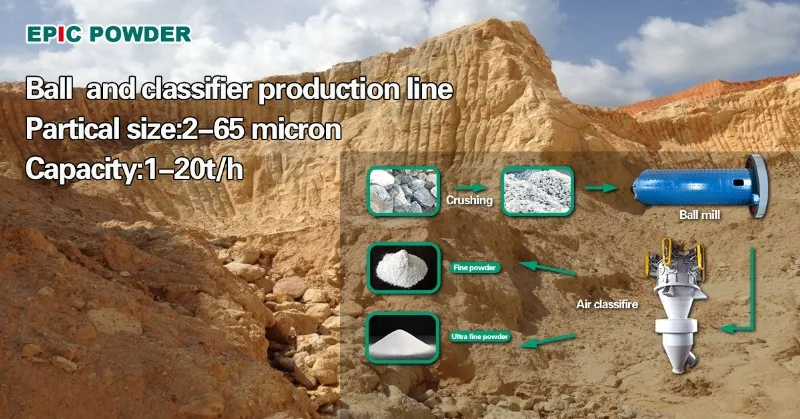
Calcium carbonate (CaCO₃) is one of the most widely used non-metallic mineral raw materials in industrial applications. It plays an essential role in plastics, papermaking, coatings, rubber, ink, and pharmaceuticals. As downstream industries demand increasingly higher material performance, ultrafine grinding technology has become the key to enhancing the added value of calcium carbonate. A calcium carbonate ultrafine grinding production line is not only the core of product refinement but also a decisive factor in market competitiveness.
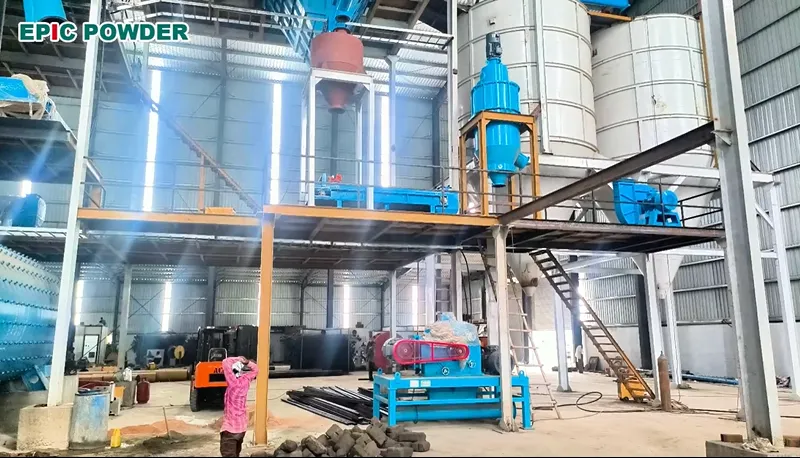
Composition and Core Technologies of the Ultrafine Grinding Production Line
A modern calcium carbonate ultrafine grinding production line is a complex system designed to process raw mineral powders or ground calcium carbonate (GCC) from tens of microns down to submicron levels (0.1 μm – 1 μm) or even finer.
Core Grinding Equipment — The Key to Precision
For ultrafine processing of calcium carbonate, the main grinding equipment includes:
- Ball Mill + Classifier Production Line: Suitable for large-scale dry processing, offering high stability and adjustable particle size control.
- Jet Mill System: Uses high-speed airflow to achieve particle–particle impact grinding, preventing metal contamination and ensuring high purity — ideal for high-value products.
- Pin Mill / Impact Mill: Compact, energy-efficient, and suitable for medium-fine grinding.
- Vertical Roller Mill & Vibration Mill: Provide higher efficiency in specific fineness ranges.
By combining grinding and classification systems effectively, the production line can achieve continuous, closed-loop operation, ensuring uniform and stable particle size distribution.
High-Efficiency Classification System — Precise Particle Control
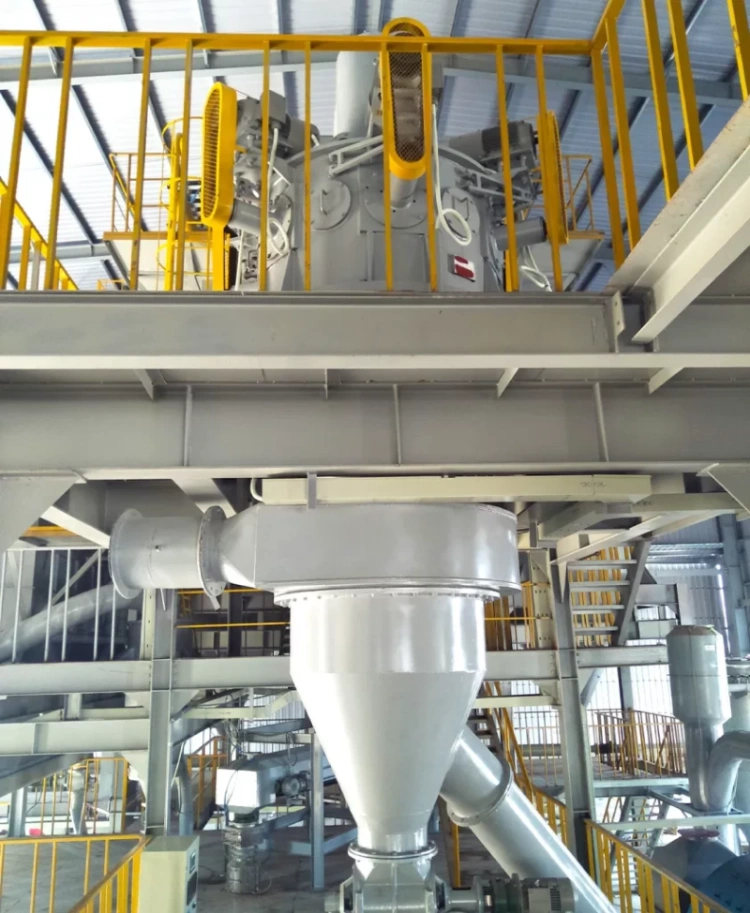
The key to ultrafine grinding lies in classification technology. Modern production lines are typically equipped with high-precision classifiers that work in closed circuit with the mill.
These classifiers can:
- Accurately separate qualified products meeting particle size requirements (e.g., d97 value).
- Return coarse particles for secondary grinding, ensuring consistent and uniform product fineness.
Auxiliary Systems — Stability and Environmental Protection
A complete production line also includes:
- Drying System – Ensures raw materials meet moisture requirements for ultrafine grinding.
- Conveying and Packaging System – Pneumatic conveying minimizes secondary pollution and dust.
- Dust Collection System – High-efficiency bag or pulse collectors maintain product purity and a clean production environment.
Value and Applications of Ultrafine Calcium Carbonate
Ultrafine calcium carbonate (also known as ultrafine or nano calcium carbonate) has higher surface area, smaller particle size, and improved reinforcing performance, making it indispensable for high-end applications.
| Application Field | Function & Value | Fineness Requirement |
|---|---|---|
| Plastics / Rubber | Enhances strength, toughness, and wear resistance; replaces part of expensive fillers; improves gloss. | Submicron – nano scale |
| Coatings / Inks | Improves hiding power, whiteness, rheology; prevents sedimentation and enhances weather resistance. | Ultrafine micron scale |
| Papermaking | Increases brightness, opacity, and printability; reduces pulp consumption. | Micron – ultrafine scale |
| Sealants / Adhesives | Improves thixotropy and structural stability. | Nano scale |
Challenges and Development Trends in Line Design
Challenges:
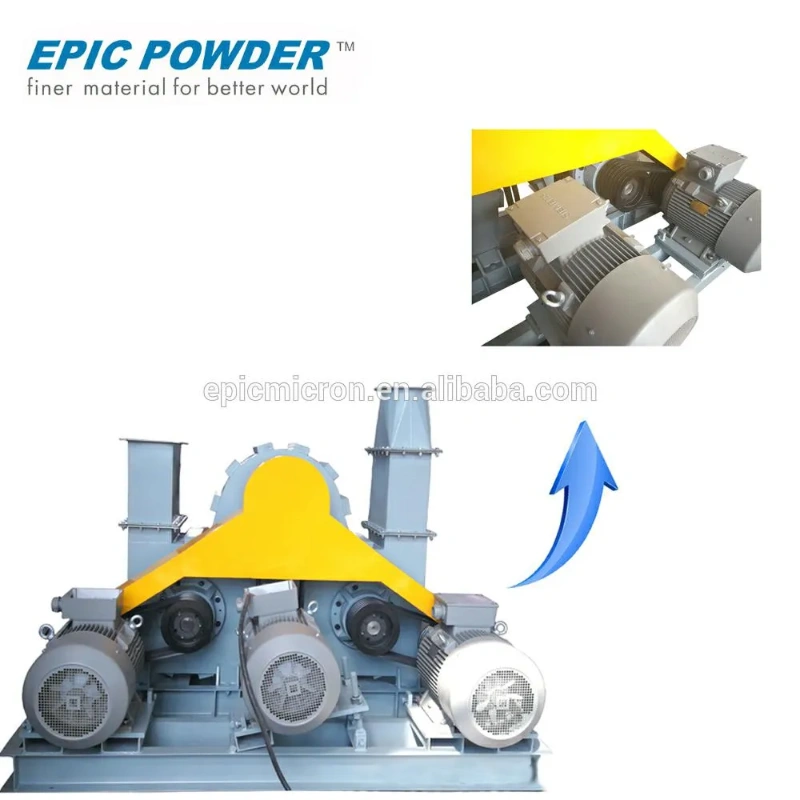
- Energy Consumption: Ultrafine grinding is energy-intensive. Equipment design and process optimization are crucial to reducing energy per ton.
- Dispersion: Fine powders, especially nanoscale ones, tend to agglomerate, affecting dispersion in the matrix.
- Equipment Wear: The moderate hardness of calcium carbonate imposes high demands on the wear resistance of grinding components under high-speed impact.
Trends:
- Integrated Grinding and Classification: Advanced systems combine these functions to improve process synergy and overall efficiency.
- In-line Surface Modification: Conducting surface activation (active calcium carbonate) during or immediately after grinding resolves agglomeration and enhances compatibility with organic materials.
Conclusion
The calcium carbonate ultrafine grinding production line is a fundamental component in the deep processing of non-metallic minerals. By integrating advanced grinding, classification, and surface modification technologies, such systems can efficiently and stably produce high-quality ultrafine calcium carbonate that meets the demanding requirements of various industries — driving continuous innovation and market expansion.
EPIC Powder, through ongoing technological innovation and equipment optimization, is helping global customers achieve efficient, large-scale, and differentiated calcium carbonate processing — providing powerful equipment support for the new materials industry.