
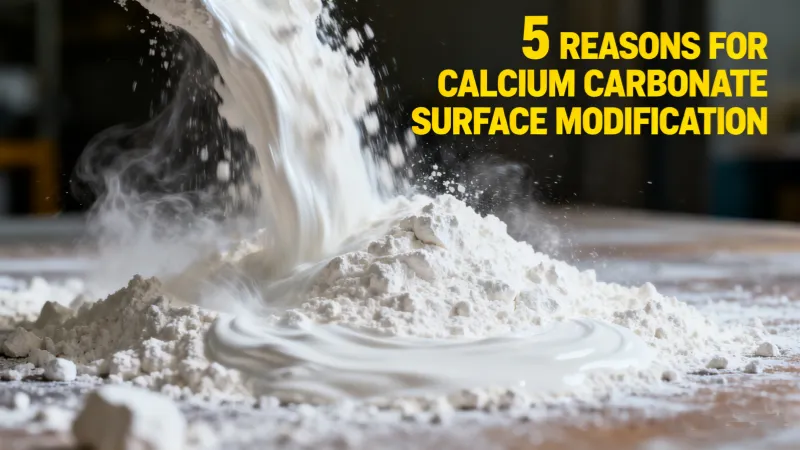
Calcium carbonate is an inorganic compound and the main component of materials like limestone and marble. When it comes to modifying calcium carbonate powder, many customers often wonder why they should increase production costs to apply a surface coating. They may also question whether this modification will affect the performance of the downstream products. The following explains the key reasons for why should calcium carbonate be surface coated?
5 Reasons for Calcium Carbonate to be Surface Coated
Surface modification plays a crucial role in enhancing the performance of calcium carbonate, expanding its applicability, and opening up new market opportunities. Once modified, calcium carbonate transforms from a traditional filler into a multifunctional additive with broader applications and increased demand.
Enhancing Dispersion of Calcium Carbonate
Surface modification allows the modifier to be selectively adsorbed onto the surface of calcium carbonate, giving it charged properties. The repulsion between like charges prevents agglomeration, ensuring better dispersion of the material.
Improving Compatibility with Other Materials
Surface modification increases the interface compatibility between calcium carbonate and other materials, such as rubber or plastics. This improves the performance of calcium carbonate in composite materials, making it more effective in a variety of applications.
Reducing the Oil Absorption of Calcium Carbonate
After surface modification, the aggregation of calcium carbonate particles is minimized, improving dispersion. The modified molecules on the surface of calcium carbonate reduce voids between particles, which lowers the oil absorption value. The change in surface properties also reduces particle friction and enhances lubricity, allowing for closer packing and increased packing density.
Expanding the High-End Market for Calcium Carbonate
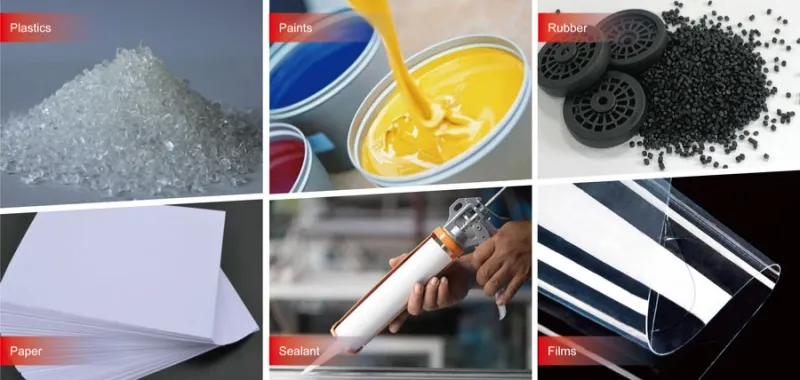
Surface-modified calcium carbonate is better suited for high-end applications in industries such as plastics, paints, rubber, paper, sealants, and transparent films. This modification not only improves the quality of end products but also helps reduce production costs.
Adding Functional Properties to Calcium Carbonate
- Metal-coated calcium carbonate can enhance specific properties in rubber products.
- Titanium dioxide-coated calcium carbonate can partially replace titanium dioxide in certain applications.
- Acid-resistant calcium carbonate can be produced by treating it with materials like phosphate, aluminate, silicate, or barium salts.
In conclusion, surface modification of calcium carbonate significantly enhances its functionality, making it a versatile material with expanded applications in various high-performance industries.
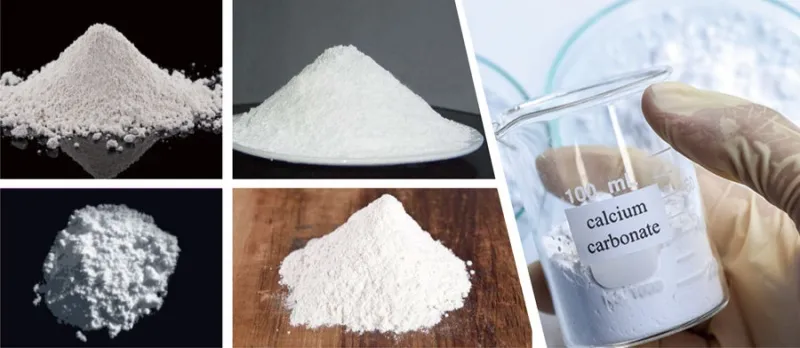
Principle of Calcium Carbonate to be Surface Coated
The principle of surface modification of calcium carbonate powder is as follows:
When modifying calcium carbonate powder with a modifier, since calcium carbonate is an inorganic substance, it has a great affinity with the hydrophilic group of the modifier, and they will form the combination like chemical bond. The lipophilic group is oriented on the surface of calcium carbonate particles to form a monomolecular film, which can significantly improve the dispersion and affinity in polymer matrices such as polyolefins, and can create an interface interaction with the polymer matrix.
This is the basic principle of activated calcium carbonate production. The filler treated in this way has changed from hydrophilic to lipophilic, and has good affinity for organic substances such as resin, thereby improving the various application properties of the product.
Application of Surface Coated Calcium Carbonate
Coated calcium carbonate has a wide range of applications across various industries:
Environmental Protection: Neutralizes acids in soil and water, raising pH levels to treat acidic conditions.
Painting: Enhances durability, hiding power, and stain resistance in paints.
Food Additives: Improves hardness, stability, anti-sedimentation, and adjusts acidity.
Rubber Fillers: Increases hardness, wear resistance, and tensile properties of rubber.
Plastics: Enhances hardness, toughness, and heat resistance, while reducing costs.
Cosmetics: Improves smoothness, softness, and consistency, reducing greasiness.
Construction: Strengthens building materials, improving hardness, water resistance, and durability.
Common Calcium Carbonate Surface Modifier
Common organic modifiers for calcium carbonate include surfactants, coupling agents, and polymer modifiers:
Polymer Modifiers: Polymer layers with a core-shell structure are adsorbed onto the surface of calcium carbonate to reduce agglomeration and improve dispersion. Common polymers include oligomers, polymers, and water-soluble polymers.
Surfactants: Molecules with both hydrophilic and lipophilic groups, such as stearic acid, phosphate esters, and quaternary ammonium salts, act as bridges to combine inorganic powders with organic matrices.
Coupling Agents: These substances contain both polar and non-polar structures, like silane, titanate, and composite coupling agents, which help bind inorganic powders and polymers through physical entanglement or chemical reactions.
Common Calcium Carbonate Coating Machine
Turbo mill coating machine
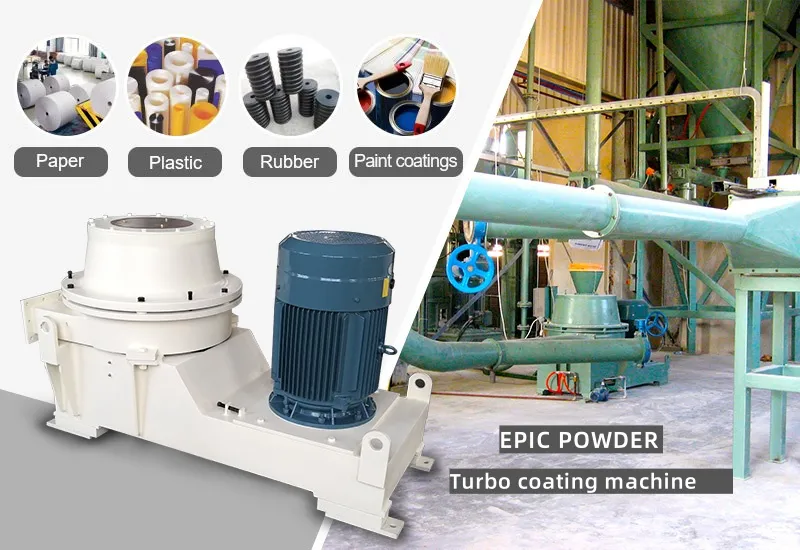
Turbo mill coating machine adopts the action of high-speed rotating impeller and airflow to mix and grind the materials in the grinding chamber, and realize surface modification by adding additives such as coating agent. Its coating rate can generally reach more than 98%, and some can reach 99%.
Three-roller coating machine

The three-roller coating machine is one of the most commonly used coating equipment. It mainly achieves surface modification of powder by changing the internal vortex through three rotating rotors. The equipment can operate continuously in production with large output, which is suitable for industrial production of various scales. Its coating rate can generally reach more than 95%.
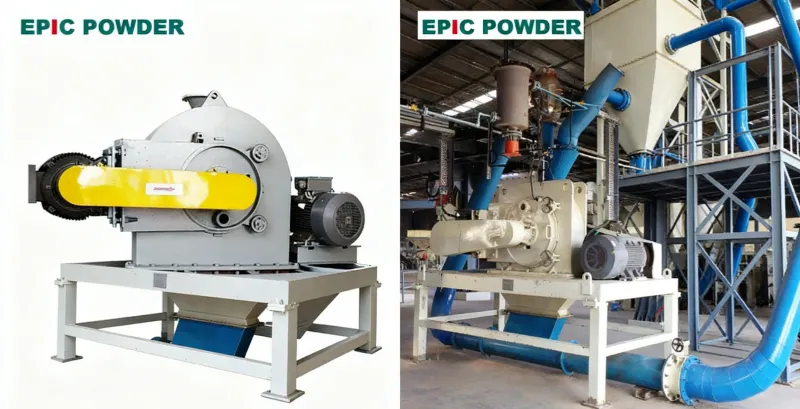
Pin Mill Coating Machine
The Pin Mill Coating Machine is a high-efficiency impact mill for ultrafine powder surface coating, ideal for modifying calcium carbonate with stearic acid. With counter-rotating pins reaching 240 m/s, it ensures uniform dispersion, high coating rates, and low energy use. Compact and easy to clean, it delivers precise, cost-effective performance.
Choose appropriate modifiers and coating machines to give calcium carbonate powder more properties and expand more application markets.