
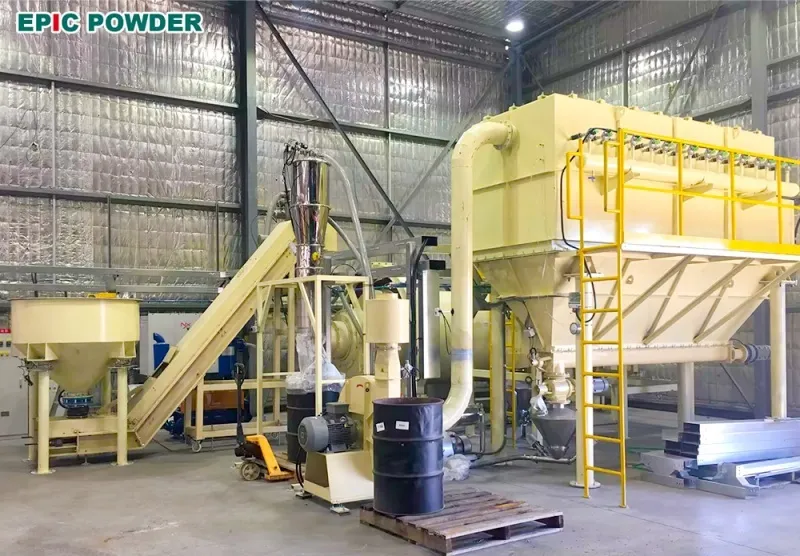
Ultra-fine treated calcium carbonate (CaCO₃), often with particle sizes below 1 μm (d50 typically 0.2–0.8 μm or even nano-scale <100 nm) and surface-modified for hydrophobicity, is a critical functional filler in high-end coatings. It enhances opacity, gloss control, rheology, scrub resistance, and cost-efficiency by partially replacing expensive titanium dioxide (TiO₂) while maintaining or improving film properties. In premium architectural paints, automotive topcoats, powder coatings, and industrial finishes, treated ultra-fine CaCO₃ can constitute 10–30% of the formulation, reducing raw material costs by 15–25% without compromising performance.
Producing it requires precise control over mineral processing, chemical synthesis, grinding, classification, and surface modification. This comprehensive guide details every step, from raw material selection to final quality assurance, drawing on established industrial practices for ground calcium carbonate (GCC) and precipitated calcium carbonate (PCC) routes. Both paths can yield ultra-fine grades, but PCC offers superior uniformity and brightness for premium coatings, while GCC provides cost advantages for high-volume production.
1. Understanding Types and Raw Materials
There are two primary forms:
- Ground Calcium Carbonate (GCC): Derived from natural limestone, marble, or chalk. It is mechanically processed and suits matte or semi-gloss coatings.
- Precipitated Calcium Carbonate (PCC): Synthetically produced for finer, more uniform particles (often 0.02–0.4 μm primary size) with controllable crystal shapes (calcite rhombohedral, scalenohedral, or aragonite). PCC excels in high-gloss and high-opacity formulations.
Raw materials for GCC: High-purity limestone (>98% CaCO₃, low SiO₂/Fe₂O₃) mined from open pits or quarries. For PCC: Limestone calcined to quicklime (CaO).
Select feedstock with whiteness >95% and minimal impurities to meet coating-grade standards (ISO 3262 or equivalent).
2. Producing the Ultra-Fine Base CaCO₃
GCC Route (Wet/Dry Grinding for Submicron Fineness)
- Mining and Primary Crushing: Drill, blast, and crush limestone to <50 mm using jaw crushers.
- Washing and Beneficiation: Wash to remove clay/silica; optional flotation or magnetic separation for purity.
- Drying: Reduce moisture to <1% in rotary dryers.
- Coarse Grinding: Raymond to 325–1250 mesh (45–10 μm).
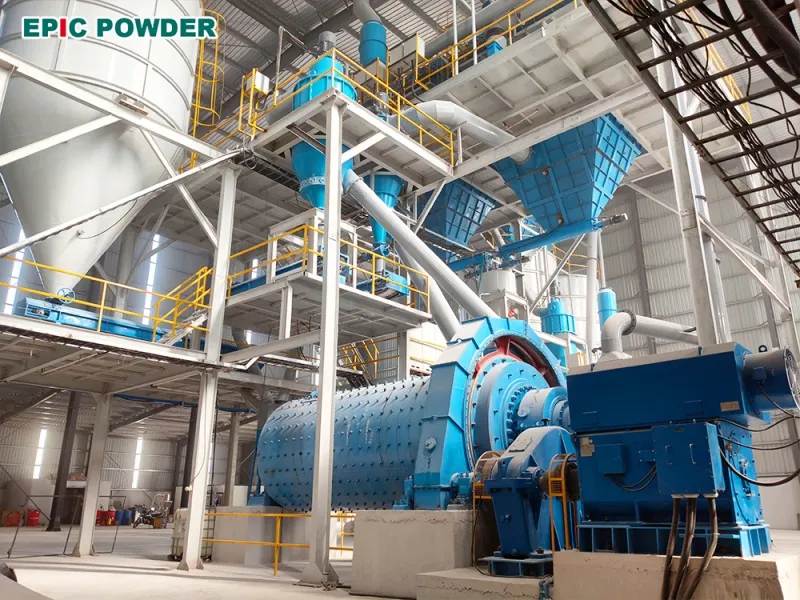
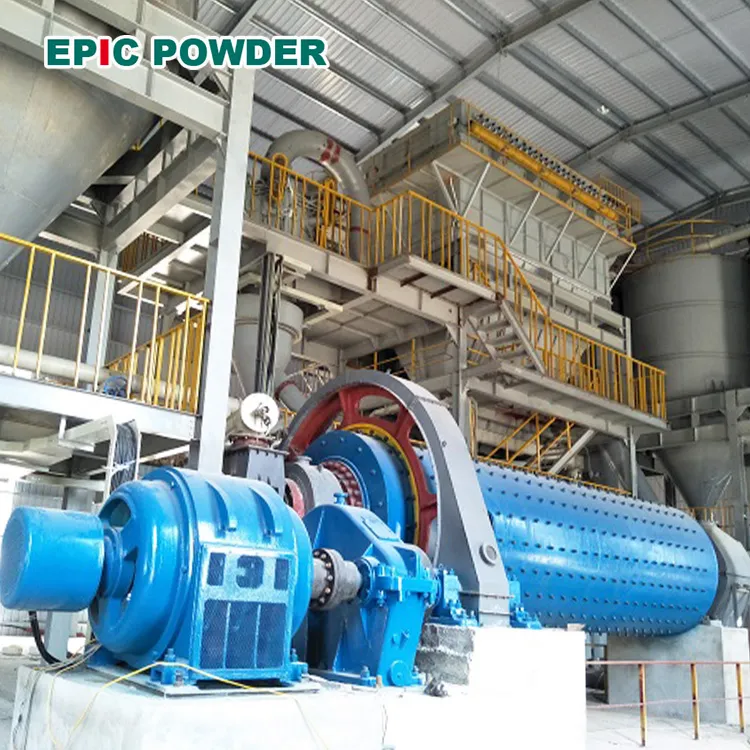
- Ultra-Fine Grinding: Switch to wet grinding for <5 μm grades using wet or dry ball mills . Wet method uses dispersants (e.g., sodium polyacrylate 0.5–1%) and achieves better dispersion. Ball mills integrate grinding, drying, and classification in one unit.
- Classification: Turbo or air classifiers in closed circuit maintain narrow PSD (particle size distribution). Target d97 <5 μm, d50 0.5–1 μm for coatings. Recirculate oversize.
Typical capacity: 5–25 t/h per mill line. Energy: 50–100 kWh/t for ultra-fine.
PCC Route (Chemical Precipitation for Superior Control)
- Calcination: Heat limestone >900°C in rotary kilns (natural gas) → CaO + CO₂. Capture CO₂ for reuse.
- Slaking: CaO + H₂O → Ca(OH)₂ slurry (milk of lime) in detention slakers (water:lime 4:1, temp 79–90°C). Higher temp yields finer particles. De-grit with 60–325 mesh screens.
- Carbonation: Bubble CO₂ into cooled slurry (cold conditions favor nano-scale) in reactors. Control pH (9–11), temp (20–40°C), concentration (6–10% Ca(OH)₂), and agitation for desired morphology. Reaction: Ca(OH)₂ + CO₂ → CaCO₃ + H₂O.
- Maturation/Filtration: Age slurry, filter to 40–60% solids cake.
- Drying/Deagglomeration: Spray dry or flash dry, then jet mill or pin mill for final dispersion. For ultra-fine (<0.1 μm), add crystal modifiers (e.g., Mg salts) during carbonation or use microemulsion/rotating packed bed reactors.
PCC allows primary particles down to 20–70 nm with high specific surface area (SSA 18–70 m²/g). Yield: High purity (>99%), whiteness 96–99%.
Post-grinding for both: Combine with classifiers for d50 <0.8 μm suitable for high-end coatings.
3. Surface Treatment – The Key to “Treated” Performance
Untreated CaCO₃ is hydrophilic and agglomerates in organic binders. Treatment (1–3% coating agent) renders it hydrophobic, improves dispersion, reduces oil absorption, and enhances compatibility with resins (acrylic, alkyd, polyurethane).
Common methods:
- Stearic Acid Coating (Most Common for Coatings): Dissolve stearic acid (or fatty acids) and spray onto dry powder (dry process) or add to wet slurry (wet process). Then mill in pin mill or coating machine to ensure monolayer coverage (~1% dosage, adjusted by SSA: finer needs slightly more). Acid end bonds to CaCO₃; hydrocarbon tail orients outward.
- Wet Surface Modification: In aqueous suspension (5–80% solids), adjust pH 7.5–12, add agents (unsaturated fatty acids, succinic anhydride derivatives, silanes, rosin acids, or maleated polybutadiene), mix at 30–120°C, then dry (40–160°C under vacuum if needed).
- Other Advanced: Mechanochemical (high-shear milling with modifier), coupling agents (titanate/silane for solvent-borne), or in-situ during PCC filtration (fatty acids form calcium stearate).
- Equipment: Dedicated coating machines (e.g., pin mills with heated jacket, high-speed mixers, or integrated ball mill + classifier + modifier system). Temperature control critical to avoid over-coating.
Benefits: Hydrophobicity index >90%, better thixotropy, anti-settling, improved scrub/stain resistance, and up to 100% replacement of some extenders in formulations.
4. Integrated Production Line and Parameters
A typical plant: Raw prep → Grinding/Precipitation → Air Classification → Modification → Collection (cyclone + baghouse, dust <20 mg/Nm³) → Packaging.
Key parameters for ultra-fine treated grade:
- Fineness: d50 0.3–0.7 μm, d97 <2–5 μm, SSA 8–25 m²/g.
- Coating level: 0.8–2.5 wt%.
- Whiteness: ≥96%.
- pH of slurry: 8–10.
- Moisture final: <0.5%.
- Throughput: Automated PLC control for consistency.
Vietnam/China plants often use EPIC ball mill + pin mill modification for paint-grade output.
5. Quality Control and Testing
Rigorous QC ensures suitability:
- PSD: Laser diffraction (wet for uncoated, IPA for coated).
- Whiteness/Brightness: Hunter or ISO meters.
- Hydrophobicity: Float test or contact angle >120°.
- Oil Absorption: <20–30 g/100g post-treatment.
- Purity/Impurities: Acid insolubles <0.5%, heavy metals per specs.
- Dispersion: Hegman gauge or viscosity in model paint.
- Performance Tests: Incorporate in lab coating; check opacity (contrast ratio), gloss (60°), rheology, scrub cycles.
Batch testing, ISO 9001 compliance, and representative sampling critical. Track during production with online analyzers.
6. Applications and Performance Benefits in High-End Coatings
In high-end coatings:
- Opacity/Hiding: Fine particles scatter light; replace 10–20% TiO₂.
- Gloss/Leveling: Uniform PSD prevents matting; treated version aids flow.
- Rheology: Increases thixotropy, prevents sagging/settling.
- Durability: Improves adhesion, weather/scrub resistance.
- Specifics: 2–5% nano-treated in latex paints boosts can stability; ultra-fine in automotive for smooth finish; powder coatings for flow.
Studies show ultra-fine PCC enables high-performance formulations with 100% CaCO₃ loading in some experimental eco-coatings.
7. Challenges, Safety, and Sustainability
Challenges: Agglomeration (solved by treatment/dispersants), high energy (mitigated by efficient mills), wastewater in wet process (recycle). Safety: Dust control (explosion-proof), PPE for modifiers. Environmental: Use captured CO₂, low-emission kilns, recycle water; pursue green PCC from flue gas.
Conclusion
Producing ultra-fine treated CaCO₃ demands integrated expertise in mineralogy, chemistry, and mechanical engineering. By following optimized GCC or PCC routes with precise grinding, carbonation, and stearic/silane modification, manufacturers deliver a versatile filler that elevates high-end coatings to new levels of performance and economy. With proper equipment (ball mills, air classifiers, coating machines ) and QC, yields exceed 95% efficiency. This process not only meets but exceeds the stringent requirements of modern paint technology.

“Thanks for reading. I hope my article helps. Please leave a comment down below. You may also contact Zelda online customer representative for any further inquiries.”
— Posted by Emily Chen