
When calcium hydroxide is mentioned, most people still think of traditional applications such as construction plastering or soil pH adjustment. However, today’s protagonist—high–specific surface area calcium hydroxide—has long moved beyond these conventional roles. Thanks to its exceptionally high specific surface area (30–80 m²/g or even higher), it is reshaping application boundaries and driving a quiet but highly efficient “performance revolution” across environmental protection, new energy materials, high-end functional coatings, and specialty rubber industries.
So what makes it so special? And which high-value applications has it unlocked? Let’s take a closer look.
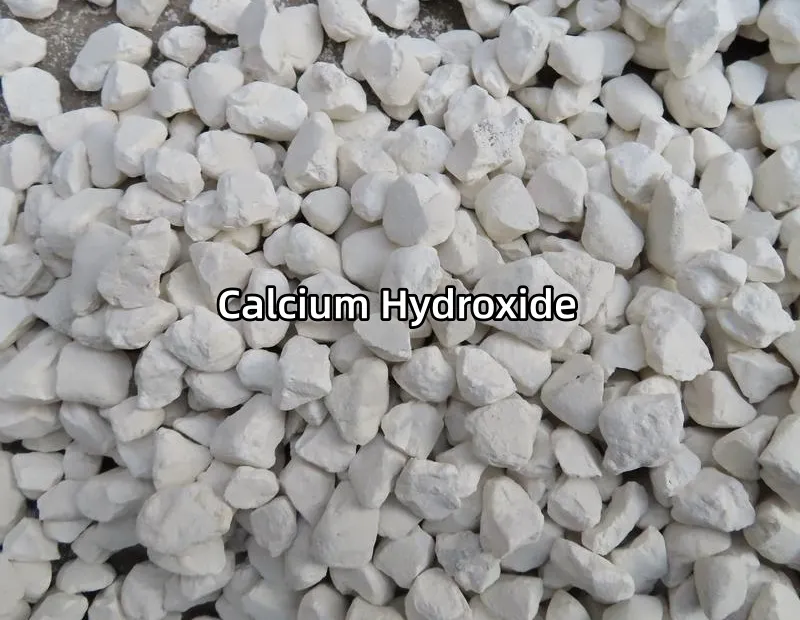
Specific Surface Area: The True Core of Calcium Hydroxide’s “Combat Power”
Specific surface area refers to the total surface area per unit mass of a material (m²/g). The higher this value, the more contact opportunities the material has with its surroundings—leading to exponential improvements in reaction rate, adsorption efficiency, neutralization capacity, and dispersion performance.
A simple analogy:
- A 1 cm³ cube has a surface area of only 6 cm².
- Cut it in half, and the surface area increases.
- Grind it further to micron, submicron, or even nanoscale particles, and the surface area can increase dozens or even hundreds of times.
Conventional industrial calcium hydroxide typically has a specific surface area of only 10–20 m²/g. In contrast, high–specific surface area calcium hydroxide easily exceeds 30 m²/g, while premium products can stably reach 50–80 m²/g or more. With its inherent strong alkalinity, high chemical reactivity, and excellent dispersibility, calcium hydroxide is no longer just a common filler. Instead, it functions as a reaction accelerator, a high-efficiency adsorbent, and a performance enhancer. In applications that demand fast, precise, and efficient conversion, it has become virtually irreplaceable.
Grinding and Preparation of High–Specific Surface Area Calcium Hydroxide: Particle Size Determines Performance
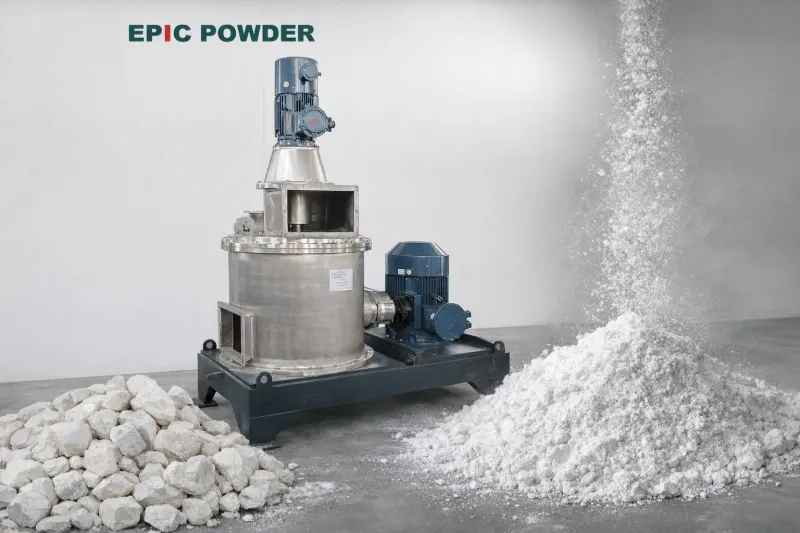
The core source of high specific surface area lies in ultrafine and superfine grinding technology. Current mainstream production routes generally include the following steps:
1. Hydration (Slaking) Stage
High-quality quicklime (CaO) reacts with water—optionally with crystal growth modifiers or dispersants—in a hydration system to form primary calcium hydroxide slurry or powder.
2. Drying and Ultrafine Grinding Stage (Key Step)
This stage ultimately determines the final specific surface area.
- Conventional requirements (D50 ≈ 10 μm):
Air classifier mills (such as turbo classifier mills or air classifier mills) are commonly used for dry ultrafine grinding. Combined with high-efficiency classifiers, they can stably control D50 within 8–12 μm, achieving a specific surface area of 30–50 m²/g, suitable for large-scale industrial production. - High-end requirements (finer particles, D50 < 3 μm or even submicron):
Jet mills, especially fluidized-bed opposed jet mills, are required. By utilizing high-speed airflow-induced collision, shear, and friction, particle sizes can be reduced to D50 of 1–2 μm, easily achieving 50–80 m²/g or higher specific surface area. The resulting particles feature rounded morphology, excellent dispersion, and high surface activity, making them ideal for advanced applications.
Through precise particle size distribution control and optional surface modification, high–specific surface area calcium hydroxide can fully unleash its “strategic-level” performance in high-end fields.
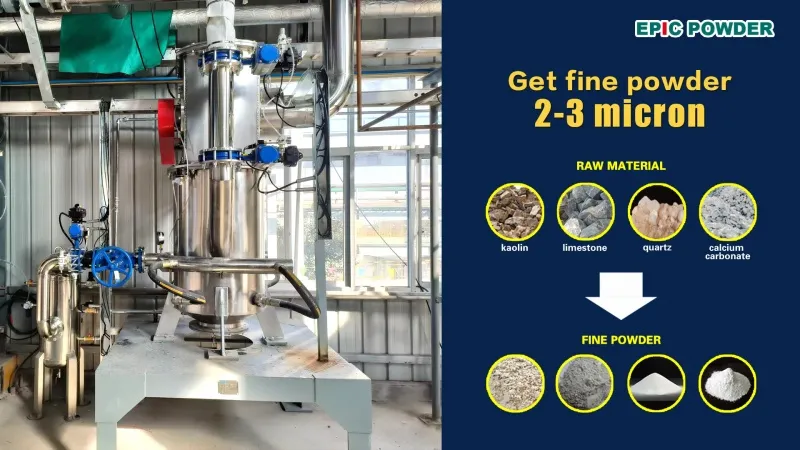
Cross-Industry High-Value Applications: Redefining Multiple Sectors
Environmental Protection
- Flue gas desulfurization / deacidification: Reaction rates increased by over 30%, with by-products easier to recycle
- Advanced heavy metal wastewater treatment: Combined adsorption and neutralization deliver industry-leading efficiency
New Energy & Advanced Materials
- Lithium battery cathode precursors (LFP, ternary materials): Regulates crystal growth, improves material density and cycling stability
- Nano-reinforcement for specialty rubber: Tensile strength increased by 30%, aging resistance improved by 25%
- High-end water-based eco-friendly coatings: Opacity improved by 25%, while adsorbing free formaldehyde for active air-purifying functionality
Chemical Functional Materials
- High-quality precursors for light and nano calcium carbonate
- Polymer modification (flame retardancy, reinforcement, improved processability)
Soil Improvement & Agriculture
- Faster and more uniform pH adjustment
- Highly efficient controlled-release pesticide carrier, significantly improving active ingredient utilization
Pharmaceutical & Food Industries
- High-purity grades for dental materials, drug sustained-release carriers, and food-grade acidity regulators
Conclusion
As high–specific surface area calcium hydroxide continues to evolve toward high-end and precision-driven applications, the role of advanced grinding technology becomes increasingly critical.
With more than 20 years of expertise in ultrafine powder processing, Epic Powder provides reliable solutions through its high-efficiency air classifier mills and fluidized-bed jet mills. These systems enable stable production of D50 ≈ 10 μm standard grades as well as ultra-high specific surface area products reaching 50–80 m²/g.
From scalable industrial output to extreme particle size refinement, Epic Powder delivers consistent performance and process control. Through cutting-edge grinding technology, calcium hydroxide gains a new level of activity and value.
When traditional hydrated lime meets modern ultrafine milling, a new materials revolution is underway—spanning environmental protection, new energy, and advanced functional materials.

“Thanks for reading. I hope my article helps. Please leave a comment down below. You may also contact Zelda online customer representative for any further inquiries.”
— Posted by Emily Chen