
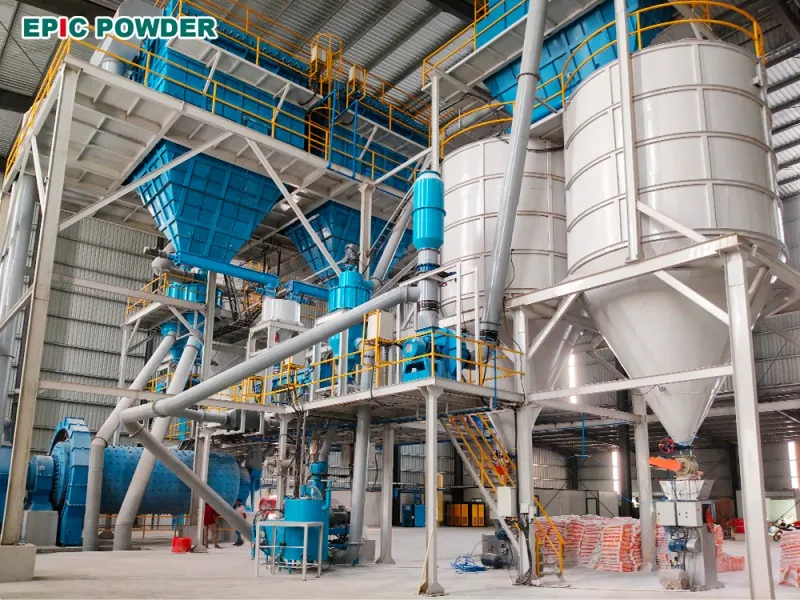
For manufacturers of latex paint, exterior paint, real stone paint, and waterborne industrial coatings, heavy calcium carbonate (GCC) is the most heavily used, cost-effective, and critical base filler in coating formulations. However, beyond the quality of raw calcite ore, the most decisive factor in Ground Calcium Carbonate performance is the grinding equipment and classification process. Today, we break down two key questions: What exact role does heavy calcium carbonate play in coatings? And what grinding equipment is needed to produce high-grade coating-level calcium powder?
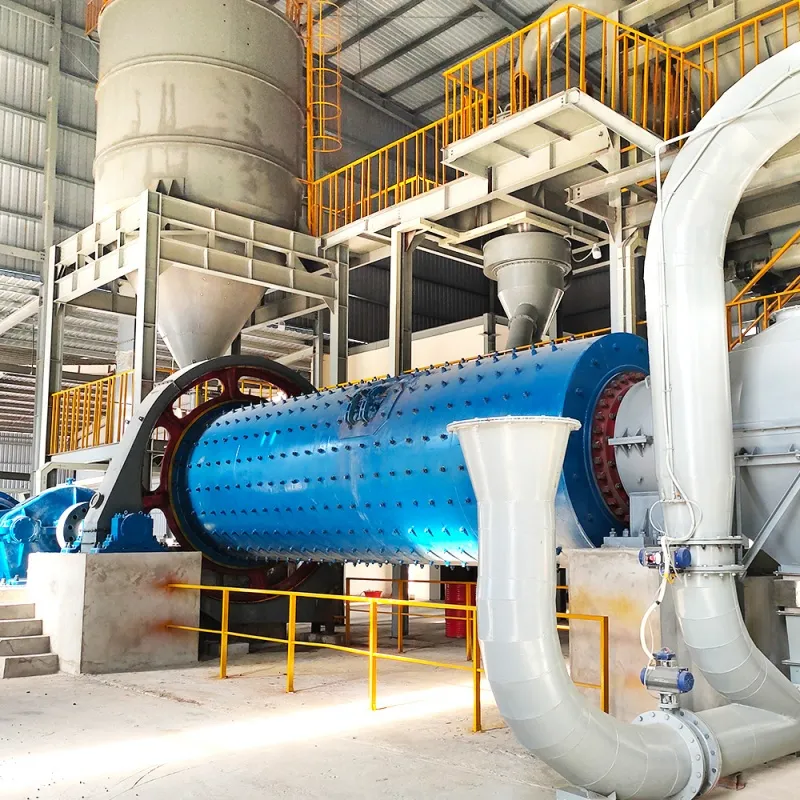
I. Why Are Coatings Inseparable from Heavy Calcium Carbonate? Eight Core Functions Explained
1. Serving as the Coating Film “Skeleton” to Increase Thickness and Prevent Cracking
GCC particles feature a stable structure and uniform density. Once added into a coating system, GCC effectively increases dry film thickness and fills gaps within the paint film. This makes the coating fuller, smoother, and more three-dimensional.
At the same time, GCC greatly enhances structural stability, helping the film resist thermal expansion and contraction. It reduces technical issues like cracking, peeling, shrinkage, and show-through, serving as the true underlying backbone of the coating.
2. Significantly Reducing Formulation Costs to Help Factories Cut Expenses
The most expensive components in a paint formula are emulsions, titanium dioxide (TiO2), and functional additives. As a highly cost-effective extender pigment, high-quality GCC can partially replace TiO2 and fill void spaces in the emulsion.
Without compromising performance, GCC drastically lowers raw material unit costs. It stands as the most direct and reliable filler for cost reduction in engineering paints, real stone paints, and waterborne coatings.
3. Assisting Whiteness and Hiding Power to Prevent Dullness
Ultra-fine, high-whiteness GCC inherently possesses excellent whiteness and mild hiding power. When paired with TiO2, it delivers key advantages:
- Elevates overall coating film whiteness
- Improves color leveling across the paint surface
- Minimizes graying, dullness, and batch-to-batch color variations
4. Enhancing Film Hardness for Superior Scrub and Wear Resistance
Derived from natural calcite ore, GCC boasts high hardness and a dense structure. Coatings formulated with premium GCC produce a tighter, firmer film. This significantly boosts scrub cycles and provides excellent resistance against scratches and chalking, easily enduring routine cleaning and harsh outdoor weathering.
5. Delivering Weathering and Aging Resistance to Prevent Chalking and Yellowing
High-quality GCC is chemically stable, offering resistance to acids, alkalis, and UV radiation. High-purity calcium powder with minimal impurities and low iron/manganese content resists yellowing, loss of gloss, chalking, and flaking even after prolonged outdoor exposure. It serves as a dedicated filler for exterior coatings and outdoor engineering paints.
6. Maintaining Low Oil Absorption to Save Emulsions and Stabilize Formulations
Compared to light calcium carbonate (PCC) and talc powder, the biggest advantage of GCC is its low oil absorption rate.
This offers distinct benefits:
- It does not absorb resin or additives in excessive amounts.
- The paint resists thickening and barrel swelling.
- The system remains stable, preventing stratification and caking during storage.
- Emulsion costs are effectively reduced.
7. Improving Application Performance for Smooth Brushing, Spraying, and Leveling
High-quality calcium powder offers superior dispersibility and suspension. The paint is less prone to hard settling at the bottom upon opening. It leaves minimal brush marks or orange peel during roller coating, while delivering fine, uniform atomization and excellent leveling during spraying.
8. Refining Surface Texture to Elevate Overall Product Grade
Ultra-fine mesh GCC powder contains no coarse particles. After film formation, the paint surface appears smooth, delicate, and softly matte with a premium feel. It significantly elevates the product grade of home decoration latex paints, artistic coatings, and matte topcoats.
II. Equipment Determines Quality: How Is Coating-Grade GCC Ground?
The particle size distribution, oil absorption value, particle shape, and impurity control of GCC are entirely dictated by upstream equipment selection and process tuning. Below are the mainstream calcium carbonate grinding routes tailored to different coating demands:
Natural Calcite Ore ➔ Coarse Crushing ➔ Core Grinding Equipment ➔ High-Precision Turboclassification ➔ Electromagnetic Iron Removal ➔ Coating-Grade GCC
1. Coarse Powder and Real Stone Paint Aggregates: Raymond Mills / Roller Mills
- Target Applications: Real stone paint aggregates, primers, and coarse architectural coatings (200-600 mesh).
- Equipment Characteristics: Traditional Raymond mills (R-type pulverizers) or upgraded pendulum mills offer low investment costs and simple operation. They maintain good particle angularity, providing excellent texture and build thickness for real stone paints.
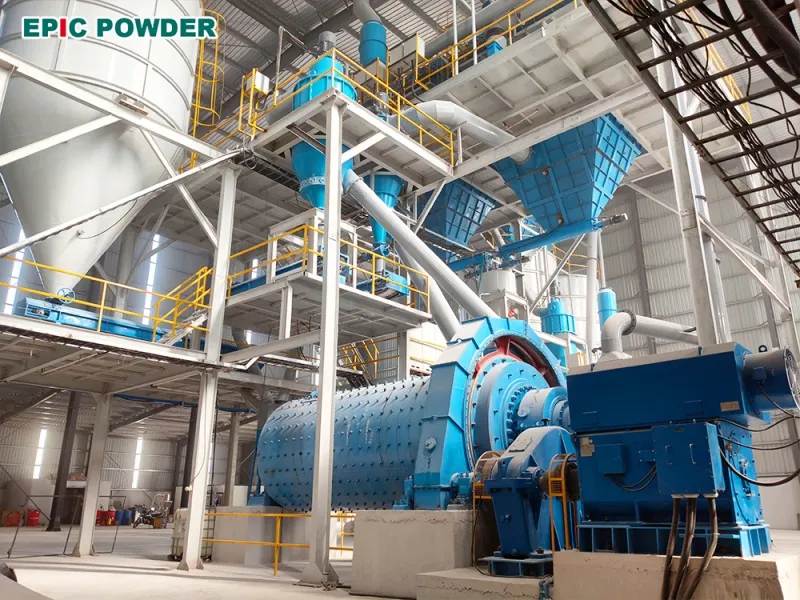
2. Fine Powder and General Latex Paints: Ball Mill + High-Precision Classification System
- Target Applications: Mid-to-high-end latex paints, exterior engineering paints, and interior wall topcoats (800-2500 mesh).
- Equipment Characteristics: The closed-circuit system combining a ball mill with a high-precision turbo classifier is the most classic and reliable setup for large-scale dry ultra-fine GCC production.
- Continuous and Stable Output: The ball mill features a rugged structure and high durability. It operates continuously 24/7, maintaining stable batch quality.
- Rounded Particles & Low Oil Absorption: Materials inside the ball mill undergo non-dead-angle grinding and impact from grinding media. This blunts particle edges and shapes the powder into rounded particles. This favorable morphology directly lowers the oil absorption value, reducing emulsion loss and saving costs for paint factories.
- Closed-Circuit Classification: Ground powder enters the turbo classifier via airflow. Qualified fine powder is collected as finished product, while oversized coarse particles automatically return to the ball mill for regrinding. This completely prevents coarse particles from entering the coating system.
3. High-End Fine Powder & Ultra-Fine Dry Powder: Ring Roller Mills (Medium-Speed Mills) / Jet Mills
- Target Applications: Premium decorative paints, matte topcoats, and ultra-fine plastic coatings (1250-3000 mesh).
- Equipment Characteristics: Ring roller mills deliver strong impact and shearing forces. Paired with multi-rotor turbo classifiers, they strictly control the maximum particle size (D100) to eliminate scratch marks caused by coarse grains. The resulting powder offers high whiteness and extreme fineness.
4. Ultra-Fine Powders & Waterborne Slurries: Wet Sand Mill Process
- Target Applications: Ultra-fine waterborne coatings, high-hiding latex paints, and liquid GCC slurries (above 3000 mesh, down to sub-micron scales).
- Equipment Characteristics: Calcium carbonate dry grinding easily leads to particle re-agglomeration at extreme fineness levels. In contrast, wet grinding (vertical or horizontal sand mills) uses water as a medium. This easily reduces particle size below 2µm (>6000 mesh).
- Key Advantages: Offers exceptional micro-hiding power, extremely low oil absorption, and superb dispersibility in waterborne systems. It serves as a core raw material for replacing titanium dioxide with calcium in high-end waterborne coatings.
III. Key Technical Details: How to Maintain Stable Metrics in GCC Production?
To manufacture Ground Calcium Carbonate powder that paint factories can trust, grinding lines must strictly control several core parameters:
| Control Link | Impacted Coating Metric | Equipment / Process Solution |
| Ultra-Fine Classification (D100 Control) | Scraper scratches, surface fineness | Equip high-precision turbo classifiers to intercept oversized grains, ensuring zero particles >45µm (325-mesh sieve residue = 0). |
| Particle Shaping & Oil Absorption Control | Resin/emulsion consumption, viscosity stability | Optimize grinding media and residence time to dull particle edges. Making particles rounded reduces BET surface area and oil absorption. |
| Magnetic Iron Removal | Black spots, impurities, exterior yellowing | Mechanical wear introduces iron during grinding. Install high-gradient electromagnetic separators (at least two stages in series) post-classification to prevent magnetic contamination. |
| Surface Modification (Active GCC) | Dispersibility in waterborne/solvent systems | Integrate a continuous powder surface modifier downstream. Apply stearic acid or silane coupling agents to boost organic affinity and prevent settling or clumping. |
IV. Conclusion
“Great coatings require great calcium powder, and great calcium powder stems from superior equipment.”
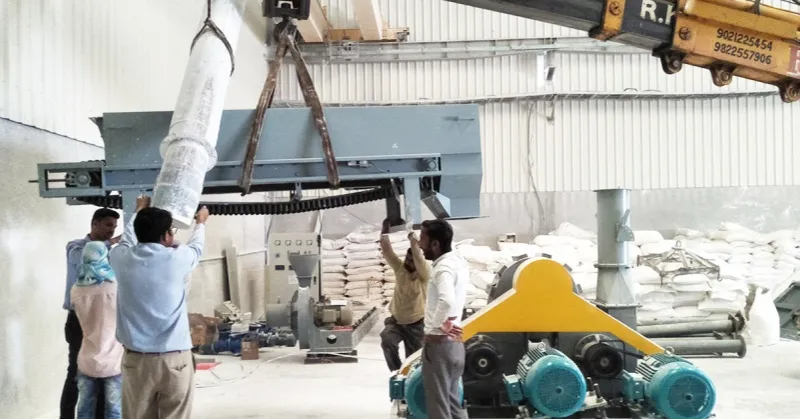
Epic Powder operates advanced ultra-fine ring roller mills, ball mill classification lines, and wet grinding production systems. Equipped with multi-stage high-precision classification and strong magnetic iron removal, we strictly control particle size distribution, whiteness (stable at 94-96 degrees), and oil absorption values.
Our heavy calcium carbonate powder features high purity, zero foreign minerals, rapid dispersion, and minimal oil absorption. We help coating manufacturers significantly lower formulation costs while improving hardness, scrub resistance, and surface texture. Whether producing white paint, engineering paint, or high-end decorative paint, Hechuang GCC provides you with a reliable foundation.

“Thanks for reading. I hope my article helps. Please leave a comment down below. You may also contact Zelda online customer representative for any further inquiries.”
— Posted by Emily Chen