
Calcium carbonate, as an inorganic mineral with abundant natural reserves and excellent cost performance, has become one of the most widely used inorganic fillers in the plastics industry. This is due to its low cost, high whiteness, good chemical stability, and strong mechanical compatibility with polymer materials. It can effectively reduce production costs while improving rigidity, dimensional stability, and processing stability of plastic products.
In industrial practice, converting calcium carbonate into high-filled masterbatch through ultrafine grinding and surface modification offers significant advantages. These include simplified compounding processes, improved melt-mixing uniformity, higher extrusion efficiency, and reduced dust pollution. Therefore, this approach has become the mainstream solution for plastic processing enterprises.
High-filled calcium carbonate masterbatch is widely applied in extruded pipes, films, injection-molded parts, and hollow products. With continuous advances in processing technology, masterbatch structures have evolved. They have progressed from simple filling to multi-layer micro-particle unit reinforcement systems. Among these, calcium carbonate acts as the core filler. Its particle size (mesh), particle size distribution, purity, and surface characteristics—largely determined by upstream ultrafine grinding and classification equipment—directly affect the processing behavior and mechanical performance of both the masterbatch and the final plastic products.
To clarify the influence of calcium carbonate particle size on PP-filled masterbatch performance, this study selected two grades of ground calcium carbonate. These were produced via ultrafine grinding and precision classification (CC-1500 mesh and CC-2500 mesh). Standard masterbatches were prepared and their processing and mechanical properties evaluated. This allowed a systematic analysis of the effects of particle size differences on PP modification performance.

Raw Materials and Powder Properties
Both calcium carbonate samples used in this study are calcite-type ground calcium carbonate (GCC). After primary crushing, the materials were processed using ultrafine grinding equipment. Examples include ball mill–classifier systems or air classifier mills. High-efficiency air classification was then applied to obtain products with narrow particle size distributions. Surface activation treatment was applied afterward. The key performance indicators are shown in Table 1.
Table 1. Key Properties of Two Calcium Carbonate Filler Grades
| Property | CC-1500 (1500 mesh) | CC-2500 (2500 mesh) |
|---|---|---|
| Median particle size D50 (μm) | 8.5 | 5.2 |
| Upper size limit D97 (μm) | 15.3 | 9.8 |
| Oil absorption (g/100g) | 18.2 | 25.7 |
| Whiteness (%) | 95.8 | 96.5 |
| CaCO₃ purity (%) | 99.2 | 99.5 |
As shown in Table 1, increasing the mesh size from 1500 to 2500 significantly reduces particle size, with D50 decreasing by approximately 39% and D97 becoming notably narrower. This improvement is primarily attributed to higher-energy ultrafine grinding and more precise air classification control.
At the same time, the substantial increase in specific surface area leads to a higher oil absorption value (an increase of about 41%), indicating stronger adsorption of the polypropylene melt. This enhanced surface interaction plays a critical role in subsequent changes in masterbatch processing performance.
In plastic masterbatch applications, finer calcium carbonate particles generally cause less deterioration in mechanical properties. However, excessively fine particles tend to agglomerate, placing higher demands on dispersion capability and classification accuracy. Therefore, industrial calcium carbonate for masterbatch applications typically requires a particle size of ≥1500 mesh, achievable only through stable and reliable ultrafine grinding and classification systems.
Masterbatch Preparation Process
Polypropylene (PP) was used as the carrier resin, combined with aluminate coupling agents and lubricants. The preparation process was as follows:
- Calcium carbonate was introduced into a high-speed mixer and heated to 100 °C to remove surface moisture;
- An aluminate coupling agent was added to form a stable coating on the ultrafine particles, improving interfacial compatibility;
- PP resin and additives were added and mixed to achieve uniform dispersion;
- The mixture was melt-extruded and pelletized using a twin-screw extruder at 160–200 °C;
- Standard test specimens were injection-molded for performance evaluation.
It should be noted that the finer the calcium carbonate particle size, the higher the requirements for shear efficiency and temperature control during compounding, further highlighting the decisive influence of powder quality on the masterbatch processing window.
Effect of Calcium Carbonate Filler Particle Size on Masterbatch Properties
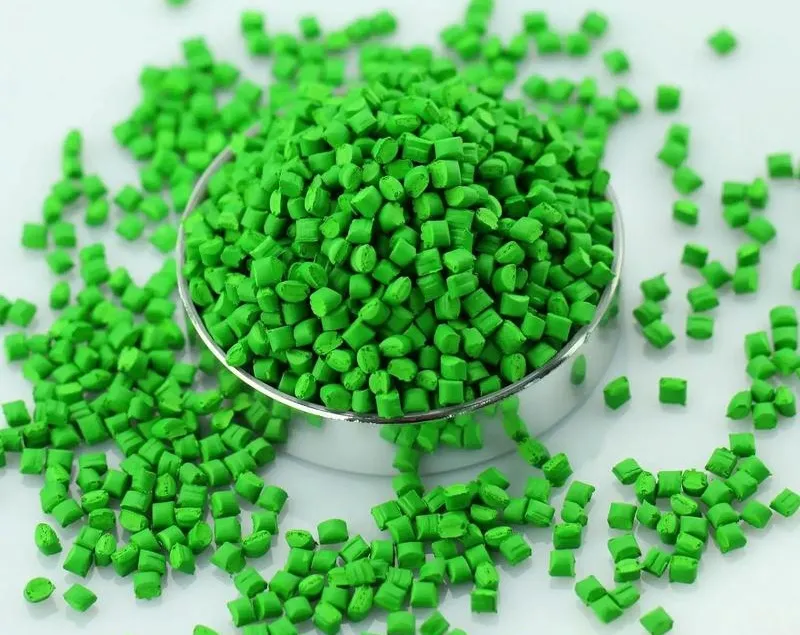
Effect on Melt Flow Properties
Melt flow rate (MFR) is a key indicator of masterbatch processability. The test results are shown in Table 2.
Table 2. Melt Flow Rate of Masterbatches with Different Calcium Carbonate Mesh Sizes
| Sample | Melt Flow Rate (g/10 min) |
|---|---|
| CC-1500 masterbatch | 46.74 |
| CC-2500 masterbatch | 24.10 |
The results indicate that the masterbatch containing 1500-mesh calcium carbonate exhibits significantly higher melt flowability, while the MFR of the 2500-mesh masterbatch decreases by nearly 50%.
This phenomenon is mainly attributed to:
- Smaller particle size resulting from ultrafine grinding, which greatly increases specific surface area;
- Higher oil absorption of finer calcium carbonate, leading to stronger adsorption of the PP melt;
- Reduced free-flow melt phase and increased resistance to molecular chain movement.
These findings clearly demonstrate that higher mesh size is not always better, and performance advantages must be matched with processing equipment capability and application requirements.
Conclusions and Engineering Recommendations
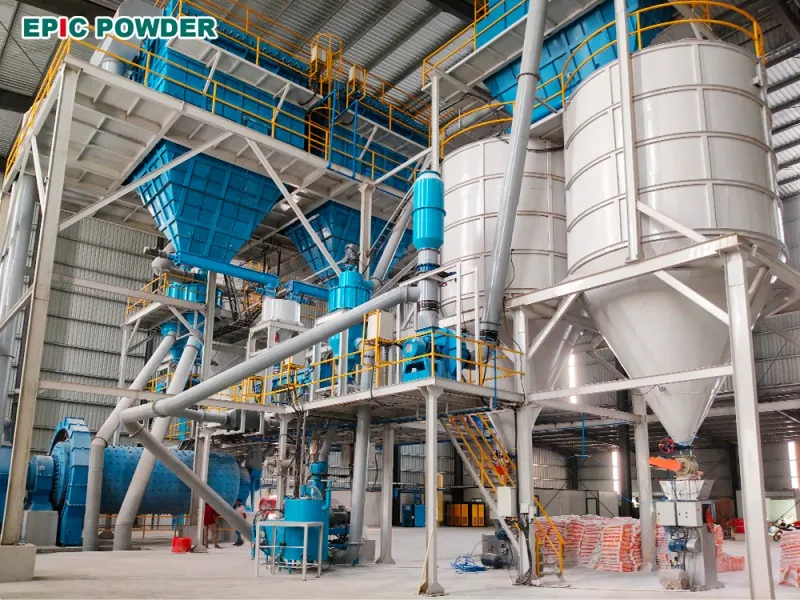
Based on calcium carbonate filler with different mesh sizes and corresponding ultrafine grinding and classification processes, the following conclusions can be drawn:
- Calcium carbonate particle size directly determines masterbatch processability
The 1500-mesh masterbatch shows a high MFR of 46.74 g/10 min, making it suitable for applications requiring high molding efficiency. - High-mesh calcium carbonate requires advanced ultrafine grinding equipment to realize its performance advantages
The 2500-mesh product provides higher strength and rigidity potential through fine grinding and narrow classification but demands stricter compounding and processing control. - Oil absorption and particle size are key coupling factors affecting masterbatch performance
As mesh size increases, smaller particle size and higher oil absorption lead to reduced flowability while enabling improved mechanical properties.
Practical Recommendation
In industrial PP filled masterbatch production, calcium carbonate mesh size and ultrafine grinding equipment should be selected based on end-use requirements:
- For high processing efficiency and productivity → 1500-mesh calcium carbonate is recommended;
- For enhanced rigidity and strength → 2500-mesh calcium carbonate, supported by high-performance ultrafine grinding and precision classification systems, is the better choice.
This study provides clear engineering guidance for precise calcium carbonate selection and equipment optimization in plastic filled masterbatch applications.

“Thanks for reading. I hope my article helps. Please leave a comment down below. You may also contact Zelda online customer representative for any further inquiries.”
— Posted by Emily Chen