
In industries such as plastics, rubber, coatings, papermaking, cables, and construction materials, calcium carbonate is one of the most widely used inorganic fillers. It plays a critical role in product performance and cost control. However, in practical applications, Precipitated Calcium Carbonate (PCC) and Ground Calcium Carbonate (GCC) are often confused or improperly selected. This can result in poor processing flowability, product yellowing, and increased production costs.
The difference between PCC and GCC is not simply a matter of “light” versus “heavy.” It stems from fundamentally different production processes. These differences lead to clear distinctions in physical properties, processing behavior, environmental performance, and overall economics.
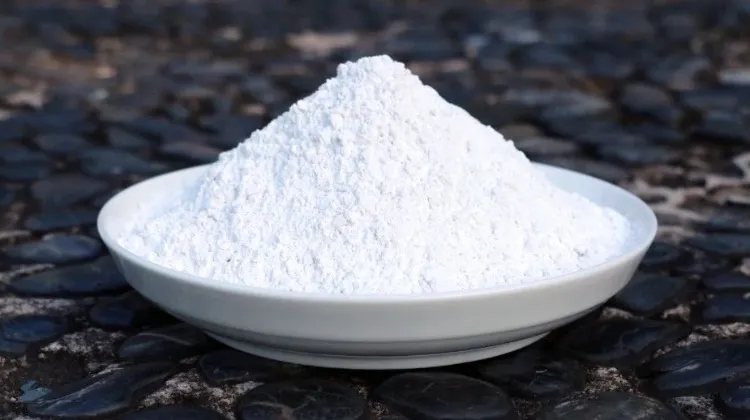
Source and Production Process: Chemical Synthesis vs. Mechanical Grinding
Precipitated Calcium Carbonate (PCC): Chemically Synthesized Material
Precipitated calcium carbonate is produced through chemical synthesis, mainly via two routes:
- Carbonation process
Limestone is calcined to produce quicklime (CaO) and carbon dioxide (CO₂). The quicklime is hydrated to form a calcium hydroxide slurry, into which CO₂ is introduced for carbonation, producing calcium carbonate precipitate. After dewatering, drying, and grinding, the final PCC product is obtained. - Double decomposition process
Calcium carbonate precipitate is formed by the reaction of sodium carbonate with calcium chloride, followed by post-treatment. Under special process conditions, crystal growth modifiers can be added to produce nano-grade precipitated calcium carbonate.
Ground Calcium Carbonate (GCC): Physically Processed Material
Ground calcium carbonate is produced by mechanically grinding natural minerals such as calcite, marble, chalk, or shells. This process only reduces particle size without altering the chemical composition.
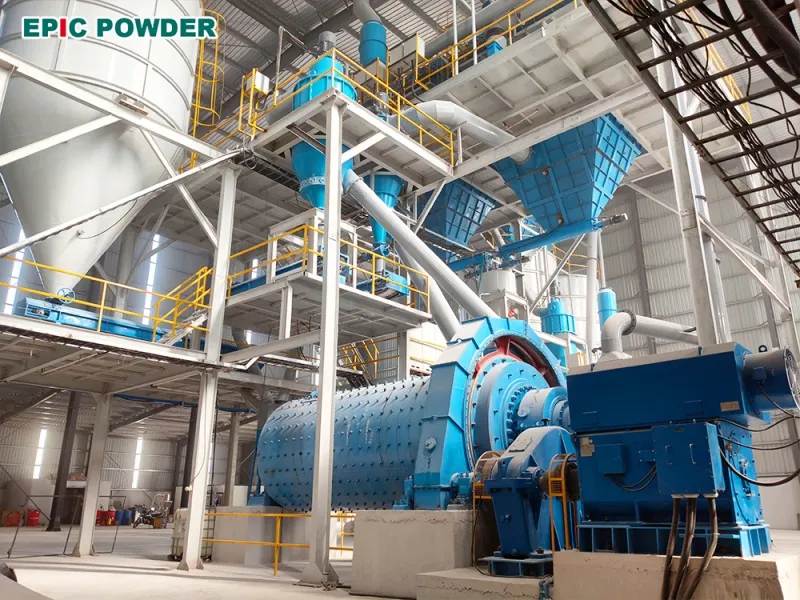
Common equipment includes Raymond mills, vertical roller mills, ring roller mills, and ball mill production lines. Among them, the ball mill + classifier system is a classic solution for producing ultrafine GCC. It features continuous closed-circuit operation, multi-stage classification, and large single-line capacity (circulating load of 300%–500%), enabling efficient production of fine and ultrafine powders with D97 = 5–45 μm, suitable for large-scale industrial manufacturing.
Core Physical Property Differences
Bulk Density
- GCC: Higher bulk density of 0.8–1.3 g/cm³, smaller packaging volume, typically 25 kg per bag.
- PCC: Lower bulk density of 0.5–0.7 g/cm³; nano PCC can be as low as 0.28 g/cm³, resulting in significantly larger packaging volume for the same weight, often packed in 15 kg or 20 kg bags.
The industry often uses sedimentation volume to quantify this difference:
- GCC: 1.1–1.4 mL/g
- PCC: 2.4–2.8 mL/g
- Nano PCC: up to 3.0–4.0 mL/g
(A larger sedimentation volume indicates finer particle size, lower bulk density, and higher product grade.)
The true density difference is small (GCC: 2.6–2.9 g/cm³; PCC: 2.4–2.6 g/cm³). Bulk density differences mainly arise from particle morphology: PCC particles are typically spindle- or rice-shaped and loosely packed, while GCC particles are irregular blocky particles that pack more tightly.
Whiteness
- GCC: Influenced by mineral impurities; typically 89%–93%, rarely up to 95%.
- PCC: Higher purity due to chemical synthesis; typically 92%–95%, with premium grades reaching 96%–97%, making it more suitable for high-end, light-colored plastic and rubber products.
Moisture Content
- GCC: Low and stable moisture content (0.2%–0.3%, premium grades ≤0.1%).
- PCC: Higher and more variable moisture content (0.3%–0.8%).
Traditional experience suggests that moisture close to 1% usually indicates PCC, while ≤0.1% is typical of GCC.
Particle Size and Morphology
- GCC: Particle size 0.5–45 μm, irregular shapes (cubic, polyhedral, etc.), crystal structure determined by the raw mineral (e.g., hexagonal for calcite, cubic for marble); grinding does not change the crystal form.
- PCC: Standard grades at 0.5–15 μm (spindle-shaped); nano grades at 20–200 nm. Particle morphology can be deliberately controlled using additives (acids, alkalis, organic compounds), producing rhombohedral, spherical, rod-like, and other shapes.

Key Application Performance Differences
Oil Absorption
- PCC: 60–90 mL/100 g
- GCC: 40–60 mL/100 g
Higher oil absorption increases consumption of liquid additives and resins. For example, when oil absorption increases from 40 to 50 mL/100 g, coupling agent usage may rise by about 30%. Therefore, formulations containing liquid additives are generally more suitable for GCC.
Flowability
- PCC: Spindle-shaped structure and high oil absorption tend to adsorb lubricants and plasticizers, resulting in poor flowability; additions above 25 phr significantly affect processing.
- GCC: Granular particle structure helps improve system flowability, with no obvious upper limit on addition level.
Color Tone Controllability
- GCC: Color tone depends on the mineral source (e.g., bluish tone from Sichuan, reddish tone from Guangxi) and cannot be altered by grinding.
- PCC: Color tone can be adjusted through crystal control. Its inherent bluish tone can neutralize yellowing in PVC products, which is a key reason why traditional PVC formulations favor PCC.
pH Value and Environmental Performance
- PCC: pH 9–10, stronger alkalinity than GCC (pH 8–9). During incineration, PCC more readily absorbs acidic gases such as HCl and H₂S, reducing the risk of dioxin formation and better meeting environmental requirements.
Price
GCC has a simpler processing route and is typically about 30% cheaper than PCC at the same particle size, offering clear economic advantages.
Conclusion
There is no absolute “better” or “worse” between precipitated calcium carbonate and ground calcium carbonate—only suitability for specific applications.
GCC, with its low cost, good flowability, and low oil absorption, is the first choice for large-scale cost reduction through high filler loading.
PCC has high whiteness, fine particle size, and a controllable crystal structure. It plays an irreplaceable role in high-end reinforcement, optical performance control, and environmentally oriented applications.
n practice, more manufacturers are adopting hybrid formulations. They use GCC to reduce cost and viscosity while incorporating PCC to enhance strength and whiteness. This combined strategy is becoming a new trend in calcium carbonate applications.
For ultrafine processing of ground calcium carbonate, ball mill + classifier production lines from Qingdao Epic Powder Machinery are widely recognized. These systems offer high efficiency, energy savings, and precise particle size control. They have been successfully applied in numerous projects worldwide. This helps customers achieve large-scale production of high-quality GCC powders and promotes a finer, more environmentally friendly industry development.

“Thanks for reading. I hope my article helps. Please leave a comment down below. You may also contact Zelda online customer representative for any further inquiries.”
— Posted by Emily Chen