
In ultrafine calcium carbonate (CaCO₃) processing, whiteness is not merely a visual parameter—it is a core indicator of product quality and market value. Whether the application is high-end plastics, paper coating, paints, sealants, or engineered composites, whiteness directly influences brightness, opacity, dispersion performance, and final product aesthetics.
As calcium carbonate particles are ground into the micron and submicron range, surface characteristics become increasingly sensitive to contamination, thermal effects, and particle morphology. Among modern ultrafine grinding technologies, jet mills and stirred mills (agitated media mills) are widely used. Both can produce fine and ultrafine powders, but they operate under fundamentally different principles.
This leads to a critical technical question:
Can a jet mill achieve better whiteness than a stirred mill in ultrafine calcium carbonate grinding?
The answer depends on grinding mechanism, contamination control, target fineness, equipment configuration, and application requirements. This article explores the comparison in depth and answers two key related questions.
1. Why Whiteness Matters in Ultrafine Calcium Carbonate
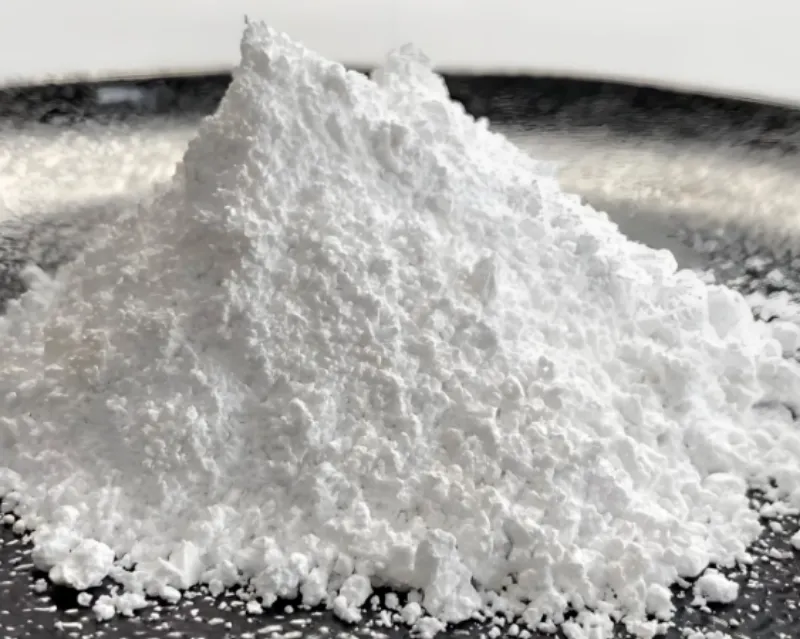
Calcium carbonate is commonly used as a white filler or functional extender. Its whiteness affects:
- Plastic brightness and color stability
- Paper opacity and printability
- Paint covering power
- Surface gloss in coatings
- Visual quality of masterbatch
Whiteness in CaCO₃ is mainly influenced by:
- Raw material purity (Fe₂O₃, MnO, Ti impurities)
- Surface contamination during grinding
- Particle size and distribution
- Particle shape and surface smoothness
- Agglomeration behavior
When particle size drops below 10 μm, and especially below 5 μm, the specific surface area increases dramatically. At this stage, even trace contamination can noticeably reduce whiteness.
2. Grinding Mechanism Differences
2.1 Jet Mill – Media-Free Fluid Energy Grinding
Jet mills use high-speed compressed air to accelerate particles to supersonic speeds. Particle-to-particle collisions cause size reduction through impact and attrition.
Key characteristics:
- No grinding media
- Minimal metal contact
- Extremely low iron contamination
- Lower material temperature due to air expansion cooling
- Excellent dispersion and narrow PSD (when combined with air classifier)
Since no steel or ceramic media are involved, the risk of introducing iron or other impurities is significantly reduced.
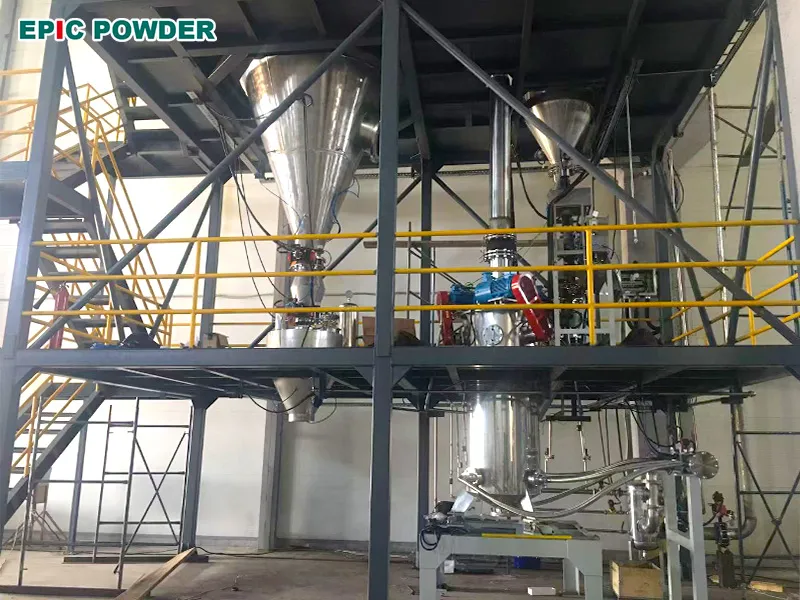
2.2 Stirred Mill – Media-Based High-Energy Grinding
A stirred mill uses ceramic or steel beads inside a rotating chamber. Particles are reduced through intense media-particle impact and friction.
Key characteristics:
- Very high grinding efficiency
- Suitable for submicron production
- Higher energy density
- Media and liner wear inevitable
- Greater mechanical contact area
Even when using high-purity ceramic beads (such as zirconia or alumina), micro-wear debris is unavoidable.
3. Whiteness Performance Comparison in Calcium Carbonate Ultrafine Grinding
3.1 Contamination Control
Iron contamination is the most critical factor affecting calcium carbonate whiteness.
- Steel media significantly increase Fe content.
- Ceramic media reduce contamination but cannot eliminate it.
- Jet mills avoid grinding media entirely.
For high-brightness calcium carbonate (≥ 95–98% whiteness), especially for premium plastics or paper coatings, contamination control becomes decisive.
In this aspect, jet mills generally have an advantage.
3.2 Thermal Effects
Excessive grinding temperature can:
- Promote oxidation of trace iron
- Cause slight yellowing
- Increase surface defects
Stirred mills, especially dry systems, may generate localized heat due to friction and high energy density.
Jet mills typically operate at relatively stable and lower material temperatures due to compressed air cooling effects.
Lower temperature helps preserve intrinsic whiteness.
3.3 Particle Morphology and Light Scattering
Whiteness is closely related to light scattering efficiency.
Jet mills tend to produce:
- More uniform particle shapes
- Better dispersion
- Narrower particle size distribution
Uniform particles enhance light reflection and scattering, improving perceived whiteness.
Stirred mills can achieve extremely fine sizes, but irregular particle surfaces and broader PSD may influence optical performance.
4. Key Related Question
Does Achieving Smaller Particle Size Always Increase Calcium Carbonate Whiteness?
Answer: No, there is an optimal size range.
Reducing particle size improves whiteness initially because:
- Smaller particles scatter light more effectively
- Surface smoothness increases
However, when particles become excessively fine (e.g., D50 < 1 μm):
- Agglomeration increases
- Light absorption may increase
- Transparency effects may reduce opacity
Over-grinding may actually reduce visible whiteness.
Jet mills equipped with precision classifiers allow better control of D97 and top cut size, helping maintain optimal whiteness.
Can High-Purity Ceramic Media in Stirred Mills Fully Match Jet Mill Whiteness Performance?
Answer: It can approach it, but usually not completely match it in ultra-high-end applications.
Using:
- High-purity zirconia beads
- Alumina ceramic liners
- Non-metallic internal structures
can significantly reduce contamination.
However:
- Media wear still exists.
- Mechanical friction is higher.
- Surface abrasion may slightly alter particle reflectivity.
For ultra-high-brightness CaCO₃ used in:
- Food-contact plastics
- High-end PVC profiles
- Premium masterbatch
- Paper coating with strict brightness standards
Jet mills often remain the preferred solution.
That said, if the target is extreme submicron fineness rather than maximum whiteness, stirred mills may offer better energy efficiency.
6. Economic and Application Considerations
| Application | Priority | Recommended Technology |
|---|---|---|
| High-end plastics | Whiteness + dispersion | Jet Mill |
| Paper coating | Brightness + opacity | Jet Mill |
| PVC pipe filler | Cost-performance balance | Stirred Mill |
| Submicron slurry | Extreme fineness | Stirred Mill |
| Surface-modified CaCO₃ | Clean surface | Jet Mill |
In many industrial cases, the final decision balances:
- Required whiteness level
- Target particle size
- Production capacity
- Operating cost
- Downstream processing needs
7. Conclusion
So, can a jet mill achieve better whiteness than a stirred mill in ultrafine calcium carbonate grinding?
In most high-purity and high-brightness applications, yes.
Jet mills offer:
- Lower contamination risk
- Better preservation of intrinsic whiteness
- Controlled particle size distribution
- Lower thermal impact
Stirred mills provide:
- Higher grinding efficiency in submicron range
- Greater throughput potential
- Competitive performance with ceramic configurations
Ultimately, for ultrafine calcium carbonate where whiteness is a critical market requirement, jet milling often provides a technical advantage—especially in premium applications.

“Thanks for reading. I hope my article helps. Please leave a comment down below. You may also contact Zelda online customer representative for any further inquiries.”
— Posted by Emily Chen