
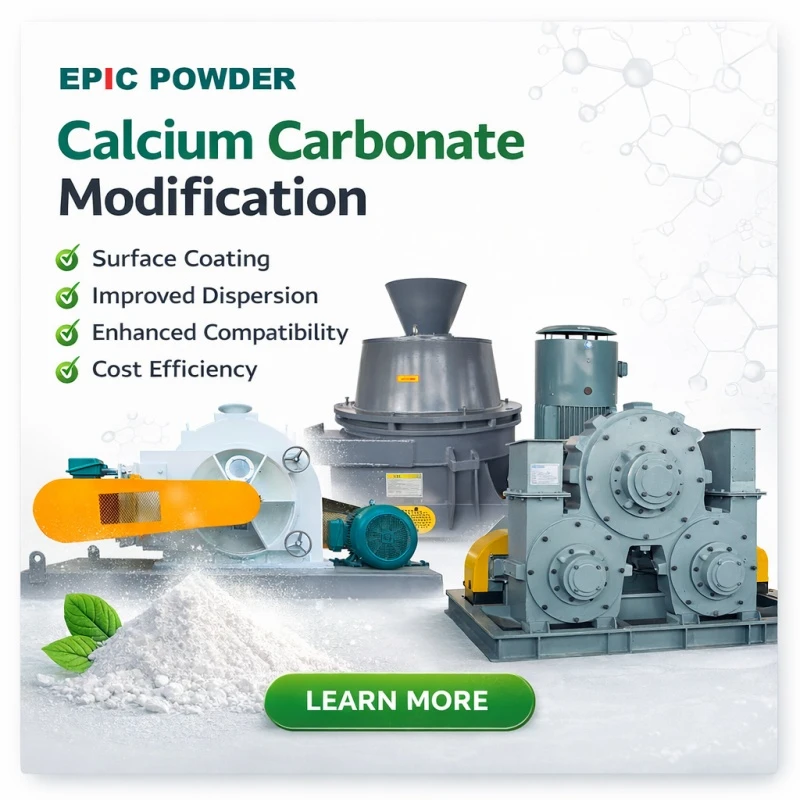
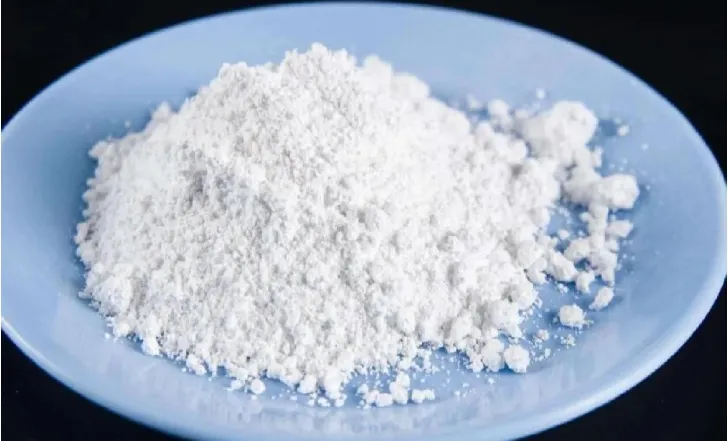
Calcium carbonate, as an inorganic powder material with abundant reserves, low cost, and environmental friendliness, has been widely used in plastics, rubber, coatings, papermaking, adhesives, and many other fields. However, it inherently exhibits hydrophilic and oleophobic surfaces, poor compatibility with organic matrices, and a strong tendency to agglomerate. These intrinsic drawbacks limit its application in high-end products. Surface modification technology, as the core approach to solving these problems, modifies the surface of calcium carbonate through physical, chemical, or composite methods. This improves surface properties, enhances compatibility and dispersibility with organic matrices, and endows calcium carbonate with special functions such as reinforcement, flame retardancy, and antibacterial performance, thereby significantly increasing product added value.
I. Core Objectives of Calcium Carbonate Surface Modification
The core objective of calcium carbonate surface modification is to improve compatibility, enhance dispersibility, and impart functionality. Through modification, its inherent hydrophilic surface characteristics are altered, and a surface structure compatible with organic matrices is constructed, thereby eliminating agglomeration and enabling calcium carbonate to fully perform its filling and reinforcing functions.
Main objectives include:
- Improve compatibility: Convert hydrophilic groups on the calcium carbonate surface into hydrophobic groups, enabling good integration with organic matrices such as plastics, rubber, and coating resins, and avoiding defects like delamination and cracking caused by poor compatibility.
- Enhance dispersibility: Reduce van der Waals forces between particles, prevent agglomeration, and ensure uniform dispersion in the matrix, thus guaranteeing consistent product performance and improved processing flowability.
- Impart functionality: Through special modifiers, calcium carbonate can obtain additional functions such as flame retardancy, antibacterial properties, weather resistance, and aging resistance to meet high-end product requirements.
- Protect surface activity: Reduce reactions between surface hydroxyl groups of calcium carbonate and other substances, improve stability during processing, and extend the service life of products.
II. Mainstream Surface Modification Technologies for Calcium Carbonate
At present, industrial surface modification technologies for calcium carbonate are mainly divided into chemical modification, physical modification, and composite modification. These technologies differ significantly in process complexity, modification effect, and application scenarios. Among them, chemical modification is the most widely used, while composite modification represents the main direction for industry upgrading.
1. Chemical Modification Technology
Chemical modification achieves surface modification through chemical reactions between modifiers and the calcium carbonate surface. It provides stable modification effects and significantly improves compatibility. According to the type of modifier, four common processes are used:
(1) Coupling Agent Modification
This is the most widely used chemical modification method. Coupling agents act as a “bridge”: one end reacts with surface hydroxyl groups of calcium carbonate, and the other end bonds with organic matrices, greatly improving compatibility. Common coupling agents include:
- Silane coupling agents: Suitable for high-end applications in plastics, rubber, and coatings. Modified calcium carbonate shows excellent dispersibility and reinforcement. Typical grades include KH-550 and KH-570, with a dosage of 0.5%–1.5% of calcium carbonate mass.
- Titanate coupling agents: Suitable for plastics such as PVC and PE. They provide both compatibility and lubricity, improving processing performance. Dosage: 0.8%–2.0%. Disadvantage: relatively poor water resistance.
- Aluminate coupling agents: High cost-performance ratio, suitable for various plastics and rubber. They offer balanced modification performance and better water resistance than titanate coupling agents. Dosage: 0.6%–1.8%. This is currently the most widely used coupling agent type in industry.
(2) Fatty Acid / Fatty Acid Salt Modification
Fatty acids such as stearic acid and palmitic acid, or their salts (calcium stearate, zinc stearate), are used as modifiers. They react with surface hydroxyl groups of calcium carbonate to form a hydrophobic coating layer. This method features simple processing and low cost and is suitable for medium- and low-end plastics and rubber applications.
(3) Phosphate Ester Modification
Mainly used in high-end coatings and inks. Phosphate ester modifiers react with calcium carbonate to form a stable phosphate salt coating layer, improving dispersibility, water resistance, and gloss, while also enhancing coating rheology. Typical dosage: 0.8%–2.2%.
(4) Polymer Modification
Polyethylene wax, polypropylene wax, and other polymers are used as modifiers. Through chemical grafting or physical coating, a polymer layer is formed on the calcium carbonate surface. This not only improves compatibility but also enhances processing flowability and surface gloss of products. Suitable for high-end plastics and cable compounds.
2. Physical Modification Technology (Auxiliary Technology)
Physical modification does not involve chemical reactions. It uses mechanical force, ultrasound, plasma, and other means to change surface morphology and dispersibility. The process is simple and environmentally friendly, but the modification effect is limited, so it is mostly used in combination with chemical modification.
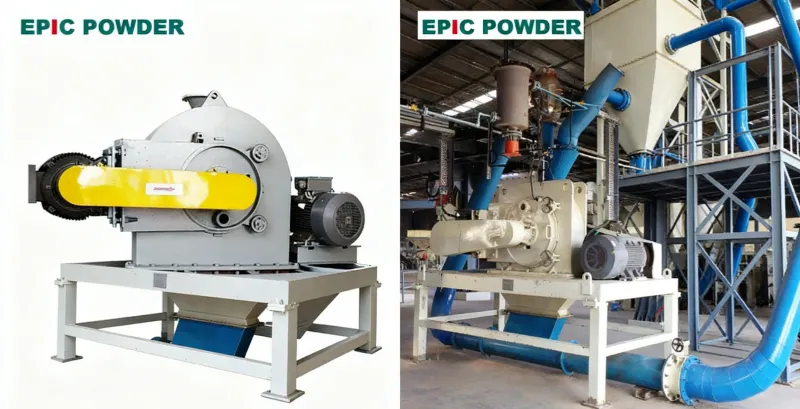
- Mechanical grinding modification: Using jet mills, ball mills, etc., to break agglomerates during grinding while enabling uniform attachment of modifiers to particle surfaces, improving dispersibility. Suitable for coarse calcium carbonate.
- Ultrasonic modification: Ultrasonic vibration breaks agglomerates and promotes modifier adsorption on particle surfaces. High modification efficiency, suitable for ultrafine and nano calcium carbonate.
- Plasma modification: Plasma treatment introduces active groups on the surface, enhancing reactivity with modifiers and improving modification efficiency. Suitable for high-end nano calcium carbonate, but equipment investment is high and large-scale industrialization is difficult.
3. Composite Modification Technology (Upgrading Direction)
Composite modification combines two or more modification technologies to balance performance and cost, overcoming the shortcomings of single methods. It is currently the mainstream trend for high-end calcium carbonate modification. Common composite approaches include:
- Coupling agent + fatty acid composite modification: Balances compatibility and lubricity while reducing cost; suitable for plastics and rubber.
- Physical grinding + chemical grafting composite modification: Breaks agglomeration and ensures firm bonding of modifiers, improving dispersibility and compatibility; suitable for ultrafine calcium carbonate.
- Coupling agent + functional modifier composite modification: Improves compatibility while imparting functions such as flame retardancy and antibacterial properties, suitable for high-end products such as flame-retardant modified calcium carbonate and antibacterial modified calcium carbonate.
III. Performance Characteristics and Application Matching of Different Modified Calcium Carbonate Products
According to modification technologies and modifiers, modified calcium carbonate can be divided into general modified calcium carbonate and functional modified calcium carbonate. Their performance characteristics differ significantly, and they are suitable for different industrial scenarios.
1. General Modified Calcium Carbonate
(Mainly for improving compatibility and dispersibility)
- Coupling-agent-modified calcium carbonate: Excellent compatibility and dispersibility with certain reinforcement effect. Suitable for mid-to-high-end plastics, rubber, and coatings, such as PVC profiles, rubber seals, and high-end coating fillers.
- Fatty-acid-modified calcium carbonate: Low cost and good lubricity. Suitable for mid- and low-end plastics and rubber, such as PE films, rubber tires, and plastic pipes. Improves processing flowability and reduces equipment wear.
- Polymer-modified calcium carbonate: High compatibility with plastic matrices and good surface gloss. Suitable for high-end plastics such as PP bumpers, ABS housings, and premium packaging plastics.
2. Functional Modified Calcium Carbonate
(Mainly for imparting special functions)
- Flame-retardant modified calcium carbonate: Composite modification with coupling agents and flame retardants (magnesium hydroxide, aluminum hydroxide). Provides both filling and flame-retardant functions. Suitable for plastic cable compounds, construction plastics, and flame-retardant rubber, in line with environmentally friendly flame-retardant trends, and can partially replace expensive flame retardants.
- Antibacterial modified calcium carbonate: Composite modification with antibacterial agents such as silver ions and zinc oxide. Provides long-lasting antibacterial performance. Suitable for food packaging plastics, pharmaceutical packaging, and daily chemical products (toothpaste, cosmetics), non-toxic and environmentally friendly.
- Weather-resistant modified calcium carbonate: Composite modification with silane coupling agents and UV absorbers. Improves UV resistance and high/low temperature resistance. Suitable for outdoor coatings, plastic building materials, and outdoor rubber products, extending service life.
- Ultrafine / nano modified calcium carbonate: Fine particle size and large specific surface area, with outstanding reinforcement effect. Suitable for high-end rubber, coatings, and plastics, such as nano-modified rubber tires (improved wear resistance), high-end coatings (improved hiding power), and precision plastic parts.
3. Key Application Focus by Industry
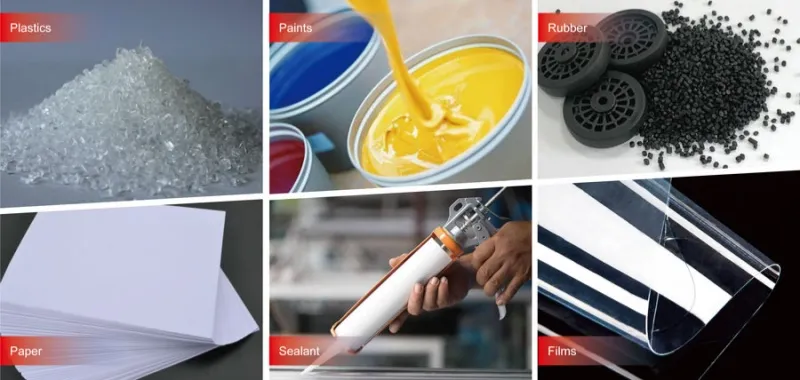
- Plastics industry: Prefer coupling-agent-modified and polymer-modified calcium carbonate. High-end products use nano-modified and functional modified calcium carbonate to solve compatibility and dispersibility issues, while reducing cost and improving strength.
- Rubber industry: Use coupling-agent-modified and fatty-acid-modified calcium carbonate; high-end rubber uses nano-modified calcium carbonate, focusing on improving compatibility and reinforcement, and enhancing wear resistance and tear strength.
- Coatings industry: Use phosphate-ester-modified and coupling-agent-modified calcium carbonate; high-end coatings use nano-modified calcium carbonate to improve dispersibility, water resistance, gloss, and hiding power.
- Adhesives and sealants: Use coupling-agent-modified calcium carbonate with uniform particle size and good dispersibility to improve bonding strength and water resistance while reducing cost.
- Daily chemical and pharmaceutical industries: Use antibacterial-modified and high-purity modified calcium carbonate, requiring non-toxicity and uniform particle size, suitable for toothpaste, cosmetics, and pharmaceutical packaging.

Conclusion
Surface modification technology is the key means to break through the application limitations of ordinary calcium carbonate and enhance product added value. Chemical modification, with its stable effect and high cost-performance ratio, dominates industrial applications. Composite modification, integrating the advantages of multiple technologies, meets high-end product requirements and has become the core direction of industry upgrading. Physical modification serves as an auxiliary method to further enhance modification effectiveness.
Different modified calcium carbonate products, based on their performance characteristics, can be precisely matched to various scenarios in plastics, rubber, coatings, daily chemicals, and other industries, realizing multiple values of cost reduction through filling, performance optimization, and functional empowerment.

“Thanks for reading. I hope my article helps. Please leave a comment down below. You may also contact Zelda online customer representative for any further inquiries.”
— Posted by Emily Chen