
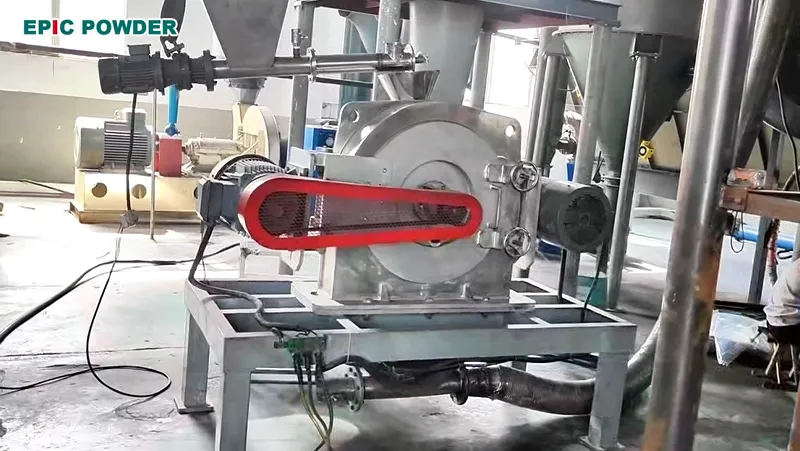
Nano-calcium carbonate (nano-CaCO₃) is an ultrafine functional filler with a primary particle size typically below 100 nm. It is widely used in plastics, rubber, coatings, inks, and adhesives to improve mechanical strength, opacity, and rheological properties. However, due to its high surface energy and strong van der Waals forces, nano-calcium carbonate tends to agglomerate during drying and storage, forming hard millimeter-scale clusters. Effective deagglomeration—breaking these clusters back into their primary nanoparticles—is essential for optimal downstream performance. Among various milling technologies, the pin mill (also known as a contraplex pin mill) stands out for its high-shear, impact-based deagglomeration mechanism. This article explains how the pin mill disperse nano-calcium carbonate efficiently, covering its working principles, design features, process parameters, and practical techniques.
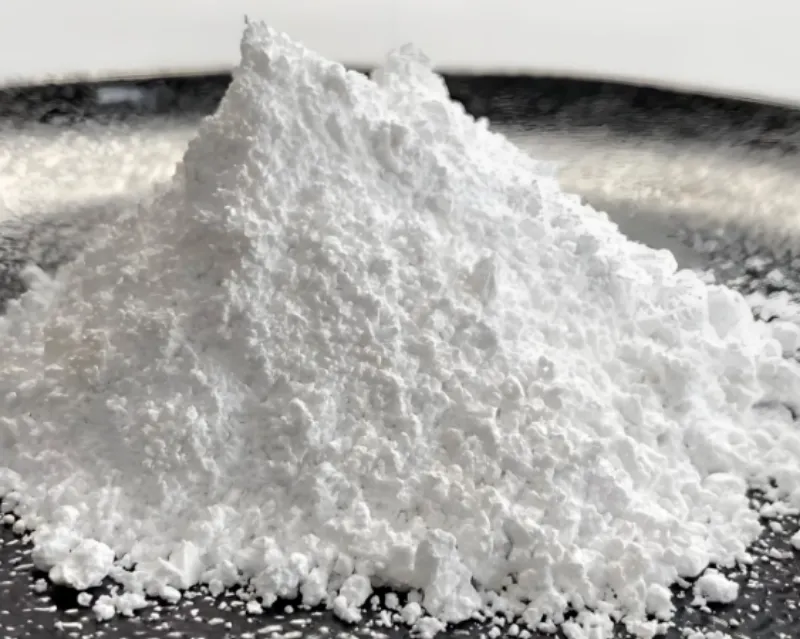
Understanding Agglomeration in Nano-Calcium Carbonate
Nano-CaCO₃ is typically produced via carbonation or precipitation, followed by filtration, drying, and packaging. During drying, capillary forces and hydrogen bonding lead to two types of agglomeration:
- Soft agglomerates — breakable with moderate shear
- Hard agglomerates — require strong mechanical stress
If not properly dispersed, agglomerates lead to:
- Poor reinforcement in composites
- Surface defects in coatings
- Sharp viscosity increases in inks
Traditional ball milling or media milling consumes high energy and may introduce contamination. Pin mills provide a clean, efficient, high-throughput alternative.
Working Principle of a Pin Mill
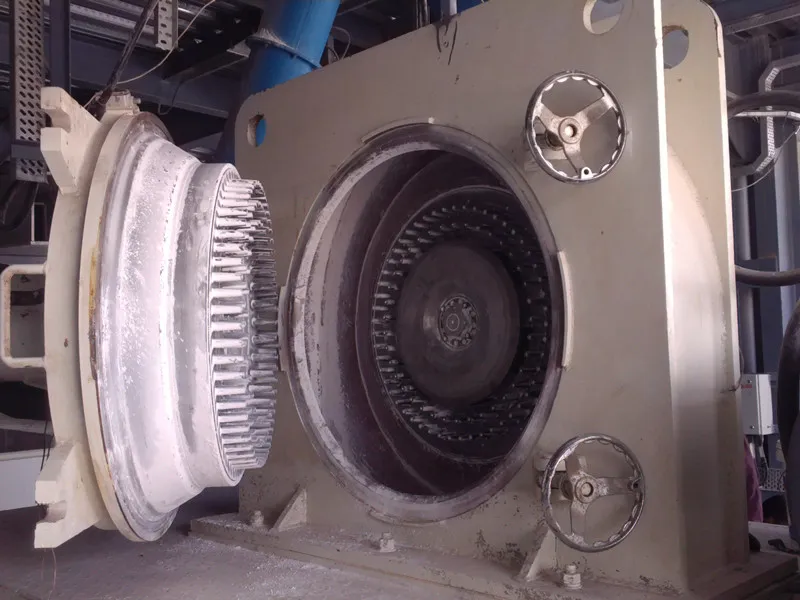
A pin mill consists of two disks—either counter-rotating or one rotating and one stationary—equipped with concentric rows of cylindrical pins. Material enters from the center and is thrown radially outward through the pin array.
Deagglomeration Mechanisms
- High-speed impact:
Pins accelerate particles to 100–200 m/s, where particle–pin and particle–particle collisions break agglomerates. - Shear zones:
Narrow gaps (0.5–2 mm) between opposing pins generate shear rates exceeding 100,000 s⁻¹. - Turbulent airflow:
Built-in high-speed airflow creates vortex motion that prevents reagglomeration. - Multiple-pass effect:
Residence time is controlled by feed rate and disk speed, improving deagglomeration efficiency.
Unlike jet mills, which rely purely on particle–particle collisions, pin mills use a combination of mechanical impact and shear—well-suited for brittle, friable CaCO₃.
Key Design Features for Nano-Calcium Carbonate
- Pin geometry:
Cylindrical or conical pins (diameter 3–10 mm) maximize impact area. - Speed control:
VFD-controlled motors allowing 5,000–18,000 RPM. - Cooling jackets:
Protect surface-treated nano-CaCO₃ from thermal degradation. - Wear-resistant materials:
Hardened steel, ceramics, or tungsten carbide pins for long service life. - Integrated air classification:
Dynamic classifiers remove fine particles while recirculating coarse agglomerates.
Modern commercial units (e.g., Hosokawa Alpine Contraplex, Netzsch Condux) can achieve d97 < 1 µm in a single pass.
Process Parameters and Optimization
| Parameter | Typical Range | Influence on Deagglomeration |
|---|---|---|
| Rotor speed | 8,000–15,000 RPM | ↑ Speed → ↑ Energy input → finer output |
| Feed rate | 50–500 kg/h | ↓ Rate → longer residence time → finer dispersion |
| Airflow | 500–2,000 m³/h | ↑ Airflow → better transport, reduced adhesion |
| Gap width | 0.5–3 mm | ↓ Gap → higher shear force |
| Moisture | < 0.5% | Dry feed prevents caking |
Case Example:
A coating manufacturer using a 250 kW pin mill at 12,000 RPM processed stearic-acid-coated nano-CaCO₃:
- Input: d50 = 15 μm (agglomerated)
- Output: d50 = 80 nm, with >95% recovery of primary particles
Advantages of Pin Mill Disperse Nano-Calcium Carbonate
- High efficiency — 30–50% lower energy consumption compared to jet mills
- Scalable — from lab scale (50 g/h) to industrial scale (5 t/h)
- No grinding media — zero metal contamination
- Dry processing — compatible with inline surface modification
Limitations and Solutions
Heat generation:
Use water-cooled disks or nitrogen inerting.
Handling ultrafine powder:
Pulse-jet bag filters and antistatic agents recommended.
Not suitable for wet cake:
Require spray drying before milling.
Epic Powder
The pin mill is one of the most effective tools to pin mill disperse nano-calcium carbonate. It combines high-speed impact, strong shear forces, and turbulent airflow in the milling chamber. By optimizing rotor speed, airflow, moisture, and feed rate, manufacturers can achieve sub-100 nm dispersion in a single pass. This ensures stable and consistent nano-calcium carbonate performance in many applications.
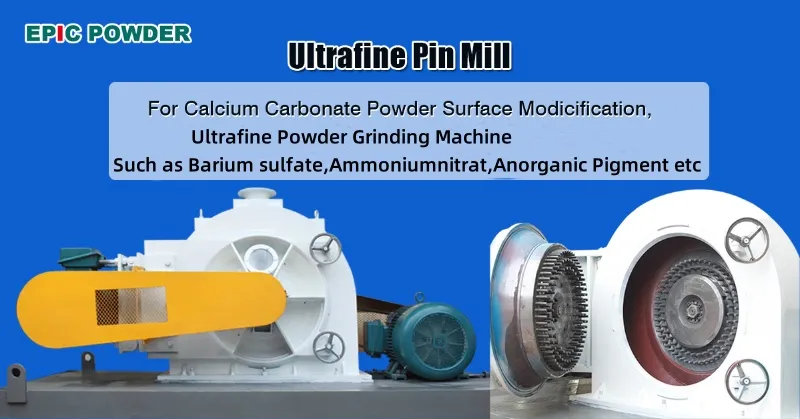
Epic Powder’s advanced Pin Mill systems further enhance this process with:
- German technology, precision-engineered wear-resistant pin designs
- High-speed dual-rotor structures for superior impact efficiency
- Optional integration with dynamic air classifiers for zero coarse-particle contamination
- Low-temperature processing ideal for surface-modified nano-CaCO₃
- Customizable solutions from laboratory to multi-ton industrial scale
With Epic Powder’s equipment and engineering expertise, producers can achieve consistent, high-purity, high-dispersion nano-calcium carbonate, meeting the demanding requirements of modern plastics, coatings, adhesives, and composite materials.

“Thanks for reading. I hope my article helps. Please leave a comment down below. You may also contact Zelda online customer representative for any further inquiries.”
— Posted by Emily Chen