
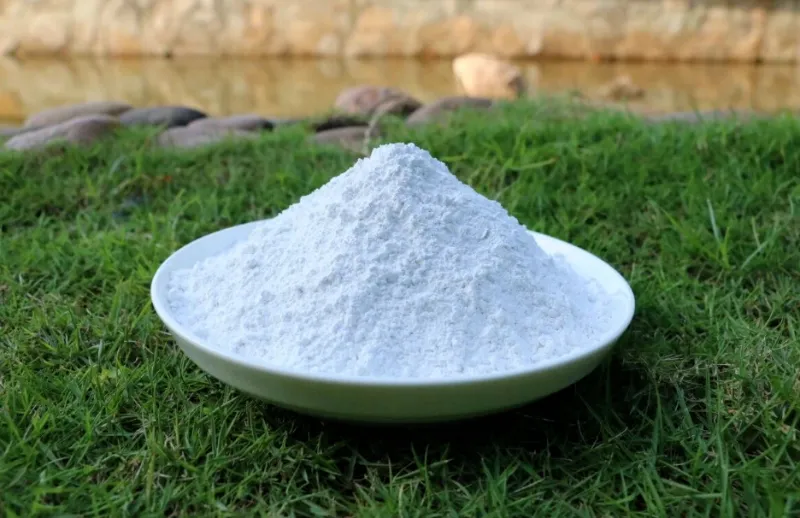
Among the many filler and modification materials used in the plastics industry, calcium carbonate holds an irreplaceable position. It is generally divided into heavy calcium carbonate and light calcium carbonate. This raises an important question for plastic formulators:
Which is more suitable for plastic products—light calcium or heavy calcium?
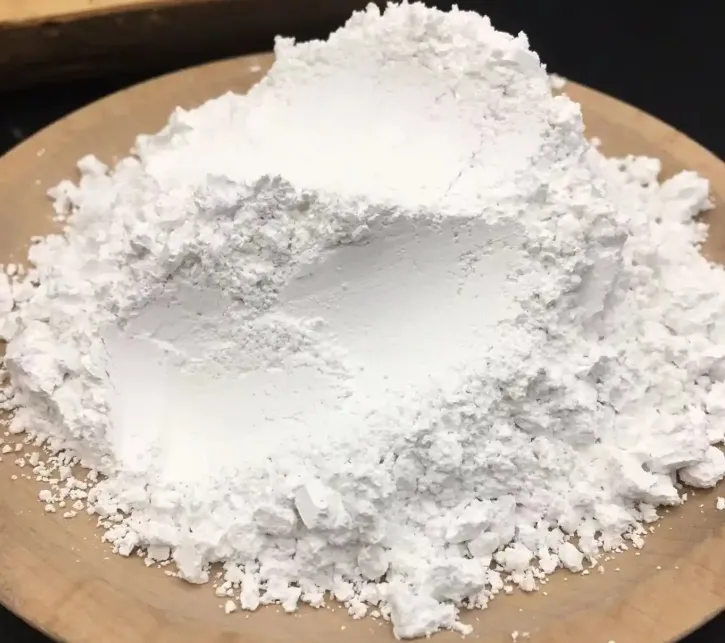
Understanding the Difference Between Heavy Calcium and Light Calcium
Some technicians classify them by sedimentation volume (using anhydrous ethanol as the medium):
- Light calcium carbonate: >2.5 mL/g
- Heavy calcium carbonate: 1.2–1.9 mL/g
However, the more essential difference lies in the production process:
- Heavy calcium carbonate is obtained by mechanically crushing and classifying natural ore.
- Light calcium carbonate is produced by calcination, hydration, and recarbonation.
A common misconception is that light calcium is “lighter” because it occupies a larger volume at equal weight. In fact, the true densities of the two materials are very close:
- Heavy calcium: 2.6–2.9 g/cm³
- Light calcium: 2.4–2.6 g/cm³
The difference in apparent density stems from their different structures and void contents.
Performance Differences in Rubber and Plastics
In rubber applications, comparative tests show that under identical filling levels and processing conditions:
- Heavy calcium disperses more easily and mixes more uniformly.
- Products with heavy calcium exhibit higher tensile strength, but also higher shrinkage and rougher surfaces.
- The 400-mesh heavy calcium used costs only half of the light calcium used for comparison, bringing significant economic benefits.
The situation is similar in plastics. Manufacturers report that replacing light calcium with 400-mesh heavy calcium is very advantageous for products sold by weight. However, for products sold by length, area, or piece-count, the benefit diminishes.
Technical Perspective: Why Their Performance Differs
Heavy and light calcium differ in multiple material properties:
- Crystal structure
- Specific surface area
- Oil absorption value
- Particle shape and size distribution
Even at “400 mesh,” the particle characteristics of the two types differ greatly. In plastics, key questions include:
- Do the particles exist individually or as loose aggregates in the polymer matrix?
- What is the interface interaction between CaCO₃ particles and polymer chains?
These microstructural factors directly impact the mechanical properties of the plastic.
Which Should You Use—Heavy or Light Calcium?
There is no universal answer. The optimal choice depends on:
- Material requirements
- Product specifications
- Process conditions
- Cost-performance considerations
In many cases, the correct approach is to leverage the distinct advantages of both types rather than strictly favoring one over the other.
Application Examples
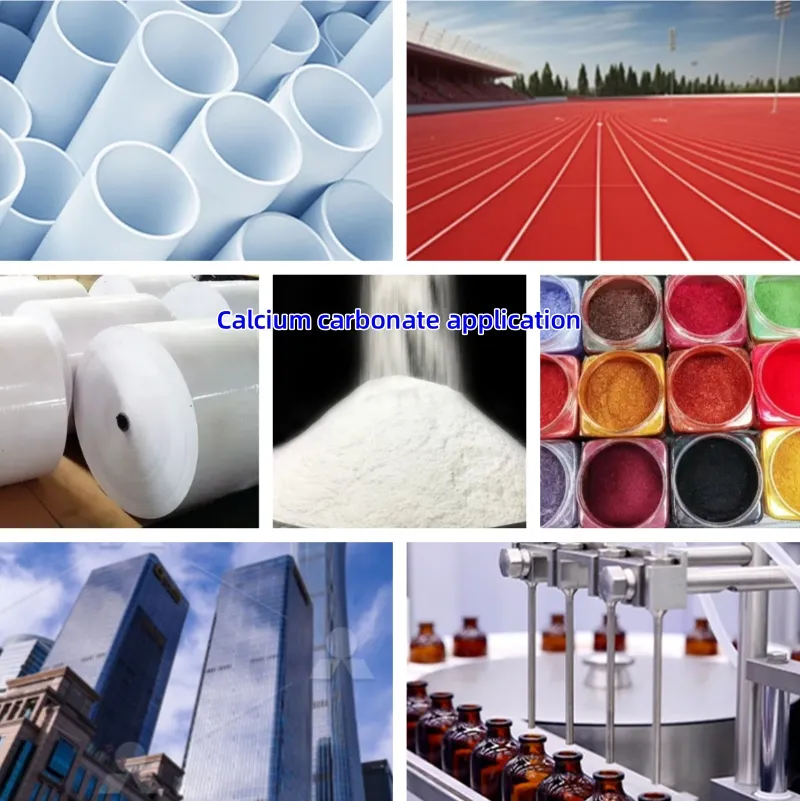
PVC Artificial Leather
PVC artificial leather can be produced via knife coating, calendering, or extrusion.
Knife-coating uses PVC paste resin and requires high levels of plasticizer.
Because light calcium has 4–5 times the oil absorption of heavy calcium, using light calcium consumes far more plasticizer to achieve the same flexibility.
In such cases, replacing light calcium with heavy calcium can significantly reduce costs.
Polypropylene Woven Bags, Straps, and Mono-Oriented Films
In uni-directional stretching products, both heavy and light calcium show similar length performance. Research reveals that filler particles typically remain in the gaps between polymer macromolecules during stretching; after rapid cooling, the structure freezes.
Since the true densities of light and heavy calcium are nearly identical, they produce similar stretching lengths.
However:
- Heavy calcium offers better processing fluidity
- Heavy calcium is much cheaper
Thus, heavy calcium dominates in this category of products.
Future Development: How to Enhance Calcium Carbonate Use in Plastics
Calcium carbonate has become a core raw material in the plastics industry. The growth of the CaCO₃ industry provides more options and contributes to the evolution of polymer materials. At the same time, its success in plastics guides future advancements in calcium carbonate technologies.
For the calcium carbonate industry to move forward, manufacturers should not only supply high-quality CaCO₃, but also:
- Develop new plastic materials incorporating CaCO₃ as a major component
- Create innovative, application-driven products rather than merely selling standard grades and expecting plastics processors to adapt
Only by integrating materials development + application innovation can calcium carbonate continue to expand its role in modern polymers.

“Thanks for reading. I hope my article helps. Please leave a comment down below. You may also contact Zelda online customer representative for any further inquiries.”
— Posted by Emily Chen