
1. What Is Ground Calcium Carbonate?
Ground calcium carbonate (GCC) is a white powder produced by mechanically grinding natural calcium carbonate minerals such as calcite, limestone, dolomite, chalk, and shells. It typically appears as a gray-white or light brown granular solid with slight acidity, high purity, and stable composition. As a widely used industrial raw material and one of the most common fillers, GCC plays an essential role in numerous applications.
2. Raw Materials for Ground Calcium Carbonate Production
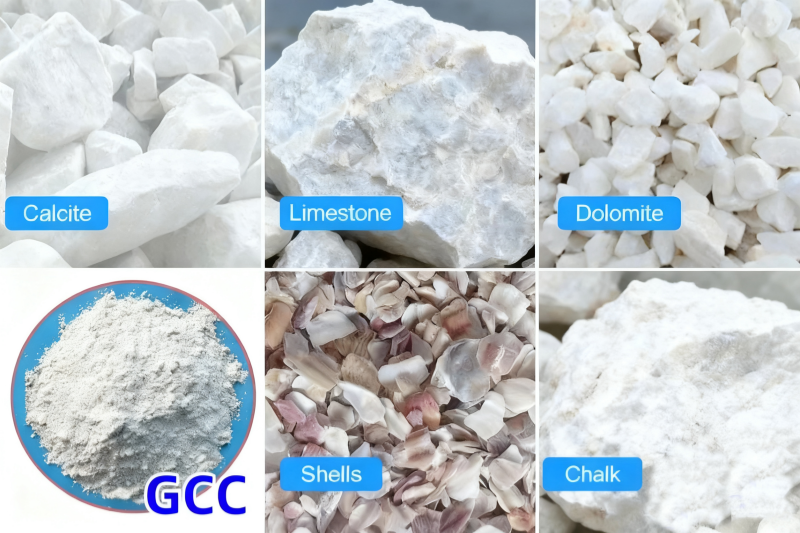
- Limestone
Limestone is formed when calcium carbonate deposits in lakes or seas lose water, compress, and cement into rock. With a Mohs hardness below 3, it is considered a medium-hardness mineral. Countries such as Egypt and Pakistan have abundant limestone resources, making it the primary raw material for heavy calcium carbonate production. - Calcite
Calcite is another natural form of calcium carbonate and one of the most common minerals found on Earth. It occurs in diverse crystal habits — granular, fibrous, stalactitic, or massive — and serves as one of the most important raw materials for GCC production due to its high purity and wide distribution. - Marble
Marble contains more than 50% calcium carbonate and often features distinctive colors and patterns. With a Mohs hardness of 2.5–5, it is not only used for GCC production but also widely applied in architecture and decoration after polishing due to its aesthetic appeal. - Chalk
Chalk is a soft, fine-grained calcium carbonate deposit derived from the compression of microscopic marine plankton on ancient ocean floors. Famous chalk deposits are found in Essex County, New York (USA), and Jiangxi Province, China.
3. Applications of Ground Calcium Carbonate
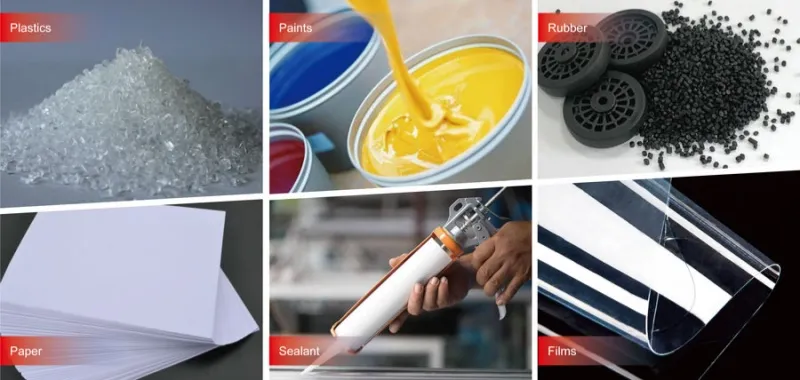
Rubber Industry
Adding GCC to rubber increases product volume and reduces the consumption of expensive natural rubber, thereby lowering production costs. It also improves the tensile strength, tear resistance, and wear performance of the rubber.
Plastics Industry
Using GCC as a filler offers several benefits:
- Increases production output and reduces material costs.
- Improves heat resistance and color consistency of plastic products.
Paper Industry
The paper industry is the largest consumer of GCC. It serves as a partial replacement for wood pulp and pigments, maintaining paper whiteness and strength while reducing production costs.
Coating Industry
With high whiteness and low oil absorption, GCC reduces the amount of emulsion required in paints, cutting costs while improving coating smoothness and coverage.
Construction Industry
In construction, GCC is used as a key ingredient in concrete and building materials. It enhances strength and durability while reducing production costs.
Fireproof Ceiling Industry
GCC improves the whiteness, brightness, and fire resistance of ceiling panels, making it an essential additive in fireproof materials.
Feed Industry
As a calcium supplement, GCC is widely added to animal feed to enhance calcium content and improve feed quality.
4. Differences Between GCC and PCC
| Aspect | Ground Calcium Carbonate (GCC) | Precipitated Calcium Carbonate (PCC) |
|---|---|---|
| Production Method | Produced by grinding natural minerals such as calcite, marble, limestone, or chalk. | Produced chemically from limestone through calcination, digestion, carbonization, dehydration, and drying. |
| Bulk Density | Higher: 0.8–1.3 g/cm³ | Lower: 0.5–0.7 g/cm³ (nano PCC can reach ~0.28 g/cm³) |
| Whiteness | 89–93%, occasionally up to 95% | 92–95%, some products up to 97% |
| Moisture Content | 0.2–0.3%, stable | 0.3–0.8%, may fluctuate |
| Price | ~30% cheaper than PCC due to simpler mechanical processing | More expensive due to complex chemical synthesis |
Because GCC production is simpler, more energy-efficient, and cost-effective, it remains the preferred choice in most industrial applications — offering broad market prospects.
5. How Ground Calcium Carbonate Is Produced
There are two main production methods: dry grinding and wet grinding.
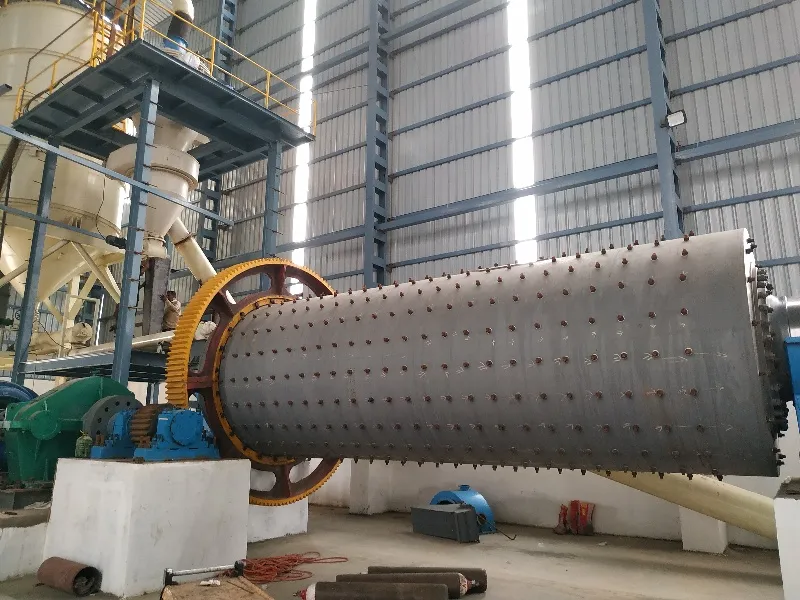
- Dry Grinding
Used for products below 2500 mesh. It involves a system of crushers, mills, and classifiers to produce powders of various particle sizes. The process is mature and widely adopted. - Wet Grinding
Used for producing ultra-fine powders above 2500 mesh. It involves additional grinding aids to improve dispersion and achieve finer particle sizes. Though it offers better product performance, it comes with higher production costs due to the complexity of the process.
6. Precautions for Storage of Ground Calcium Carbonate
- Moisture Protection
GCC is hygroscopic and easily absorbs moisture. It must be stored in a dry, well-sealed environment. - Avoid Acidic Substances
Since GCC is calcium carbonate, it reacts with acids. Avoid contact with acidic materials to maintain product stability and performance. - Keep Away from Heat
High temperatures can cause decomposition of calcium carbonate, reducing its effectiveness. Store GCC in a cool, shaded area away from direct sunlight.
Conclusion
Ground calcium carbonate, as an abundant, cost-effective, and multifunctional mineral filler, plays an essential role in industries ranging from plastics, rubber, and coatings to construction, paper, and feed. Understanding its raw materials, production methods, and applications allows manufacturers to better leverage GCC’s advantages — achieving improved performance, reduced costs, and sustainable production outcomes.

“Thanks for reading. I hope my article helps. Please leave a comment down below. You may also contact Zelda online customer representative for any further inquiries.”
— Posted by Jason Wang