
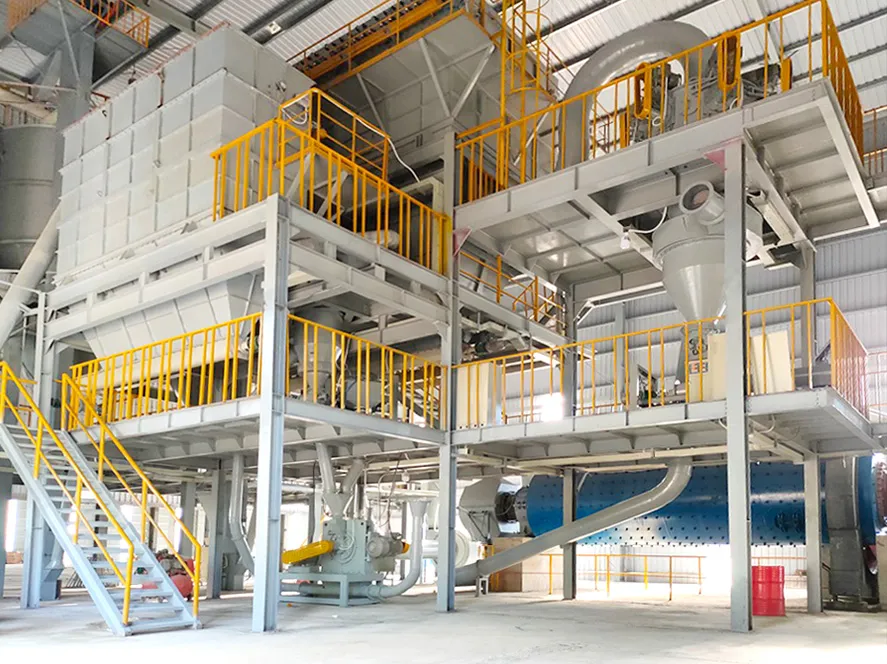
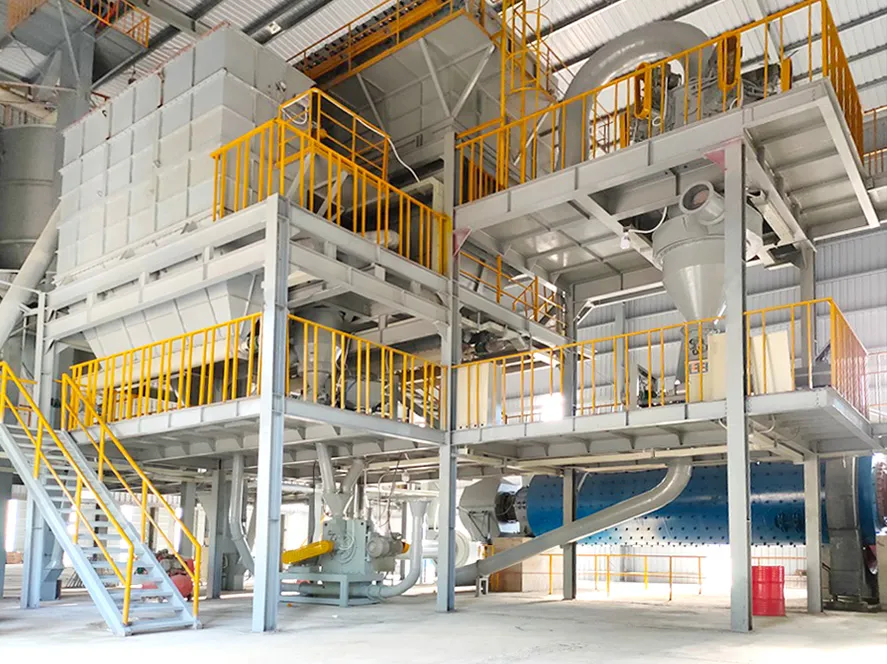
Calcium carbonate powder is widely used in plastics, rubber, coatings, paper, and construction materials. It is mainly produced by grinding natural minerals such as limestone, marble, and calcite. In a complete calcium carbonate production line, key equipment includes crushers, conveyors, storage bins, grinding mills, classifiers, dust collectors, and packaging systems — among which, the grinding mill plays the most crucial role in determining the quality, fineness, and performance of the final powder.
Choosing the right grinding mill is therefore essential for achieving efficient production, stable quality, and low operating costs. This article provides a detailed guide on how to select the most suitable calcium carbonate grinding equipment for your production needs.
Production Methods of Calcium Carbonate Powder
Before selecting a mill, it’s important to understand the two main production methods: dry grinding and wet grinding.
| Method | Description | Typical Product Fineness |
|---|---|---|
| Dry Grinding | Mainly used for coarse and medium-fine powders. It offers low equipment cost, flexible process control, and ease of modification after grinding. | ≤1500 mesh |
| Wet Grinding | Used for producing ultrafine and high-purity powders. The process includes solvent and additive use, impurity removal, and slurry formation with high solid content and low viscosity. | 1500–6500 mesh |
Comparison:
Dry process: Simple operation, easy maintenance, lower investment. However, it is mainly suitable for coarser powders.
Wet process: Higher fineness and purity, ideal for high-end applications, but requires greater equipment investment and higher energy consumption.
Key Factors When Selecting a Calcium Carbonate Grinding Mill
Raw Material Characteristics
Different raw materials vary in hardness, purity, and abrasiveness. Matching the right mill ensures high efficiency and longer equipment lifespan.
- Medium and low hardness: Raymond mill, micro powder roller mill.
- Various hardness materials: Ball mill, vertical mill, or wet grinding mill.
Feeding and Discharging Particle Size
| Equipment Type | Feeding Size | Final Product Size |
|---|---|---|
| Ball Mill | 0–4 mm | 5–45 μm |
| Micro Powder Roller Mill | 0–10 mm | 5–45 μm |
| Raymond Roller Mill | 25–35 mm | 45–180 μm |
| Vertical Mill | 0–40 mm | 3–45 μm |
| Wet Grinding Mill | ≈45 μm | 0–5 μm |

Capacity (Output)
Accurately define your daily or annual output target.
If a single mill cannot meet the required tons per hour (t/h), consider configuring multiple mills in parallel (to increase total output) or in series (for higher fineness/quality, typical for wet grinding).3
Product Quality and Particle Shape
For materials like talc, kaolin, graphite, or wollastonite, maintaining flake or needle-like morphology enhances application performance. Conversely, spherical particles are preferred for some plastics and coatings.
For high-end applications, the shape and size distribution of the particles matter.
- Spherical/Close to Spherical Shape: Often produced by Ball Mills, which can enhance the material’s application performance, especially for minerals where shape retention (like flakes or needles) is less critical.
Application Requirements
| Industry | Fineness (Mesh) | Purpose |
|---|---|---|
| Rubber | 400 | Filler to improve strength and wear resistance |
| Plastic | 400 | Enhances dimensional stability and surface smoothness |
| Paint | 800 | Increases filler loading (>30%) and improves dispersion |
| Paper | 325 | Improves whiteness, brightness, and strength at low cost |
| Construction | 325 | Enhances toughness and compressive strength |
Input Costs and Investment Return
Initial equipment cost must be balanced against operational efficiency and product quality.
- Budget-Friendly Fine Powder: Consider a Micro Powder Roller Mill for ultrafine needs with a limited budget.
- High-Quality, High-Budget Fine Powder: A Ball Mill offers superior finished product quality and stability, justifying a higher investment.
Features of Common Grinding Equipment
Ball Mill
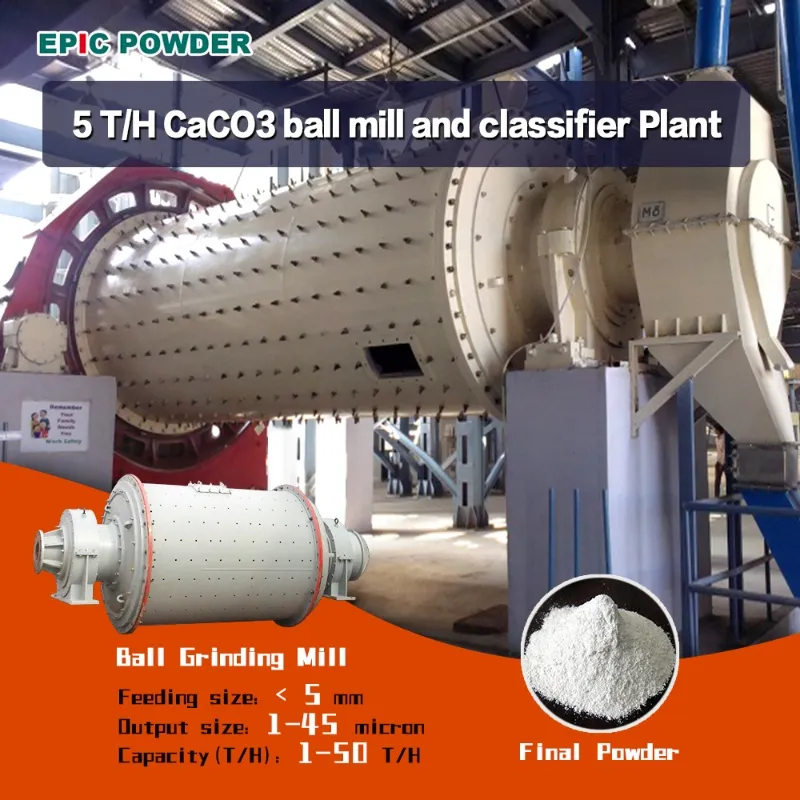
Ball mills are often paired with classifiers to produce D97 5–45 μm calcium carbonate powders. With annual outputs ranging from 10,000–200,000 tons, ball mills are ideal for medium- to large-scale production. They offer:
- High reliability and stability
- Uniform particle size and good morphology
- Strong adaptability for ultrafine powder production
Micro Powder Roller Mill
This mill uses multiple grinding rollers to crush and shear materials, producing 8–45 μm fine powders.
- Common models: 21, 28, or 34 rollers — more rollers mean higher output.
- Compact structure and low energy consumption make it ideal for dry fine grinding.
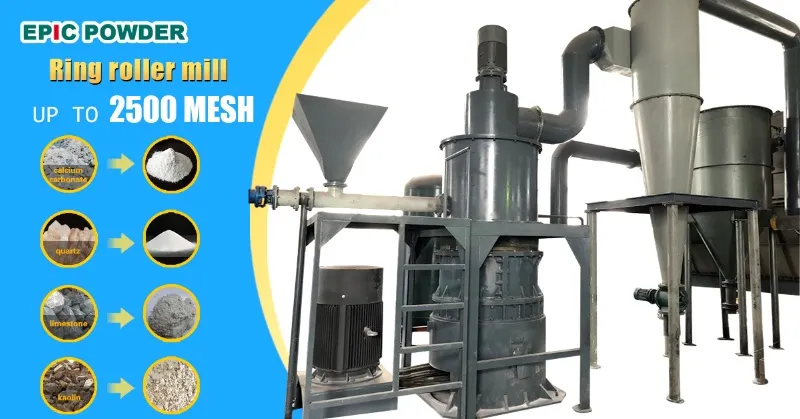
Raymond Roller Mill
Best suited for coarse powder processing (45–180 μm).
Advantages:
- 99% screening rate
- Small footprint and easy maintenance
- Energy-efficient with 1–30 tons/hour capacity
It’s a reliable, globally popular choice for general calcium carbonate grinding applications.
Related knowledge: Common Particle Size Conversion
| Mesh | Micrometer (μm) | Millimeter (mm) |
|---|---|---|
| 100 | 150 | 0.15 |
| 200 | 74 | 0.074 |
| 325 | 45 | 0.045 |
| 400 | 38 | 0.038 |
| 600 | 23 | 0.023 |
| 800 | 18 | 0.018 |
| 1250 | 10 | 0.010 |
| 1750 | 8 | 0.008 |
| 2500 | 5 | 0.005 |
| 5000 | 2.5 | 0.0025 |
| 8000 | 1.6 | 0.0016 |
Epic Powder
In conclusion, selecting the right calcium carbonate grinding mill is key to achieving high efficiency, consistent quality, and optimal cost performance. EPIC Powder, with over 20 years of expertise in ultrafine grinding and classification, provides customized solutions including ball mill classification systems, micro powder roller mills, and vertical grinding technology. From coarse to ultrafine grades, EPIC Powder ensures stable operation, precise particle control, and reliable performance — empowering customers to produce high-quality calcium carbonate that meets the demands of modern industry.
“Thanks for reading. I hope my article helps. Please leave a comment down below. You may also contact Zelda online customer representative for any further inquiries.”
— Posted by Emily Chen