
Calcium carbonate is one of the most widely used inorganic mineral powders in the world. It is extensively applied in industries such as plastics, rubber, coatings, paper, adhesives, sealants, and building materials. In many of these applications, particle size plays a critical role in determining the final product performance. Ultrafine calcium carbonate with controlled particle size distribution can significantly improve mechanical strength, surface smoothness, dispersion properties, and processing stability. Among different particle size specifications, D97 10 μm calcium carbonate powder is a common industrial standard for mid-to-high-end applications. Producing such fine powder consistently requires advanced grinding technology and precise particle classification. One of the most reliable and widely used solutions is the ball mill classification system, which combines high-efficiency grinding with dynamic air classification to achieve accurate particle size control.
This article explains the process, equipment, and key technical considerations for producing D97 10 μm calcium carbonate powder using a ball mill classification system.
1. Understanding D97 10 μm Calcium Carbonate Powder
Before discussing the production process, it is important to understand what D97 10 micron means in particle size measurement.
In powder technology, D97 indicates that 97% of the particles are smaller than a specific size. Therefore, D97 10 μm means that 97% of the calcium carbonate particles are smaller than 10 microns.
This particle size range is particularly suitable for applications such as:
- Plastic fillers (PVC, PE, PP)
- Rubber reinforcement
- Coatings and paints
- Adhesives and sealants
- Paper coating
- Construction materials
Compared with coarse calcium carbonate powder, ultrafine calcium carbonate provides several advantages:
- Improved dispersion in polymer matrices
- Higher surface area for better interaction with additives
- Enhanced mechanical strength of composite materials
- Better surface smoothness in coatings and paper
However, achieving a stable D97 10 μm particle size distribution requires efficient grinding and precise classification.
2. Why Use a Ball Mill Classification System?
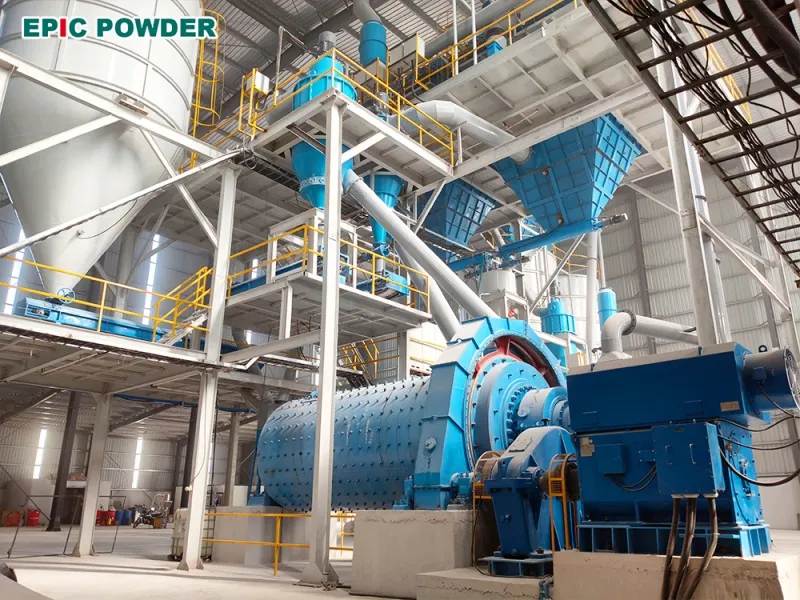
Several grinding technologies can be used to produce calcium carbonate powder, including Raymond mills, vertical mills, jet mills, and ball mills. Among them, the ball mill classification system is particularly suitable for producing ultrafine calcium carbonate with controlled particle size.
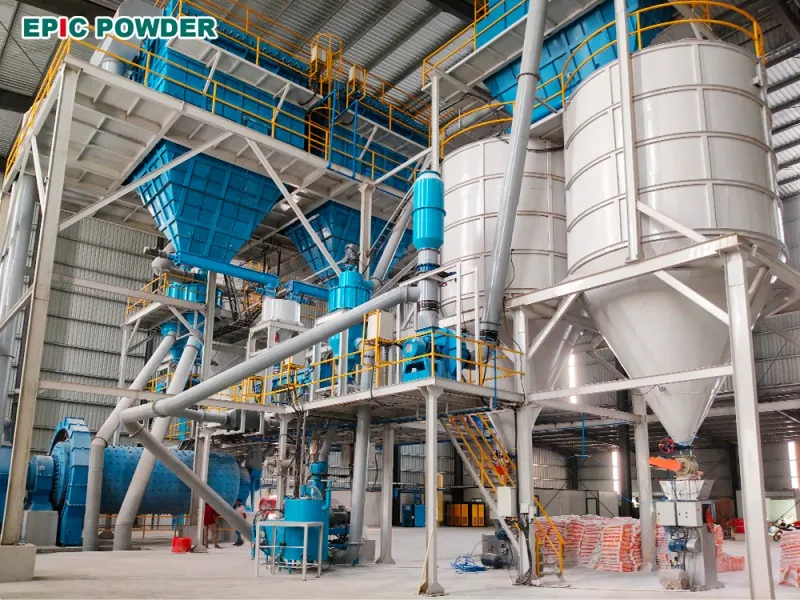
The system typically consists of:
- Ball mill
- Air classifier
- Cyclone collector
- Dust collector
- Fan and conveying system
- Control system
This configuration offers several advantages.
Stable and Uniform Particle Size
The integrated air classifier continuously separates fine particles from coarse particles. Fine particles are collected as finished products, while coarse particles are returned to the ball mill for further grinding. This closed-loop system ensures a narrow particle size distribution.
High Production Capacity
Ball mills are capable of processing large volumes of material, making them suitable for industrial-scale calcium carbonate production lines.
Flexible Particle Size Control
By adjusting the classifier rotor speed and airflow, operators can precisely control the final particle size, including D97 10 μm or other specifications.
Energy Efficiency
Modern ball mill classification systems are designed with optimized grinding media and airflow systems, improving energy efficiency compared with traditional grinding methods.
3. Raw Material Preparation
The quality of raw materials directly influences the final powder quality. Calcium carbonate powder is usually produced from limestone, marble, or calcite.
Key requirements for raw materials include:
- High CaCO₃ purity (usually above 98%)
- Low silica and iron impurities
- Stable mineral structure
- Appropriate hardness
Before entering the grinding system, the raw material typically undergoes primary crushing using equipment such as a jaw crusher or hammer crusher. The crushed material is reduced to a particle size of about 10–20 mm, which is suitable for feeding into the ball mill.
In some production lines, a pre-grinding stage may also be used to improve grinding efficiency.
4. Grinding Process in the Ball Mill
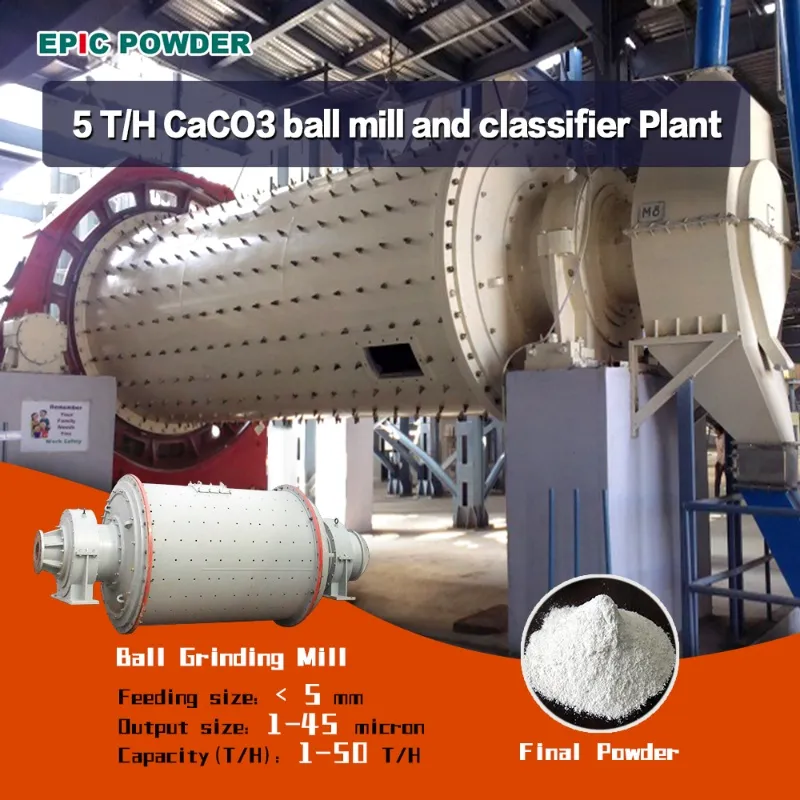
The ball mill is the core equipment in the calcium carbonate grinding system. Inside the mill, grinding media such as steel balls or ceramic balls rotate with the mill cylinder.
When the mill rotates, the grinding media rise along the inner wall of the cylinder and then fall under gravity. This movement creates strong impact and friction forces, which gradually reduce the particle size of the calcium carbonate.
The grinding process typically involves several stages:
- Initial crushing of larger particles
- Intermediate grinding
- Fine grinding to micron-level particles
The grinding efficiency depends on several factors, including:
- Ball size distribution
- Filling rate of grinding media
- Mill rotation speed
- Material feed rate
- Grinding time
Optimizing these parameters is essential for producing consistent D97 10 μm powder.
5. Air Classification for Precise Particle Size Control
After grinding, the powder enters a dynamic air classifier, which is responsible for separating fine particles from coarse particles.
The classifier works based on the balance between centrifugal force and aerodynamic drag force. When the powder-air mixture enters the classifier:
- Fine particles are carried by airflow and pass through the classifier rotor.
- Coarse particles are rejected and returned to the ball mill for further grinding.
By adjusting the rotor speed and airflow, the classifier can precisely control the cut point of particle size.
For producing D97 10 μm calcium carbonate powder, the classifier must maintain stable operating conditions to ensure that oversized particles are efficiently removed.
6. Product Collection and Dust Control
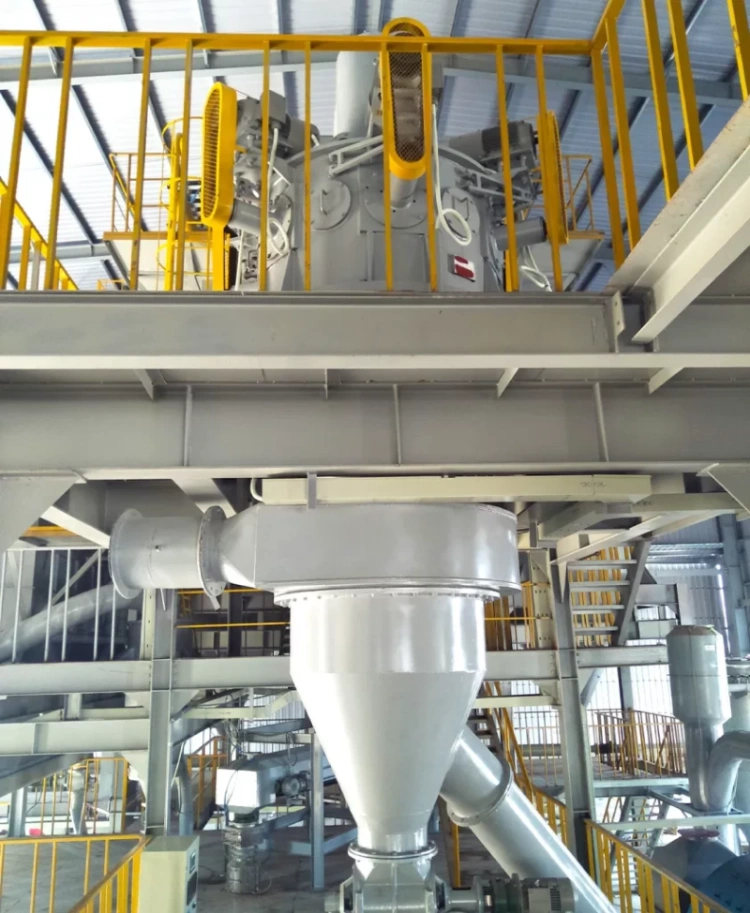
After classification, the fine calcium carbonate powder is transported by airflow into a cyclone collector, where most of the powder is separated from the air.
The remaining fine dust is captured by a bag dust collector, ensuring clean air discharge and preventing environmental pollution.
The final product is then collected and stored in silos or packaging systems.
Modern calcium carbonate plants often integrate automated systems for:
- Powder conveying
- Storage
- Packaging
- Quality monitoring
This improves production efficiency and reduces labor costs.
7. Key Factors for Achieving Stable D97 10 μm Production
Producing consistent D97 10 μm calcium carbonate powder requires careful control of several technical parameters.
Grinding Media Configuration
The size and proportion of grinding balls significantly affect grinding efficiency. A well-designed media distribution helps achieve efficient particle breakage.
Classifier Speed
Higher rotor speeds generally produce finer particles. However, excessively high speeds may reduce production capacity.
Airflow Control
Stable airflow ensures efficient particle separation and prevents material accumulation in the system.
Feed Rate Stability
Fluctuating feed rates can cause unstable particle size distribution. Continuous and uniform feeding is essential.
Temperature Control
Grinding generates heat, which can affect powder properties. Proper ventilation and system design help maintain stable operating temperatures.
8. Advantages of Ball Mill Classification Systems for Calcium Carbonate
Many calcium carbonate producers prefer ball mill classification systems because they provide several important benefits:
- High reliability for long-term industrial operation
- Stable particle size distribution
- Suitable for large-scale production
- Flexible control of micron-level particle size
- Compatibility with surface modification systems
In addition, these systems can be integrated with coating machines for producing surface-treated calcium carbonate, which is widely used in plastics and polymer composites.
9. Future Trends in Ultrafine Calcium Carbonate Production
With the rapid development of industries such as plastics, new energy materials, and high-performance coatings, the demand for ultrafine calcium carbonate continues to grow.
Future production systems are expected to focus on:
- Higher energy efficiency
- More precise particle size control
- Intelligent automation
- Integration with surface modification technologies
Advanced ball mill classification systems will continue to play an important role in meeting these industry requirements.
Conclusion
Producing D97 10 micron calcium carbonate powder requires a carefully designed grinding and classification process. The ball mill classification system offers a reliable and efficient solution for achieving precise particle size control and stable production.
By combining optimized grinding conditions, efficient air classification, and proper process control, manufacturers can produce high-quality calcium carbonate powder that meets the requirements of modern industrial applications.
As global demand for ultrafine mineral powders continues to grow, ball mill classification technology will remain a key solution for high-performance calcium carbonate production.

“Thanks for reading. I hope my article helps. Please leave a comment down below. You may also contact Zelda online customer representative for any further inquiries.”
— Posted by Emily Chen