
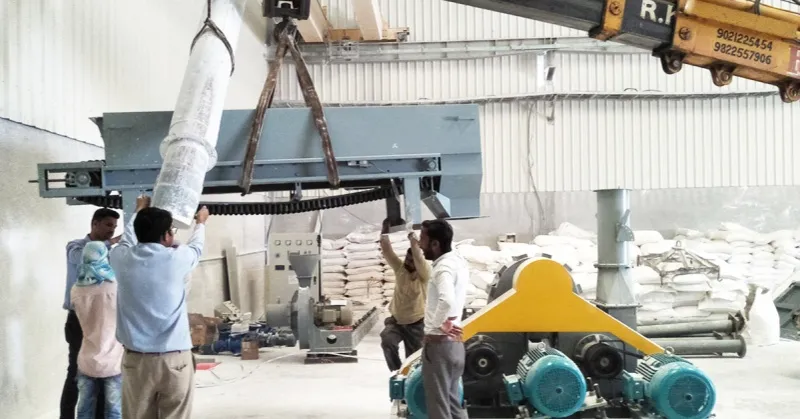
Calcium carbonate (CaCO₃) is a widely available mineral used across many industries. Structurally, it exists in three main crystal forms: calcite, aragonite, and vaterite. Each form differs in morphology and stability, with calcite being the most stable and commonly used in industrial applications.
Although unmodified calcium carbonate is widely utilized, it has several limitations. Due to moisture and surface energy, it tends to agglomerate, which complicates handling and dispersion. Its hydrophilic nature also results in poor compatibility with non-polar or oil-based materials, causing uneven distribution in polymers, coatings, or rubber. This mismatch can lead to processing issues such as high oil absorption, unstable rheology, and reduced mechanical performance.
Understanding these inherent challenges highlights the importance of surface treatment and advanced modification technologies. Calcium carbonate modification improves dispersibility, compatibility, and overall performance in demanding applications.
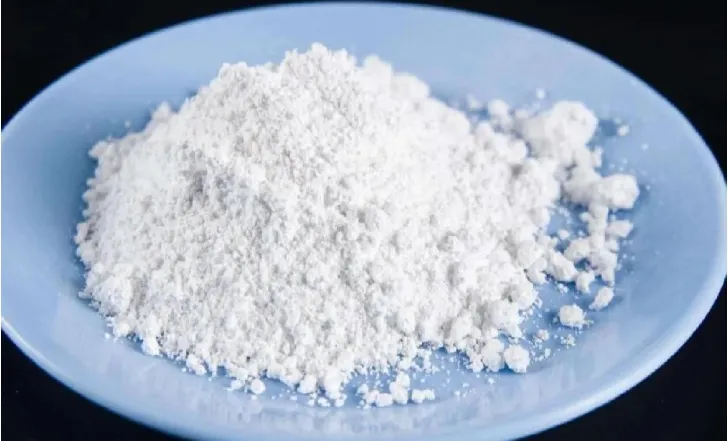
Modification Objectives: Enhancing Calcium Carbonate Performance
The core objective of calcium carbonate modification is to improve its interaction with other materials, especially in polymer and coating systems. One major goal is to increase its lipophilicity, enabling better compatibility with oil-based plastics such as PVC and HDPE. This helps reduce issues of poor dispersion and weak interfacial bonding.
Another key objective is reducing oil absorption. Unmodified CaCO₃ often absorbs large amounts of oil, raising costs and reducing formulation stability. Modification allows manufacturers to achieve the required texture and strength while lowering the dosage of plasticizers or oils.
Uniform particle distribution is also essential. Well-dispersed modified CaCO₃ improves mechanical properties and product appearance, preventing clumping, streaks, or surface defects—critical in paints, plastics, and rubber.
As environmental standards rise, modification technologies are increasingly shifting toward greener, more energy-efficient methods that reduce chemical waste and energy consumption. This supports regulatory compliance and meets market demand for sustainable materials.
These modification goals ensure that calcium carbonate performs reliably across industries while supporting efficient and sustainable production.
Methods of Modification
In industrial practice, surface coating modification is the most widely used method. A thin molecular coating is formed around CaCO₃ particles using appropriate modifiers.
| Modifier Type | Representative Materials | Modification Effect | Main Applications |
|---|---|---|---|
| Fatty acids and their salts | Stearic acid, calcium stearate | Reduce surface energy, increase hydrophobicity; most common and cost-effective | General plastics, rubber, coatings |
| Coupling agents | Titanate, aluminate coupling agents | Create chemical bonds between inorganic and organic phases; strongest interface bonding | High-end plastics, cable compounds, elastomers |
| Surfactants | Various nonionic/anionic surfactants | Improve wetting and dispersion; used as auxiliaries | Water-based coatings, paper filling |
| Polymers | PE wax, silicone oil | Improve flowability and antistatic properties | Specialty functional materials |
Calcium Carbonate Modification Equipment
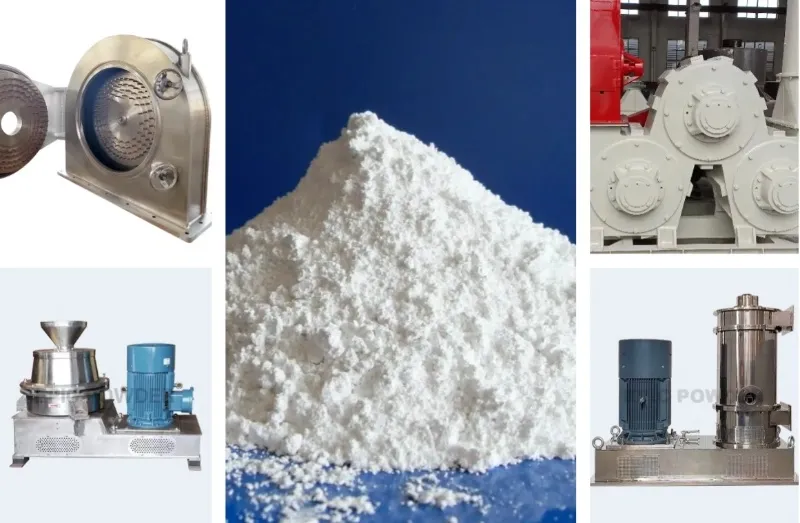
Selecting the right modification equipment is crucial—it determines modifier dispersion uniformity, coating completeness, and modification efficiency. High-performance modification equipment provides adequate mechanical energy (shear, impact, friction) and thermal energy, enabling full interaction between modifiers and powder surfaces.
Epic Powder Modification Equipment Series
Features: Multi-stage roller structure applies intense compression, friction, and shear. Ensures highly uniform modifier dispersion; ideal for ultra-fine or difficult-to-disperse powders.
Applications: High-precision CaCO₃ or nano-CaCO₃ modification.
Features: High-speed rotating pins provide strong impact and shear, enhancing powder activation. Mixing and coating occur simultaneously in the high-velocity airflow.
Applications: Continuous modification of medium-fine powders; excellent balance of capacity and energy efficiency.
Features: High-speed airflow creates strong cyclonic motion, causing intense impact and friction. Compact structure with large throughput capacity.
Applications: Large-scale modification of light/heavy calcium carbonate.
Applications of Modified CaCO₃
Surface-modified calcium carbonate—often called “activated CaCO₃”—shows significantly improved performance, enabling its use in high-end applications.
| Industry | Key Role After Modification | Typical Applications |
|---|---|---|
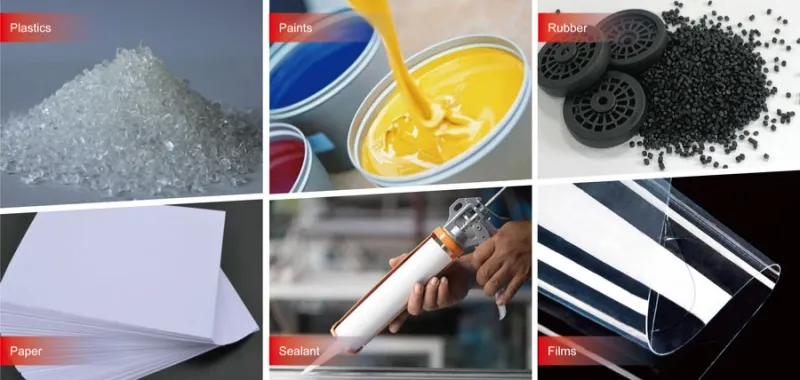
| Plastics | Higher filling levels; improved rigidity, heat resistance, and dimensional stability; better flowability | PVC pipes, cables, PE/PP compounding |
| Coatings | Lower oil absorption; better film smoothness, gloss, weather resistance; improved rheology | Automotive coatings, high-gloss latex paint, industrial anti-corrosion coatings |
| Rubber | Improved reinforcement and mixing dispersion; reduced permanent deformation | Tires, seals, shoe soles |
| Adhesives/Sealants | Increased volume and tackiness; better thixotropy and storage stability | Silicone sealants, PU adhesives |
Potential Issues and Solutions: Over-Modification, Scaling-Up, and Monitoring
Common Issues
- Over-modification:
Excessive surface treatment can reduce dispersion, increase costs, or alter product properties. For example, too much stearic acid can reduce compatibility with certain polymers, while excessive silane or titanate may cause agglomeration or processing difficulties. - Scale-up challenges:
Laboratory methods don’t always scale smoothly to industrial production. Equipment limitations, poor mixing, and uneven coating thickness can affect product quality. Choosing suitable equipment—such as high-shear mixers or dedicated coating machines like three-roller or pin-type modifiers—is essential. - Need for continuous monitoring:
Regular checks of particle size distribution, coating degree, and oil absorption can help identify deviations early. Technologies such as ultrasonic modification or mechanochemical activation require tight control to ensure repeatable results.
Best Practices
- Conduct pilot-scale trials before full-scale production to identify potential issues.
- Use versatile equipment capable of supporting both dry and wet modification while maintaining consistent coating quality.
- Perform routine tests on CaCO₃ dispersibility and hydrophobicity to detect over-modification or uneven coating.
- Train operators to monitor parameters and troubleshoot common problems.
By balancing modification levels, ensuring equipment suitability, and maintaining rigorous process monitoring, manufacturers can maximize the benefits of modified calcium carbonate while avoiding costly pitfalls.
For more information on matching equipment with modification technology, explore Epic Powder’s specialized calcium carbonate coating systems designed to streamline consistent industrial-scale surface treatment.

“Thanks for reading. I hope my article helps. Please leave a comment down below. You may also contact Zelda online customer representative for any further inquiries”
— Posted by Emily Chen