
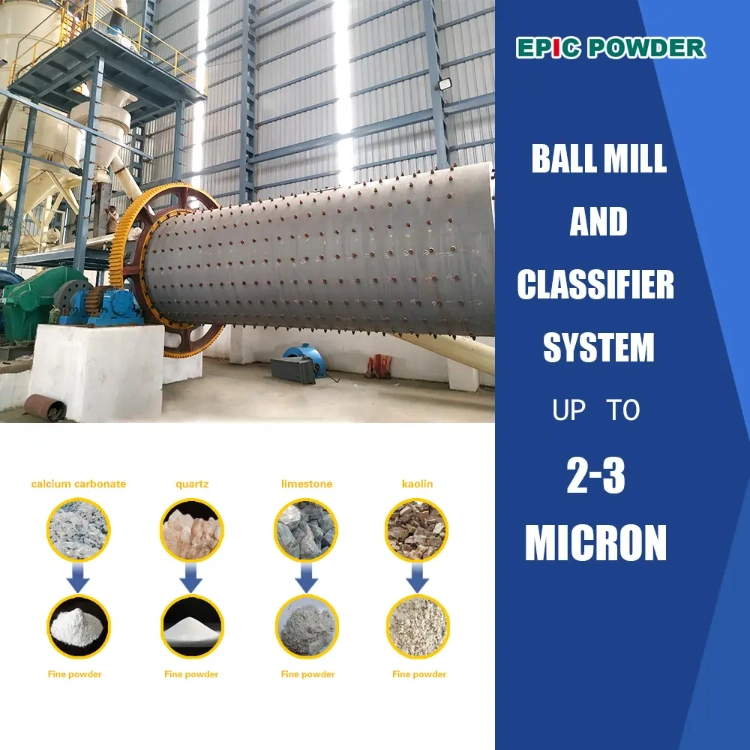
You already know that achieving high-quality ground calcium carbonate ultrafine grinding is a constant battle between particle fineness and energy consumption.
But how do you consistently hit precise D97 targets without destroying your profit margins?
In this guide, I’m going to break down the exact processing line—specifically the Ball Mill and Air Classifier system—that is currently outperforming traditional methods in industrial mineral processing.
We’ll move beyond the basics and look at:
- Why dry grinding technology using ceramic media ensures purity.
- How to achieve a steep particle size distribution from 800 mesh to 2500 mesh.
- The critical role of a Pin Mill Coating Machine for surface modification.
If you are ready to optimize your GCC production line for maximum throughput and efficiency, this post is for you.
Let’s dive in.
Why Ball Mill + Air Classifier is the Preferred Technology
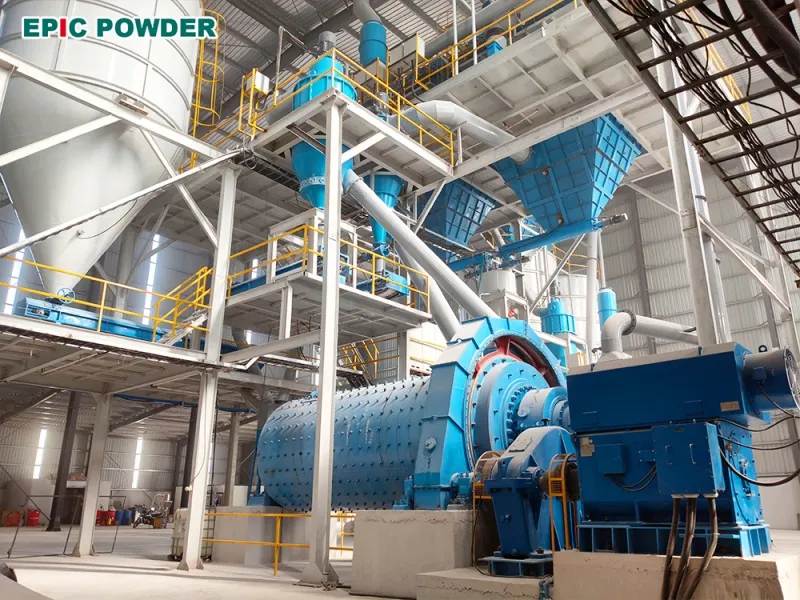
In the competitive landscape of non-metallic mineral processing, selecting the right ground calcium carbonate ultrafine grinding system is the difference between profitability and stagnation. While various milling technologies exist, we consistently engineer and recommend the Ball Mill and Air Classifier system for large-scale, high-quality production. This configuration has established itself as the industry standard for producing D97: 5μm to 45μm powders because it balances throughput, energy consumption, and particle precision better than any standalone unit.
Comparing Ball Mills vs. Vertical Roller Mills vs. Raymond Mills
When designing a GCC production line, we evaluate three primary technologies. Here is why the ball mill and classifier setup reigns supreme for ultrafine applications:
- Raymond Mills: Excellent for coarse powders (200–400 mesh). However, they struggle with efficiency when targeting ultrafine sizes (above 800 mesh). The wear on rollers and rings increases operational costs significantly at higher fineness levels.
- Vertical Roller Mills (VRM): While VRMs offer high capacity, the initial capital investment is steep. Furthermore, controlling the D97 particle size distribution for ultra-fine grades can be less stable compared to a dedicated classification system.
- Ball Mill + Air Classifier: This is the workhorse for industrial mineral grinding. By separating the grinding mechanics from the classification process, we achieve a steeper particle size distribution (PSD). It allows for continuous, heavy-duty operation with lower maintenance costs compared to high-speed mechanical impact mills.
The Ceramic Media Advantage: Ensuring Whiteness and Purity
For high-end applications like paper coatings, plastics, and paints, whiteness is non-negotiable. Traditional steel grinding media introduces iron contamination, resulting in a gray or yellowish tint that devalues the final product.
To combat this, our calcite processing equipment utilizes specialized ceramic liners and grinding media (typically high-alumina or zirconia). This configuration offers two distinct benefits:
- Zero Iron Contamination: Maintains the natural high whiteness of the raw calcite.
- Extended Lifespan: Ceramic components offer superior wear resistance, reducing the frequency of maintenance shutdowns.
Energy Efficiency: Reducing Consumption by 30-50%
Energy consumption is the largest operational expense in dry grinding technology. Traditional open-circuit milling leads to massive over-grinding, wasting power on particles that are already fine enough.
Our integrated systems utilize a closed-circuit design with high-efficiency air classifiers. This ensures that qualified powder is immediately extracted while coarse material is returned to the mill. By optimizing the ball charge ratio and classifier rotor speeds, we prevent energy waste. This engineered approach allows our energy-efficient pulverizer systems to reduce power consumption by 30-50% compared to conventional airflow mills, directly impacting your bottom line.
Deep Dive: The Ultrafine Grinding Process Flow
To achieve high-quality ground calcium carbonate ultrafine grinding, we rely on a strictly controlled, integrated system. It isn’t just about smashing rocks; it’s about engineering a precise particle size distribution (PSD) that meets the rigorous demands of the plastics, paper, and paint industries. Here is how we transform raw mineral ore into premium filler material using our dry-process technology.
Step 1: Crushing and Feeding Raw Calcite
The process begins with raw calcite, marble, or limestone. Before these large stones can enter the fine grinding stage, they must be reduced to a manageable size. We typically crush the raw ore down to a feed size of less than 10mm. This secondary crushing phase is critical because feeding consistent, smaller particles into the mill ensures the system runs smoothly and prevents unnecessary wear on the grinding media. Once crushed, the material is conveyed to a storage silo and fed continuously into the system via a weigh belt feeder for stable throughput.
Step 2: The Grinding Core (Ball Mill Mechanics)
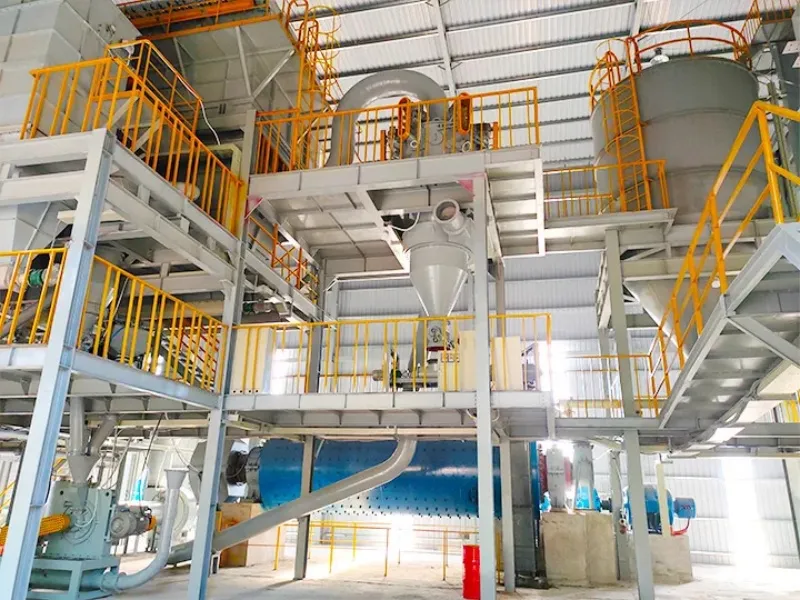
The heart of our GCC production line is the ball mill. Unlike other methods, the ball mill and air classifier system offers the best balance of scale and reliability for ultrafine powders. Inside the mill, the material is pulverized by the impact and attrition of grinding media.
We optimize the ratio of grinding media and use specialized liners—often ceramic or specialized metal—to minimize iron contamination and maintain high whiteness. This setup not only ensures purity but also improves energy efficiency. For those evaluating different machinery options, selecting the right grinding equipment for limestone processing is the most important step in establishing a profitable operation.
Step 3: Precision Classification via Air Classifiers
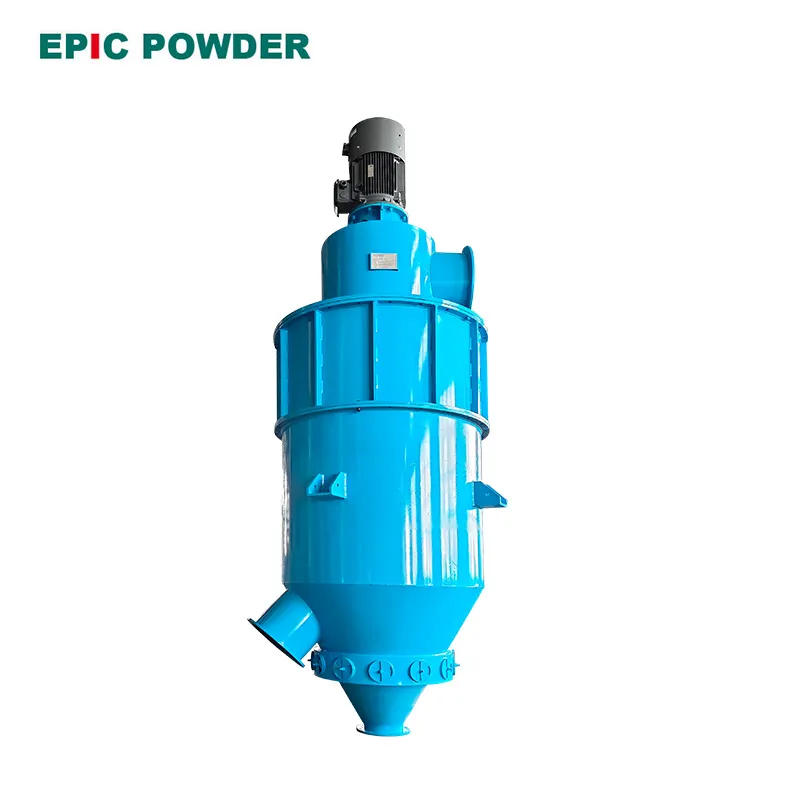
Grinding alone does not guarantee a high-value product; classification does. The ground powder is carried by airflow into a high-efficiency turbine air classifier. This is where the magic happens:
- Fine Powder Collection: Particles that meet the required fineness (e.g., D97: 10μm) pass through the classifier wheel and are collected by the pulse dust collector.
- Coarse Powder Return: Oversized particles are rejected by the centrifugal force of the classifier wheel and fall back into the ball mill for regrinding.
This closed-circuit operation ensures that no energy is wasted on over-grinding particles that are already fine enough.
Achieving Steep PSD and D97 Control
In industrial mineral grinding, the “steepness” of the particle size distribution curve defines quality. A steep curve means the particles are uniform in size, which is essential for high-loading applications in polymers. Our classifiers allow for precise adjustment of the D97 particle size distribution, ranging from 325 mesh up to 3000 mesh (2μm – 45μm). By controlling the classifier speed and airflow, we can lock in the exact specifications required by downstream customers, ensuring the final powder delivers superior performance in dispersion and opacity.
Value-Added Processing: Surface Modification (Coating)
Why Coat GCC? Hydrophilic to Hydrophobic Transformation
Raw calcium carbonate is naturally hydrophilic (water-loving) and oleophobic (oil-hating). This creates a major compatibility issue when you try to mix it into polymer matrices like PVC, PE, or PP, which are hydrophobic. If you skip this step in ground calcium carbonate ultrafine grinding, the filler will agglomerate, causing weak spots and poor surface finish in the final plastic product.
To solve this, we apply a surface coating—typically stearic acid or titanate coupling agents. This chemical process transforms the particle surface to be hydrophobic, allowing the calcium carbonate powder coating to bond seamlessly with organic polymers. This is essential for high-value applications where the mineral acts as a functional reinforcement rather than just a cheap filler.
The Pin Mill Solution for Uniform Dispersion
Achieving a uniform monolayer coating on billions of ultrafine particles requires more than just a simple mixer. We utilize Pin mill surface modification technology to ensure every single particle is treated. Unlike traditional batch mixers, our continuous modification systems use high-speed rotation to generate shear force and heat.
- Atomization: The coating agent is melted and atomized into a fine mist.
- Dispersion: High-speed pins ensure the agent coats the powder evenly without creating “dead spots.”
- Efficiency: This continuous process integrates perfectly downstream from our ball mill grinding systems, maintaining high throughput.
Increasing Activation Rates for Polymer Matrices
The ultimate measure of success in mineral filler applications is the activation index. A high activation rate indicates that the powder floats on water, proving it is fully hydrophobic. Our modification systems consistently achieve activation rates above 98%.
For the end-user, this translates to:
- Lower Oil Absorption: Reduces the amount of expensive resin or plasticizer needed.
- Better Flow: The coated powder flows significantly better through extruders and injection molding machines.
- Enhanced Mechanical Properties: Improved impact strength and flexibility in the final plastic composite.
Technical Specifications and Performance Benchmarks
Fineness Flexibility: Switching Between 800 and 2500 Mesh
Our ball mill and air classifier system offers unmatched versatility for producers who need to adapt quickly to market shifts. You are not locked into a single product grade. By simply adjusting the classifier wheel speed and system airflow, you can switch from 800 mesh to 2500 mesh grinding with high precision. This capability allows you to maintain a strict D97 particle size distribution, ensuring the final powder meets the rigorous standards required for the application of calcium carbonate in coatings industry.
Scalability: From 10,000 to 200,000 Tons/Year
We engineer the GCC production line to grow with your business. Whether you are setting up a pilot plant or a massive processing hub, our designs accommodate a wide range of capacities.
- Small Scale: Starting at 0.5 t/h for specialized batches.
- Large Scale: Exceeding 50 t/h for high-volume industrial mineral grinding.
- Annual Output: Flexible configurations support production goals from 10,000 tons up to 200,000 tons per year.
Environmental Control: Negative Pressure and Dust-Free Design
Modern manufacturing demands cleanliness. Our dry grinding technology operates under a fully sealed, negative pressure environment. This ensures that no dust escapes into the workshop, protecting your workforce and keeping the facility compliant with strict environmental regulations. The integrated pulse dust collector recycles clean air, making the entire process eco-friendly.
System Performance
| Parameter | Specification |
|---|---|
| Fineness Range | D97: 2μm – 45μm (325 mesh – 3000 mesh) |
| Throughput Capacity | 0.5 t/h – 50+ t/h (Customizable) |
| Feed Size | Generally < 10mm |
| Control System | PLC Intelligent Control (Unmanned Operation) |
| Environment | Negative Pressure / Dust-Free |
Case Study: Achieving D97 800 Mesh Efficiently
Real-World Scenario: PVC Filler Production
We recently worked with a manufacturer focused on producing high-grade fillers for the plastics industry. Their primary requirement was a consistent D97: 800 mesh powder derived from calcite. In the PVC sector, particle size consistency is non-negotiable; if the powder is too coarse, it ruins the surface finish of the plastic, and if it’s too fine without proper distribution, it clumps during mixing.
Configuration: Ball Mill + Single Classifier + Pin Mill
To meet these strict demands, we engineered a customized GCC production line. We moved away from standard roller mills and implemented a ball mill + air classifier + pin mill coating machine setup.
- Grinding: The ball mill serves as the heavy lifter, utilizing ceramic grinding media to ensure the whiteness of the calcium carbonate remains unaffected by iron contamination.
- Classification: A single high-precision air classifier separates the fines from the coarse material, ensuring the D97 particle size distribution hits the 800 mesh target exactly.
- Coating: Since this was for PVC, the powder needed to be hydrophobic. We integrated a pin mill for surface modification. Just as Vietnamese customers buy our company’s pin mill for calcium carbonate coating to improve dispersibility, this setup ensured every particle was evenly coated with stearic acid.
Outcome: High Throughput and Low Wear Costs
The results of switching to this integrated ground calcium carbonate ultrafine grinding system were immediate. The client reported a significant reduction in energy consumption per ton compared to their previous Raymond mill setup.
Key Performance Metrics:
- Stability: The PLC-controlled system allows for unmanned operation, reducing labor costs.
- Durability: The optimized liner and media ratio extended the equipment lifespan, keeping wear costs remarkably low.
- Quality: The coated powder demonstrated excellent flowability and dispersion in the polymer matrix, increasing the market value of their final product.
FAQs: Common Questions on GCC Ultrafine Grinding
What is the difference between wet and dry grinding for GCC?
The choice depends entirely on your final application. Dry grinding technology is the industry standard for producing fillers used in plastics, rubber, and paints because it delivers a dry powder ready for immediate use. It is generally more cost-effective as it eliminates the energy-heavy drying stage. Wet grinding is typically reserved for producing slurries for the paper industry or when ultra-high fineness (nano-scale) is required. For most industrial needs, understanding the uses of heavy calcium carbonate helps confirm that a dry process ball mill system is the most efficient route.
How does the air classifier determine the final mesh size?
Think of the air classifier as the gatekeeper of your product quality. Inside the system, a turbine wheel spins at high speeds. This creates a balance between centrifugal force and air drag.
- Fine particles that meet your specs (e.g., D97: 10μm) are carried out by the airflow.
- Coarse particles that are too heavy are rejected and sent back to the mill for regrinding.
By simply adjusting the speed of the classifier wheel via our PLC system, you can switch between 800 mesh to 2500 mesh grinding without stopping the machine. This precise ultrafine powder classification ensures a strict particle size distribution (PSD).
Why is stearic acid coating necessary for plastic applications?
Raw Ground Calcium Carbonate is naturally hydrophilic (water-loving), while polymers like PVC and PE are hydrophobic (oil-loving). If you mix them directly, they don’t bond well, leading to weak plastic products.
Stearic acid coating transforms the surface of the powder, making it compatible with the organic polymer matrix. Using a pin mill surface modification system ensures every particle is evenly coated. This is crucial for high-end applications; knowing the types of calcium carbonate and their applications highlights why modified GCC commands a higher market price.
How can we reduce energy costs in ultrafine powder production?
Energy consumption is the biggest operational cost in a ground calcium carbonate ultrafine grinding system. To lower this, we focus on three areas:
- Media Ratio: We optimize the ratio of grinding balls to ensure efficient impact and attrition.
- Classification Efficiency: A high-efficiency classifier prevents “over-grinding” by quickly removing finished powder.
- Liner Design: Using specialized liners reduces resistance.
Our ball mill and air classifier system is engineered to act as an energy-efficient pulverizer, often reducing power consumption by 20-30% compared to traditional setups.

“Thanks for reading. I hope my article helps. Please leave a comment down below. You may also contact Zelda online customer representative for any further inquiries.”
— Posted by Emily Chen