
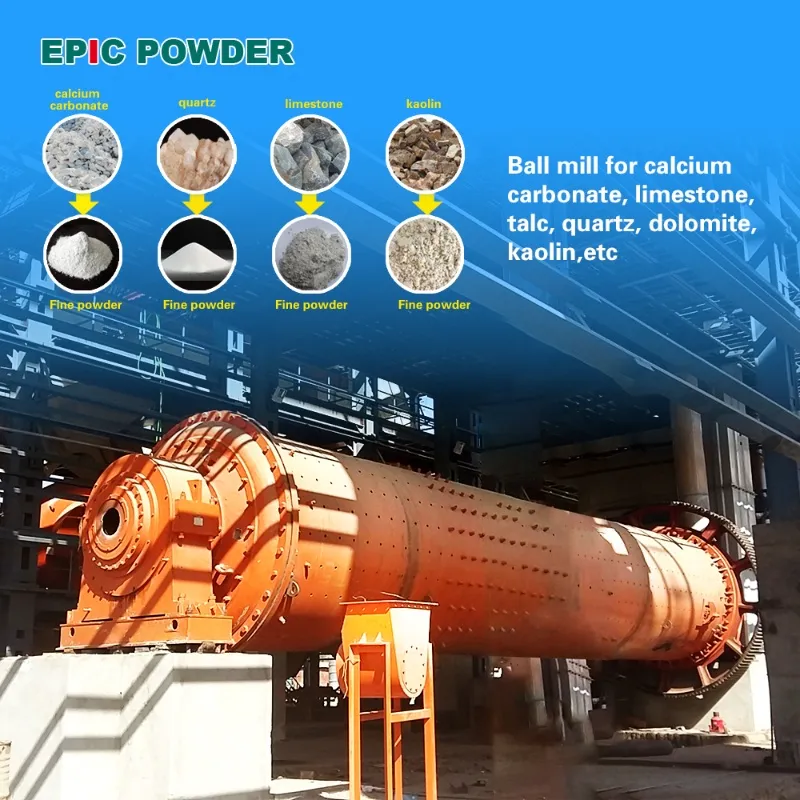
Calcium carbonate (CaCO₃) is a common inorganic compound, commonly known as limestone, marble, or chalk. It is neutral in nature, has low solubility in water, but readily dissolves in hydrochloric acid. Thanks to its abundant sources and low cost, calcium carbonate is widely used across many industries. It also offers good chemical stability, making it a reliable functional material.
At present,calcium carbonate is a core filler in construction materials, rubber, plastics, coatings, papermaking, food, and pharmaceuticals. At present, calcium carbonate products on the market fall into four main categories. These include ground calcium carbonate (GCC), precipitated calcium carbonate (PCC), activated calcium carbonate, and nano calcium carbonate.
These types differ significantly in production processes, physical properties, and application fields.
Ground Calcium Carbonate (GCC)
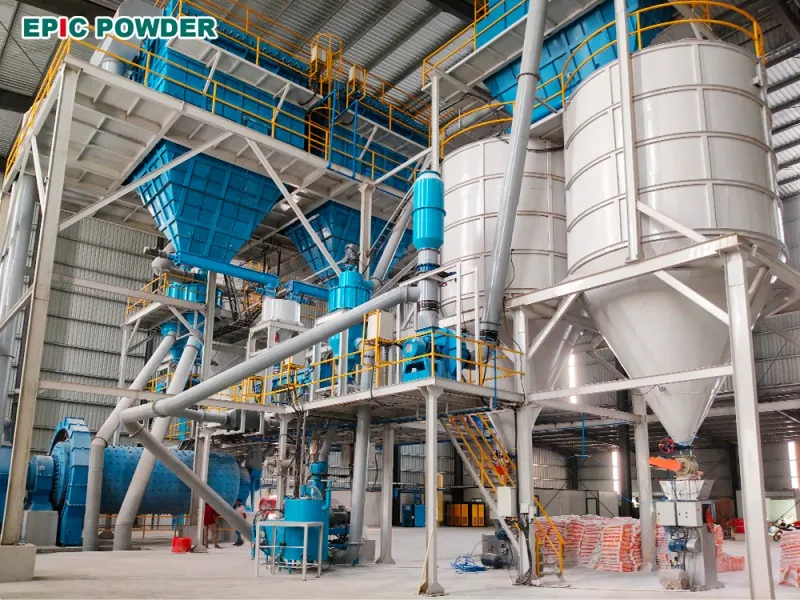
Ground calcium carbonate is produced by mechanically grinding natural minerals such as calcite, limestone, chalk, or shells. It is named for its relatively small sedimentation volume (typically 1.1–1.9 mL/g). GCC is the most widely used powdered inorganic filler. Its particles are generally irregular polyhedral or cubic in shape, with a relatively broad particle size distribution and an average particle size typically ranging from 1 to 10 μm.
Typical Production Process
Dry processing is dominant and usually includes coarse crushing → fine grinding → classification → packaging. Ultrafine GCC processing commonly adopts a ball mill + classifier system, which is currently the mainstream solution for large-scale production of high-quality GCC. The typical process is as follows:
- Raw ore is coarsely crushed by a jaw crusher to a suitable size (usually <20 mm).
- The material is conveyed by an elevator into a ball mill (with an optimized length-to-diameter ratio and ceramic or high-alumina liners to reduce contamination). Steel balls or ceramic balls are used as grinding media, and size reduction is achieved through impact, friction, and shear. Ball mills are usually operated in closed circuit with turbine classifiers or multi-rotor classifiers.
- The ground material enters the classifier (such as a turbine classifier or multi-stage air classifier). Fine particles are collected as qualified product, while coarse particles are returned to the ball mill for regrinding, forming a circulating loop.
- The final product is collected by dust collectors and packaged.
This process offers large single-line capacity (up to tens of thousands of tons per year), relatively controllable energy consumption, and flexible particle size adjustment (D97 ranging from 5 μm to 45 μm). It is particularly suitable for producing medium- and low-fineness products (325–2500 mesh).
Modern ball mill–classifier systems are often equipped with PLC automatic control. They also include grinding aid dosing systems and negative-pressure conveying. These features enable efficient and environmentally friendly production. Compared with traditional Raymond mills or vertical mills, ball mill classification systems perform better in ultrafine GCC production (<5 μm). They help avoid overgrinding. They also improve control accuracy of the <2 μm particle fraction.
Unique Applications
GCC is widely used in PVC pipes and profiles, cable compounds, coatings, and paper fillers. It is valued for its low oil absorption, high filling capacity, and low cost. In construction materials, it enhances rigidity, while in plastics it improves dimensional stability.
Precipitated Calcium Carbonate (PCC)
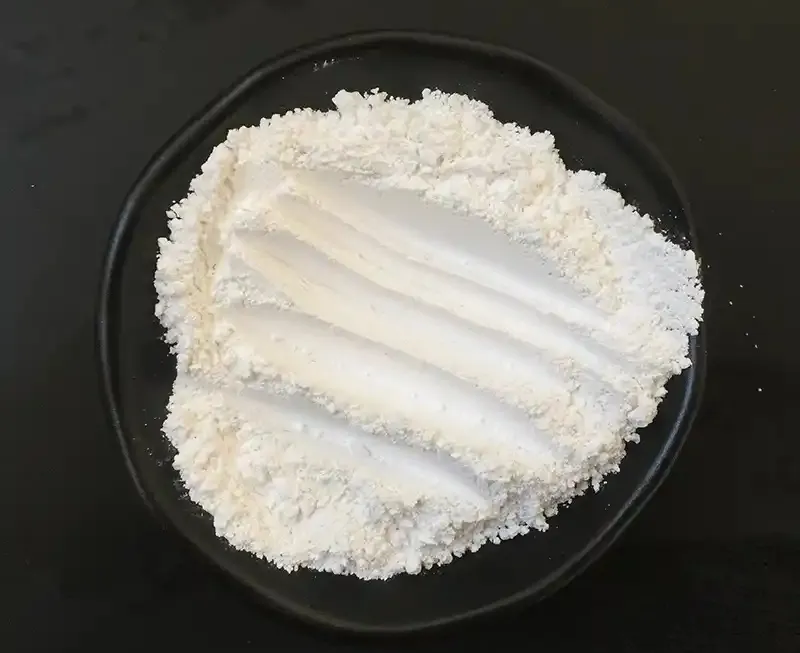
Precipitated calcium carbonate, also known as light calcium carbonate, is produced by chemical synthesis: limestone calcination → hydration to calcium hydroxide → CO₂ carbonation → dewatering and drying → grinding. It has a relatively large sedimentation volume (2.4–2.8 mL/g), spindle-shaped or cubic particles, and high purity.
Unique Applications
PCC is suitable for applications requiring high whiteness and strong covering power, such as high-end coatings, inks, food-grade calcium supplements, and welding electrodes.
Activated Calcium Carbonate
Activated calcium carbonate is produced by surface modification of GCC or PCC using agents such as stearic acid or titanate coupling agents. This treatment imparts hydrophobicity and improves dispersion and reinforcing effects.
Unique Applications
It is mainly used in rubber (to improve strength and wear resistance), plastics (to enhance processability and impact strength), and cable compounds. After modification, compatibility with organic matrices is significantly improved.
Common Specialized Modification Equipment
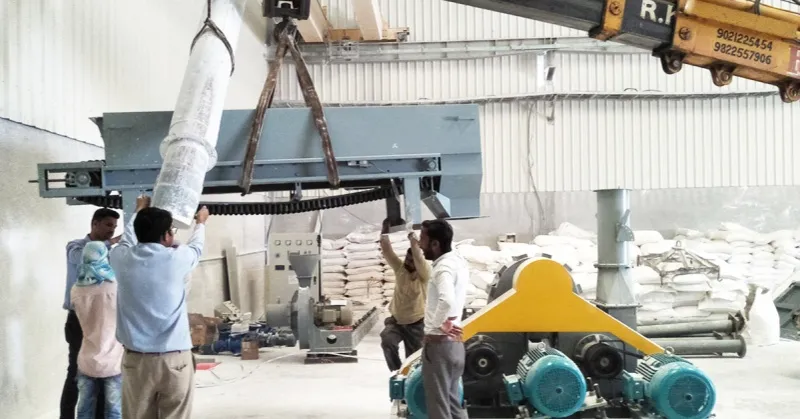
- Three-Roller Modifier (Three-Roller Coating Machine / Three-Rotor Modifier)
Structural features: Composed of three high-speed rotating rotors arranged in a triangular pattern, forming a special vortex activation chamber. The material undergoes repeated impact, shear, and friction between the rollers, enabling continuous production.
Advantages: Uniform coating, high modification efficiency (up to over 95%), large capacity, and direct integration with ultrafine grinding lines, enabling “grinding and modification simultaneously” or post-grinding modification.
Applications: Medium- to large-scale continuous production, particularly suitable for conventional activation of GCC (325–2500 mesh). - Pin Mill Modifier (Pin Mill Coating Machine/ Wide-Chamber Pin Mill)
Structural features: Consists of two oppositely rotating pin discs (or multiple rows of pins) at high speed. The linear speed can reach 200–240 m/s, generating extremely strong impact, shear, and vortex airflow. The material is thoroughly dispersed and deagglomerated between the discs, while the modifier is atomized and uniformly coated.
Advantages: Exceptional deagglomeration capability (especially for ultrafine and nano powders), the highest coating efficiency (up to 98%–99.9%), low modifier consumption, excellent dispersion, and strong adhesion. It also provides a certain grinding effect, making it suitable for handling highly agglomerated fine powders.
Applications: High-end activated calcium carbonate production, especially for nano calcium carbonate, ultrafine GCC or PCC surface modification, and applications with extremely high requirements for dispersion and reinforcing performance.
Other commonly used equipment includes honeycomb mill modifiers and turbo mill modifiers. However, three-roller and pin mill systems are currently the two most widely used solutions in large-scale industrial production.
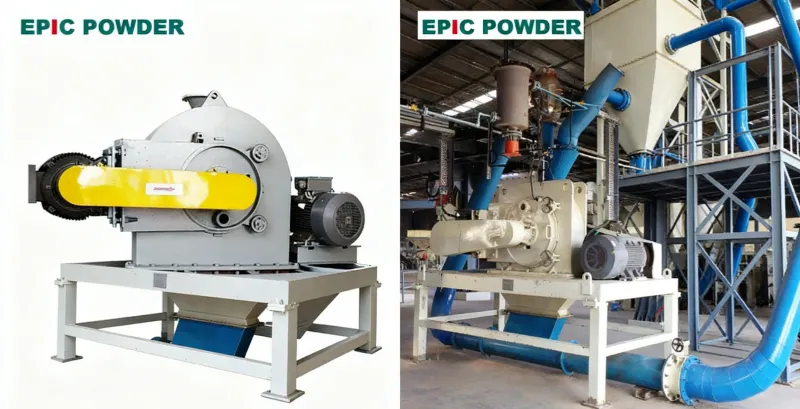
Nano Calcium Carbonate
Nano calcium carbonate typically has a particle size of 20–200 nm and is produced via a refined carbonation process: calcination → hydration → high-shear treatment → carbonation → surface treatment. Due to its extremely small particle size and large specific surface area, it exhibits quantum and size effects.
Unique Applications
Nano calcium carbonate is a high-end reinforcing filler used in high-performance rubber, sealants, automotive coatings, and food- or pharmaceutical-grade calcium products, providing excellent reinforcement and thickening effects.
Comparison of Different Types of Calcium Carbonate
GCC vs. PCC
- Whiteness: GCC 80%–95% (slightly more impurities); PCC 92%–97% (higher purity).
- Moisture content: GCC is relatively stable at 0.1%–0.3%; PCC ranges from 0.3%–0.8% and fluctuates more.
- Oil absorption & covering power: PCC has higher oil absorption and stronger dry covering power but is more expensive. GCC offers better cost performance, and with technological advances (such as optimized ball mill classification), GCC is gradually replacing PCC in some applications.
- Applications: GCC is more suitable for large-volume filling (e.g., cement, plastic matrices), while PCC is favored in applications with higher functional requirements.
Activated vs. Non-Activated Calcium Carbonate
- Hydrophobicity: Activated calcium carbonate, coated with organic agents, is clearly hydrophobic (floats on water), while non-activated products are hydrophilic.
- Dispersion: Activated calcium carbonate has better flowability and dispersion but generates more dust; non-activated products tend to agglomerate.
- Particle size: Surface modifiers reduce surface energy, resulting in smaller secondary particle sizes; differences are clearly visible under SEM.
- Applications: Activated calcium carbonate provides reinforcing effects and is suitable for high-performance composite materials.
Conclusion
Although all calcium carbonate products share the same chemical composition, their preparation routes and modification processes give them distinct characteristics. As downstream industries continue to demand higher value-added products, production requirements are becoming more refined. In response, ball mill–classifier technology for ground calcium carbonate has become a benchmark for large-scale and energy-efficient production. e-scale, energy-efficient production.
As an internationally recognized expert in powder processing equipment, Epic Powder is well known for its ball mill and classifier systems. These systems feature optimized length-to diameter ratios, efficient closed-circuit operation, and precise particle size control. Such solutions help many manufacturers achieve low-energy, high-quality GCC production. They also drive the calcium carbonate industry toward greater intelligence and sustainability. Looking ahead, choosing the right type of calcium carbonate is essential. Selecting the appropriate processing technology will be equally important. Together, these choices will be key to enhancing product value and market competitiveness.

“Thanks for reading. I hope my article helps. Please leave a comment down below. You may also contact Zelda online customer representative for any further inquiries.”
— Posted by Emily Chen